
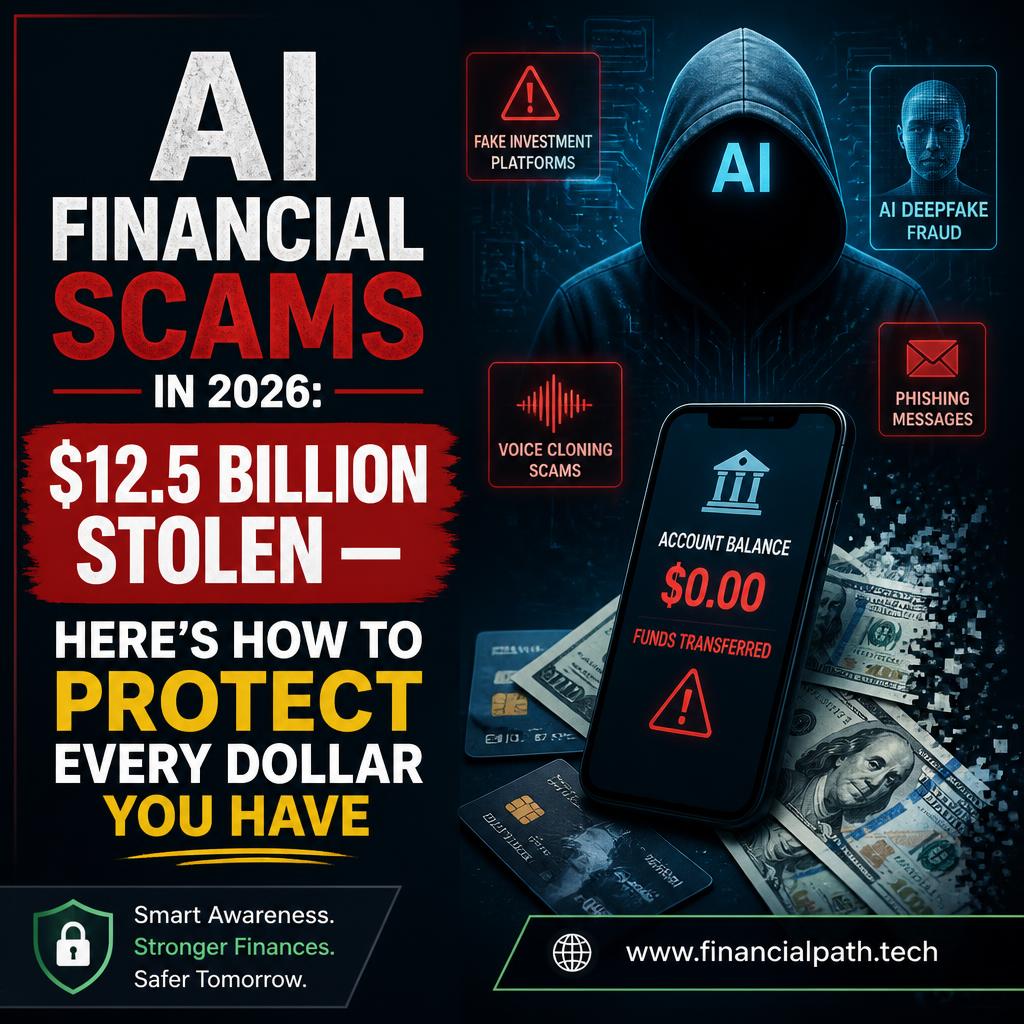
AI Financial Scams in 2026: $12.5 Billion Stolen — Here's How to Protect Every Dollar You Have
AI financial scams stole $12.5 billion in 2024 and got dramatically worse in 2026. Here's every scam you need to know — and exactly how to protect your money.
FINANCIAL ADVICE
- Financial Path Team
7/11/202617 min read
Imagine getting a phone call from your mother. Her voice is unmistakable — the same cadence, the same way she pronounces your name, the same slightly worried tone she uses when something's wrong. She's in trouble. She needs you to transfer money immediately. You don't hesitate, because it sounds exactly like her.
But it isn't her. It's an AI-generated voice clone created from three seconds of audio harvested from her social media. The call takes twelve minutes. By the time it ends, you've sent $8,000 to an untraceable account. Your mother has no idea any of this happened.
This is not a hypothetical. Real-world cases confirm that scammers have cloned voices from three seconds of audio, fooling victims into sending thousands of dollars. And it's one of dozens of AI financial scams in 2026 that are targeting ordinary people with a sophistication that previous generations of fraud simply couldn't match. Consumers reported more than $12.5 billion in losses to fraud in 2024 — a 25% increase over 2023 — and impersonation scams surged 148%, the largest increase on record.
The scams you were taught to spot — the obvious spelling errors, the robotic voice, the implausible story — those protections are gone. AI has eliminated them. What replaces them is something far more dangerous: fraud that looks, sounds, and reads exactly like the real thing. This article tells you exactly what these scams look like, how they work, and — most critically — how to protect every dollar you have.
Table of Contents
Why 2026 Is the Most Dangerous Year for Financial Fraud in History
The 8 AI-Powered Scams Targeting Your Money Right Now
The Psychology Behind Why Smart People Get Scammed
How Scammers Find and Target You Specifically
Your Complete Financial Fraud Protection System
What to Do If You've Already Been Scammed
AI Financial Scams in Nigeria and Emerging Markets
Step-by-Step: Building Your Personal Anti-Fraud Defence
Key Takeaways
1. Why 2026 Is the Most Dangerous Year for Financial Fraud in History
The fraud landscape didn't gradually evolve into what it is today. It transformed suddenly — driven by the widespread availability of AI tools that previously required significant technical expertise and resources to deploy. What changed isn't criminal intent. It's criminal capability.
AI tools are inexpensive, accessible, and constantly improving. They cut the cost of deception while increasing scale and believability. Criminals use them to impersonate people, companies, and institutions across every communication channel.
Consider what AI has specifically eliminated as fraud detection mechanisms:
Spelling and grammar errors — the single most reliable historic indicator of a scam message. AI language models produce perfect text in any language. The Nigerian prince email of 2006 was littered with errors that served as unintentional quality filters, ensuring only the least suspicious recipients engaged. AI eliminates this filter entirely.
Robotic or foreign-accented voices — previously, voice scams were detectable by their unnatural cadence or unfamiliar accent. Voice cloning technology now replicates specific individuals' voices from minimal audio samples, creating calls that are indistinguishable from the real person.
Generic, impersonal approaches — mass fraud previously used identical scripts sent to millions of people. AI enables personalised fraud, tailored to your specific name, relationships, employer, recent purchases, and financial situation, harvested from your digital footprint.
The sophistication level of AI will make it that much harder for people to discern legitimate from illegitimate, real from fake, according to Eva Valesquez, CEO of the Identity Theft Resource Center. One fraud prevention expert puts it bluntly: "I encourage people to adopt a zero-trust attitude."
The mindset shift required is significant. The question is no longer "Is this a scam?" The question in 2026 is "How do I verify this?" — because the surface characteristics that once helped answer the first question no longer work.
2. The 8 AI-Powered Scams Targeting Your Money Right Now
Understanding specific scam mechanics is the most practical form of protection available. Each of these operates in ways that are genuinely difficult to detect without knowing what to look for.
Scam 1: Voice Cloning and Deepfake Calls
This is the scam most people find hardest to believe until it happens to someone they know. Scammers harvest audio from social media — a Facebook video, a TikTok, a YouTube appearance — and use AI voice cloning tools to generate convincing synthetic speech in that person's voice.
The call arrives claiming to be a family member in trouble, a colleague needing an urgent transfer, or even your bank's fraud department using a cloned version of a representative's voice from a previous call recording. AI scams rely on panic and speed — if something feels urgent, emotional, and money-related, that's exactly when you need to verify twice.
How to protect yourself: Establish a family code word — a specific phrase that any family member requesting emergency financial help must provide. No code word, no money. This single step neutralises voice cloning scams almost entirely.
Scam 2: Pig-Butchering Investment Scams
Criminals, usually based overseas, carefully foster an online relationship with a victim over weeks or months to create feelings of trust, then lure them into bogus cryptocurrency or investment opportunities. Once victims realize they're in the midst of a scam, the criminals often follow up posing as law enforcement, offering "recovery" services.
These scams are called "pig-butchering" because fraudsters "fatten" victims with small apparent profits on fake investment platforms before "slaughtering" them by disappearing with the full balance. Victims are shown fake dashboards with fake profits to encourage additional deposits before the scammer disappears with the victim's money.
How to protect yourself: Any investment opportunity that arrives through social media, dating apps, WhatsApp, or Telegram — regardless of how long you've "known" the person introducing it — should be treated as a scam until independently verified through official channels.
Scam 3: Imposter Scams (Banks, Government, Tech Support)
Imposter scams accounted for $2.95 billion in losses in 2024. Scammers succeed by creating panic or urgency — claiming there's suspicious activity, a legal threat, or a relative in trouble — to pressure you into wiring funds or giving sensitive information.
These now use AI to clone the actual phone numbers and voices of real institutions. Your caller ID shows your bank's official number. The voice sounds like the customer service representative you spoke to last month. They tell you your account has been compromised and you need to move your funds to a "safe account" immediately.
Your bank will never ask you to move money to protect it. No legitimate institution asks you to transfer funds to a new account to keep them safe. Ever.
Scam 4: AI-Generated Phishing (Email, Text, QR Codes)
Traditional phishing emails were detectable by generic greetings, spelling errors, and obvious lies. AI-generated phishing is personalised, grammatically perfect, and contextually accurate. It references your name, your bank, your recent activity, and your employer with specificity that makes it feel authentic.
QR codes have become a new phishing vector — scammers place fraudulent codes over legitimate ones in restaurants, parking metres, and public spaces. Victims scan what appears to be a legitimate code and are directed to phishing sites that capture banking credentials.
How to protect yourself: Never click links in unexpected emails or texts. Go directly to the institution's official website by typing the URL yourself. Inspect QR codes for physical tampering — a sticker placed over the original is the most common method.
Scam 5: Fake Job Scams
Text and WhatsApp messages encouraging you to apply for lucrative-sounding jobs are now extremely common. If you follow up with these scammers, they want your Social Security number and financial account details ASAP so they can "make sure you get paid." The only thing that actually happens is your identity and money get stolen.
Employment scams are making a big comeback in 2026, driven by the 1.17 million workers laid off in 2025 — the most since the 2020 pandemic. People looking for work are particularly vulnerable to fraudulent job offers that request personal and financial information.
Scam 6: Recovery Scams
The FTC warns that scammers maintain "sucker lists" to repeatedly target previous fraud victims with fake recovery offers and upfront fees. Scammers return to victims with promises to recoup their losses by charging fees for their nonexistent services.
If you've been scammed once, you are a specific target for recovery scammers who claim to be able to recover your lost funds — for an upfront fee. They may know specific details about your original scam, harvested from public reports or sold between criminal networks, which makes them sound genuinely legitimate. They are not. Fake recovery offers often promise help, then ask for upfront fees, personal information, or risky payment methods. Never pay upfront to recover stolen money.
Scam 7: Synthetic Identity Fraud
Criminals combine real personal data with fake information to create new identities used to open credit accounts or commit fraud. These synthetic identities are increasingly indistinguishable from genuine ones because AI tools can generate convincing supporting documentation. Checking your credit report regularly is an important defence.
You may not discover this for months or years — until a loan application is declined for an account you never opened, or a collection agency contacts you about a debt you don't recognise.
Scam 8: AI-Enhanced Romance Scams
Romance scams have always been devastating — both financially and emotionally. AI makes them dramatically more scalable and convincing. Scammers build trust and emotional connection, often online or via text, then invent an emergency or an urgent need. It might be medical bills, travel costs, a business emergency requiring a "temporary loan" that's never repaid.
AI chatbots can now maintain dozens of romantic relationships simultaneously, responding at all hours with contextually appropriate messages, learning the victim's preferences and using them to deepen the apparent connection.
3. The Psychology Behind Why Smart People Get Scammed
One of the most important things to understand about financial fraud is that intelligence doesn't protect you. Neither does financial sophistication or general skepticism. Scams succeed because they exploit psychological mechanisms that are hardwired into human cognition — not weaknesses, but features of the way we process information and make decisions.
Urgency bypasses critical thinking. When we believe something requires immediate action, our brains switch from careful analytical processing to fast, intuitive decision-making. This is adaptive in genuine emergencies — but it's exploitable in manufactured ones. Every effective scam creates urgency because urgency turns off the rational evaluation that would otherwise detect the fraud.
Authority overrides skepticism. We're conditioned from childhood to respond to authority figures. When someone presents as a bank official, a government agent, or a law enforcement officer, our default is compliance rather than questioning. Scammers understand this and exploit it systematically.
Emotional connection creates trust. In romance scams and pig-butchering schemes, weeks or months of emotional investment create genuine feelings of trust and connection. These feelings are real even when the relationship isn't — and they override the financial skepticism that would otherwise protect people.
Loss aversion drives desperate action. When we believe we're about to lose something valuable — money, a relationship, our freedom from legal threat — we act to prevent that loss even when the action itself is irrational. Scammers manufacture these loss scenarios because they're more effective than opportunities for gain.
💡 Tip — The Pause Protocol
Establish a personal rule: any financial decision involving more than $500, requested with urgency by someone who contacted you, gets a mandatory 24-hour pause and independent verification. Legitimate requests can always wait 24 hours. Fraudulent ones create artificial urgency precisely because they can't survive the verification that a pause enables. This single rule blocks the overwhelming majority of fraud attempts.
4. How Scammers Find and Target You Specifically
The personalisation that makes AI scams so dangerous relies on information — and most people are far more generous with personal information than they realise.
Your social media profiles reveal: your full name, your employer, your family members' names and faces, your location, your recent activities, your interests, and audio and video samples of your voice. All of this is harvested automatically by fraud operations and used to personalise attacks.
Your data broker profiles compile information from hundreds of sources: your address history, phone numbers, email addresses, purchasing behaviour, estimated income, and relationships. This information is commercially available and actively sold to data brokers — including, unfortunately, to criminal operations that access it through fraudulent data buyer accounts.
Data breaches have exposed billions of credential records over the past decade. If your email and password appear in a breach (check at HaveIBeenPwned.com), criminals may have access to accounts you've forgotten about, which give them additional personal information and potential financial access.
"Think about what you're publicly posting," says Amy Nofziger, senior director of victim support with the AARP Fraud Watch Network. "A criminal could use information to manipulate you."
The practical implication: every piece of personal information you share publicly is potentially a tool in a future fraud attempt against you. This doesn't mean deleting your social media presence — it means being thoughtful about what you share and adjusting privacy settings to limit public visibility.
⚠️ Warning — The "Minor Information" Misconception
Many people underestimate how much damage can be done with "minor" personal information. Your mother's maiden name is a common security question answer. Your pet's name appears in your Instagram bio. Your high school is on your LinkedIn. Your birthday is on your Facebook. Individually, none of these seems sensitive. Combined, they may be enough to pass identity verification at a financial institution, answer security questions, or make a social engineering attempt convincingly personalised. Review what's publicly visible on your profiles today.
5. Your Complete Financial Fraud Protection System
Protection from AI-powered financial fraud requires layers — no single measure protects against all vectors. Here's the complete framework:
Account Security
Enable multifactor authentication (MFA) on every financial account. Preferably use an authentication app (Google Authenticator, Authy) rather than SMS-based codes, which can be intercepted through SIM-swapping attacks. One-time passcodes are a prime target for fraudsters who either trick victims into sharing these temporary codes or intercept them without the victim knowing.
Use unique, strong passwords for every financial account. A password manager (1Password, Bitwarden, Dashlane) makes this practical. If you reuse passwords and one is compromised in a breach, every account using that password becomes vulnerable simultaneously.
Place a credit freeze with all three bureaus. A credit freeze prevents new accounts from being opened in your name — the most effective defence against synthetic identity fraud and unauthorised credit applications. It's free, can be temporarily lifted when you need to apply for credit, and takes about five minutes to implement at each bureau: Equifax, Experian, and TransUnion.
Monitoring
Check your credit reports regularly. An occasional credit check can fall short — a report you pull every few months may miss an account opened the week after you looked. Use AnnualCreditReport.com for free reports from all three bureaus, or consider a credit monitoring service that alerts you to new accounts or inquiries in near-real time.
Monitor your bank and investment accounts weekly. Don't wait for monthly statements to review transactions. Set up transaction alerts for all accounts — most banks and investment platforms allow you to receive notifications for any transaction above a minimum threshold you set.
Review your Social Security earnings record annually. At ssa.gov/myaccount, you can verify that no one else is working under your Social Security number — a form of identity theft that can affect your future benefits and create tax complications.
Communication Protocols
Never share financial information with inbound contacts. If you receive a call, text, or email from anyone claiming to represent your bank, the IRS, Social Security, or any financial institution, end the communication and initiate contact yourself using the official number from their website or the back of your card.
Establish a family verification code word. Create a family or work safe word especially useful against voice cloning scams. This phrase, known only to your family, is required for any financial request. No code word, no funds — full stop.
Slow down all urgent requests. Urgency is the scammer's primary weapon. Your defence is deliberate delay. A genuine emergency can survive 30 minutes of verification. A fraudulent one cannot.
6. What to Do If You've Already Been Scammed
If you've lost money to fraud, the hours immediately following the discovery are the most critical for limiting damage and beginning recovery.
Step 1: Contact your bank immediately. If you transferred money from a bank account, call the fraud department on your bank's official number. Wire transfers are harder to reverse than ACH or card transactions — but acting within hours gives you the best chance of recovery. Explain that you're the victim of fraud and ask about their fraud recovery process.
Step 2: File reports with the relevant authorities. In the US: file a report with the FTC at ReportFraud.ftc.gov, your local police department, and the FBI's Internet Crime Complaint Center at IC3.gov. In Nigeria: report to the EFCC (Economic and Financial Crimes Commission) at efcc.gov.ng or the NITDA (National Information Technology Development Agency) for cybercrime specifically.
Step 3: Freeze your credit immediately. If personal information was shared, freeze your credit at all three bureaus to prevent the scammer from opening new accounts in your name.
Step 4: Change all passwords and enable MFA on every account. Assume that any credential shared with the scammer, or any credential reused across accounts, is now compromised.
Step 5: Document everything. Screenshot all communications — messages, emails, transaction records. These are evidence for fraud reports and, in some cases, for insurance claims.
Step 6: Contact the Identity Theft Resource Center. The ITRC found in its 2026 report that more than a quarter of identity crime victims were managing two or more incidents at the same time, up from 23.5% the year before. The ITRC offers free victim assistance at idtheftcenter.org and can guide you through the full recovery process.
Step 7: Be alert for recovery scams. As noted above, fraud victims are specifically targeted by recovery scammers. Anyone contacting you claiming to help recover your lost funds — especially for an upfront fee — is attempting to defraud you a second time. Report them to the FTC.
7. AI Financial Scams in Nigeria and Emerging Markets
The global fraud picture described above takes specific local forms in Nigeria and across African markets — and some additional dimensions that deserve direct attention.
Nigeria occupies a unique position in the international fraud landscape: it's simultaneously a country with a significant history of originating certain fraud types AND a country whose citizens are now frequently targeted by increasingly sophisticated international fraud operations. Both dimensions matter for Nigerian readers.
Advance fee fraud evolution. The classic "419 scam" that Nigeria became internationally associated with has itself been transformed by AI. What was once an obvious, error-laden email is now a personalised, professionally written communication that passes every traditional spam filter and visual inspection. Nigerian readers are now targeted by sophisticated versions of these scams originating from criminal networks in China, Eastern Europe, and other regions — the scripts have simply been upgraded with AI.
Investment scams targeting dollar earners. Nigerian professionals earning in foreign currency — remote workers, freelancers, diaspora recipients — are specifically targeted by pig-butchering investment scams. The fraudsters understand that someone receiving dollars or pounds has both the financial resources and the appetite for investment growth that makes investment fraud viable. Building income through platforms like those covered on our Side Income page creates opportunity; protecting those earnings from fraud is the essential companion responsibility.
Mobile money and fintech fraud. The rapid expansion of mobile money and digital payment platforms across Nigeria — Opay, Palmpay, Kuda, PiggyVest — has created new fraud surfaces. SIM-swap attacks (where fraudsters convince mobile carriers to transfer your number to a new SIM) enable account takeovers that can drain digital wallets instantly. Call your mobile carrier and add a PIN or verbal password to your account to defend against this specific attack.
Job scams targeting the unemployed. Nigeria's high youth unemployment rate creates a large population of people actively seeking income opportunities — exactly the condition that makes job scams effective. Fraudulent opportunities promising remote work for international companies, data entry jobs paying in dollars, or crypto trading opportunities regularly circulate on WhatsApp groups and social media platforms. If a job requires you to pay any amount to access it, provide your bank details before receiving a contract, or perform any financial transaction as part of "training," it's a scam.
The CFPB's consumer fraud resources are US-focused but contain principles that translate globally — particularly the emphasis on verification, documentation, and never sending money to someone who contacts you unsolicited.
8. Step-by-Step: Building Your Personal Anti-Fraud Defence
Here is the complete implementation checklist — work through this systematically to build meaningful protection against the fraud landscape of 2026:
Step 1: Audit your current security posture.
Log into every financial account — bank accounts, investment accounts, pension accounts, payment apps — and check whether multifactor authentication is enabled. Enable it on every account that offers it, prioritising authentication apps over SMS codes.
Step 2: Place credit freezes at all three major bureaus.
Go to Equifax, Experian, and TransUnion individually and place a security freeze on your credit file. This costs nothing and prevents new account applications in your name. Keep a note of your unfreeze PIN for when you legitimately need to apply for credit.
Step 3: Set up a family code word.
In a face-to-face conversation with immediate family members, establish a shared code word. Agree that any request for financial help — regardless of how urgent, how emotional, or how convincingly it sounds — requires this code word before any money moves.
Step 4: Review your social media privacy settings.
On every social media platform you use, review what information is publicly visible and adjust privacy settings to limit public access. Specifically: remove your workplace, limit who can see posts, make your friends list private, and restrict video content that contains clear audio of your voice.
Step 5: Check HaveIBeenPwned.
Go to HaveIBeenPwned.com and enter your email addresses. For any breach identified, change the password for that account and any other account using the same password immediately.
Step 6: Set up transaction alerts.
Configure your bank and investment accounts to send immediate alerts for all transactions above a minimal threshold — even $1. This ensures you know about any unauthorised transaction within minutes rather than discovering it weeks later on a statement.
Step 7: Establish your personal verification protocol.
Write down the official contact numbers for your bank, your investment platforms, and any other financial institutions you use. Keep this list somewhere accessible. Commit to using only these numbers whenever you initiate contact in response to any communication — never the number from the communication itself.
Step 8: Protect your income-generating accounts specifically.
For FinancialPath readers who earn income through digital platforms — Upwork, Fiverr, Payoneer, Wise — these accounts represent both income and financial identity. Enable every security feature available on each platform, use unique strong passwords, enable MFA, and review connected payment methods regularly for anything you didn't authorise.
Key Takeaways
Consumers reported more than $12.5 billion in fraud losses in 2024 — a 25% year-on-year increase — with investment scams ($5.7 billion) and imposter scams ($2.95 billion) leading the damage
Global deepfake fraud rose 700% in Q1 2025, and impersonation scams surged 148% — the largest annual increase ever recorded — the fraud landscape of 2026 is categorically different from anything that came before
AI has eliminated the traditional fraud detection signals — spelling errors, robotic voices, generic approaches — making the question "Is this a scam?" nearly unanswerable from surface characteristics alone; replace it with "How do I verify this?"
The most powerful single protection against voice cloning scams is a family code word — a shared phrase required for any financial request, regardless of how convincing the caller sounds
Credit freezes at all three bureaus cost nothing, take minutes, and provide complete protection against new account fraud — the single highest-return fraud protection step available
More than a quarter of identity crime victims in 2026 are managing two or more simultaneous fraud incidents — being scammed once makes you a specific target for follow-up recovery scams; never pay upfront to recover lost money
For Nigerian and emerging market readers, dollar-earning remote workers and freelancers face specific targeting by pig-butchering investment scams; protecting your income accounts deserves the same priority as earning from them
Building wealth through legitimate income streams on our Side Income page and protecting those earnings through the fraud defence system in this article are two sides of the same financial security coin
📚 Related Articles to Read Next on FinancialPath
Credit Score Changes in 2026: The Rules Just Shifted — Identity fraud directly damages your credit score; understanding the new credit scoring landscape helps you detect fraud through credit monitoring and minimise long-term damage when fraud does occur
Side Hustle Taxes in 2026: The IRS Is Watching Every Dollar — Remote workers and freelancers building income online face specific fraud vectors targeting their payment platforms and income accounts — this article covers the income side, this fraud article covers the protection side
Medical Debt and Health Insurance Costs in 2026 — Bogus health insurance scams are one of the fastest-growing fraud categories in 2026, targeting people seeking affordable coverage — understanding both genuine health insurance and the scams that mimic it is essential reading
The $12.5 billion stolen from consumers in 2024 didn't flow from a small number of dramatic heists. It came from millions of individual transactions — most of them between $500 and $10,000 — executed against ordinary people who were simply going about their day when a call arrived, a message appeared, or a link was clicked. The victims weren't naive or uninformed. They were human. And the scams were built by people who understand human psychology at a level that would make most marketers envious.
Protecting yourself from this landscape isn't about paranoia. It's about having systems — a family code word, a verification protocol, a credit freeze, active monitoring — that work automatically, even when you're tired, distracted, or emotionally activated by what feels like an emergency. Systems don't get tired. They don't panic. They just apply the pause and the verification that separates a recovered situation from a devastating one.
FinancialPath is here to help you build the complete financial life — earning more through the Side Income page, growing wealth through the Compound Interest Calculator, protecting income through the Insurance page, and now, with this article, protecting everything you've built from the people who want to take it from you.
Your money took real effort to earn. It deserves real effort to protect.
Written by the FinancialPath Team — Personal Finance Writers dedicated to making smart money decisions accessible to everyone, everywhere.
Published: Wednesday, July 8, 2026 — Morning Edition | Sources: FTC Consumer Fraud Report March 2026, Identity Theft Resource Center 2026 Trends Report, AARP Fraud Watch Network April 2026, JMB Financial Managers/Biometric Update July 2025, FVCbank Fraud Guide 2026, Advancial Federal Credit Union Fraud Trends April 2026, Santa Cruz Community Credit Union 2026, Fox News/CyberGuy July 2026
RESOURCES
GET IN TOUCH
info@financialpath.tech
Kaduna, Nigeria
Serving emerging markets worldwide
© 2026 FinancialPath-No-nonsense math for emerging market builders.
LOCALLY RELEVANT, GLOBALLY USEFUL