
Buy Now Pay Later Dangers in 2026: The Convenient Debt Trap Swallowing Half Its Users
47% of Buy Now Pay Later users missed a payment in 2026. Here's the truth about BNPL debt traps — and how to avoid becoming another statistic.
FINANCIAL ADVICELOAN MANAGEMENT
- Financial Path Team
7/7/202612 min read
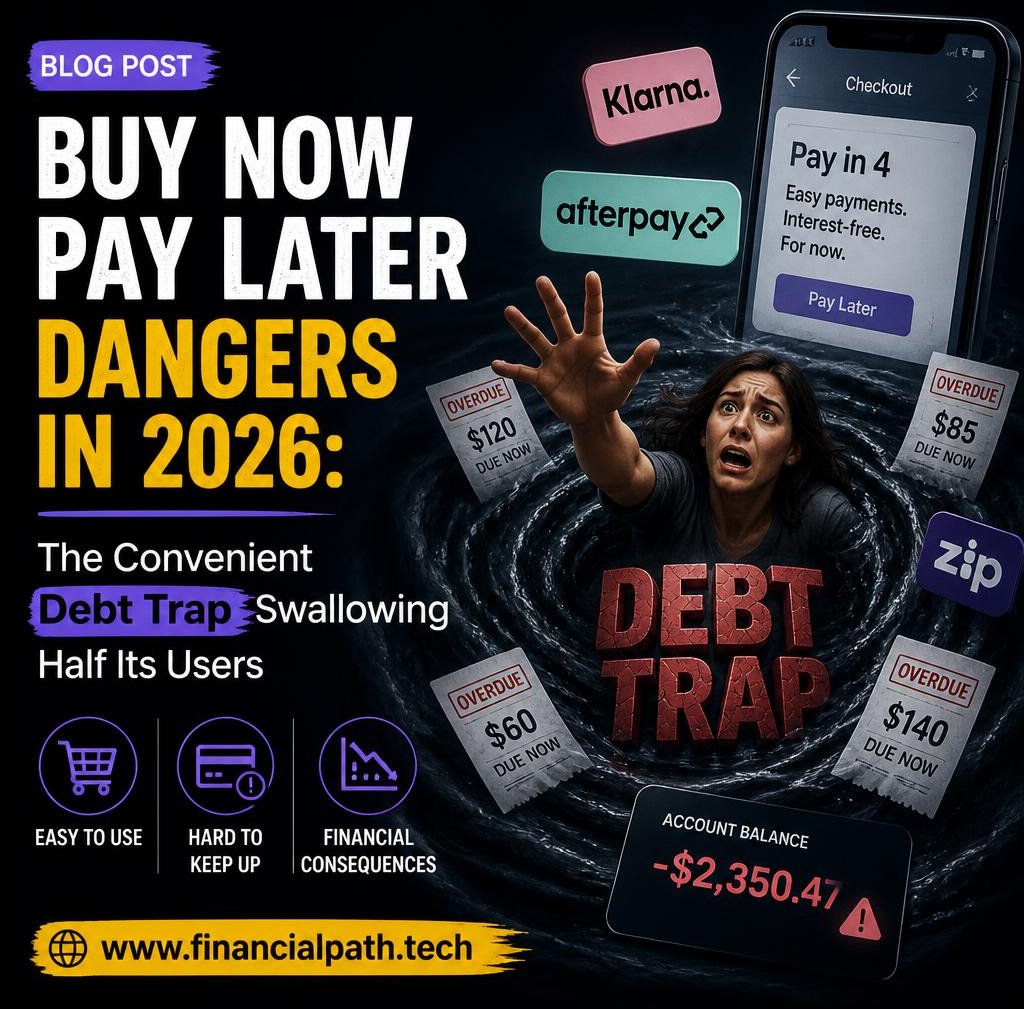
It starts with a pair of shoes. Or a phone. Or a refrigerator. The price tag feels uncomfortable — ₦85,000, $400, £350 — but then a little button appears at checkout: Pay in 4. No interest. Just ₦21,250 now. Suddenly the purchase feels completely manageable. You click, you buy, you move on.
Three months later you have six of these plans running simultaneously. Your bank account gets hit on four different days each week by four different providers. You've lost track of which one charges on Tuesday and which one drafts on Thursday. One payment bounces. A late fee lands. And the item you bought with that first plan? You've stopped thinking about it entirely. The payment, though, is still very much thinking about you.
This is what Buy Now Pay Later actually looks like for nearly half of its users in 2026 — and the numbers have never been more alarming. LendingTree's 2026 BNPL Report found that 47% of BNPL users made at least one late payment in the past year, up 13 percentage points from just two years ago. More than half of BNPL users say they wouldn't be able to make ends meet without access to these loans. People are using them for groceries. Everyday essentials. Not luxuries — survival.
That is not financial empowerment. That is a debt crisis dressed up in a friendly checkout interface.
This article gives you the full, unvarnished picture of how BNPL works, what it's costing people financially, and exactly how to protect yourself — whether you're reading this from Lagos, London, or Los Angeles.
Table of Contents
What BNPL Actually Is — And How It Really Makes Money
The 2026 Numbers That Should Concern Every Consumer
The Hidden Costs Nobody Talks About at Checkout
How BNPL Became a Debt Trap for Ordinary People
BNPL in Nigeria — A Rapidly Growing Market With Unique Risks
BNPL vs Credit Cards vs Personal Loans — The Real Comparison
Step-by-Step: How to Escape a BNPL Debt Spiral
When BNPL Is Actually Fine to Use
Key Takeaways
1. What BNPL Actually Is — And How It Really Makes Money
Buy Now Pay Later services — Klarna, Afterpay, Affirm in global markets; CredPal, Carbon Zero, CDcare, and EasyBuy in Nigeria — offer a simple proposition: buy something now and split the payment into instalments, typically four equal payments over six to eight weeks. Most of these "pay-in-4" structures carry zero interest for the consumer.
Zero interest sounds like a gift. It isn't. Somebody is paying for it — and that somebody is merchants, who pay BNPL providers between 8% and 10% in processing fees per transaction, compared to the 2%–4% that standard credit card processors charge. Those costs don't disappear. Merchants bake them into shelf prices that every shopper pays, whether they use BNPL or not. So every time you walk into a store that accepts Klarna or CredPal and pay in full with your debit card, you're subsidising the BNPL users in front of you.
And the providers also earn from late fees, from selling merchant services, and — increasingly — from longer-term financing products that do carry interest rates, sometimes substantial ones.
💡 Tip — The "Interest-Free" Reality Check
Before accepting any BNPL offer, ask these two questions: First, does this provider charge late fees — and how much? Second, are there any longer-term financing options attached to this platform that carry interest? Affirm charges no late fees but offers longer-term loans at rates up to 30% APR. Afterpay and Klarna charge late fees. Read the terms before you click, not after.
2. The 2026 Numbers That Should Concern Every Consumer
The data coming out of the BNPL industry in 2026 paints a picture that the providers' marketing absolutely does not.
Read those numbers slowly. Nearly half of BNPL users are missing payments — in a product marketed as a simple, manageable payment plan. More than half say they can't function financially without it. These aren't the characteristics of a helpful financial tool. These are the characteristics of a dependency that's building up hidden debt across millions of households.
The Federal Reserve Bank of Richmond's February 2026 analysis concluded that BNPL's direct impact on overall financial stability appears limited at present — the total BNPL debt outstanding at any given moment is small relative to credit card debt ($1.23 trillion). But the Richmond Fed's own researchers noted the concerning structural feature: this debt is largely invisible to the credit reporting system, which means lenders making mortgage or car loan decisions cannot see the full debt picture of BNPL-heavy borrowers. The Richmond Fed's full analysis is worth reading if you want the authoritative deep-dive.
3. The Hidden Costs Nobody Talks About at Checkout
The BNPL checkout experience is engineered to feel frictionless and consequence-free. The reality sitting behind that experience is considerably less comfortable.
The Phantom Debt Problem
Because most BNPL loans — especially pay-in-4 products — have historically gone unreported to credit bureaus, a term has emerged to describe them: phantom debt. This is debt the credit system cannot see, which means lenders making decisions about your mortgage, your car loan, or your next credit card cannot accurately assess your true financial obligations.
The CFPB found that roughly two-thirds of BNPL users carry multiple BNPL loans simultaneously, often across different providers, with no centralized system tracking the total. A mortgage lender sees your salary, your credit card balance, and your car loan. They do not see the six BNPL plans running in the background eating ₦15,000 to ₦20,000 per week out of your income.
This is changing. Starting in 2025–2026, all three major US credit bureaus began including BNPL data on credit reports. FICO's new scoring models now incorporate BNPL payment history. In the UK, the Financial Conduct Authority launched formal BNPL oversight in July 2026 — this month — requiring stricter creditworthiness assessments and mandatory consumer protection standards. The phantom debt era is ending. BNPL obligations are becoming visible to the credit system. If you have missed BNPL payments, they may now follow you into your next mortgage application.
The Spending Distortion Effect
Research consistently shows that BNPL users spend 30–40% more than they would have if paying upfront. This isn't a coincidence — it's the fundamental mechanism that makes BNPL work for merchants. When a $400 purchase becomes "four payments of $100," the psychological resistance to buying melts away. Your brain processes $100 as the price of the item. It isn't. The price is $400, and your future paychecks already owe it.
⚠️ Warning — The Loan Stacking Crisis
"Loan stacking" — carrying multiple BNPL plans simultaneously — has become one of the most financially damaging patterns in consumer debt. When you have three BNPL plans, two of which coincidentally draft on the same day, and your account is short, all three can default simultaneously. The cascade of late fees, potential collection activity, and credit score damage from a single bad fortnight can take months to repair. If you currently carry more than one active BNPL plan, count the total remaining payments right now. That number is likely to be larger than you expect.
4. How BNPL Became a Debt Trap for Ordinary People
Understanding how smart, financially aware people end up in BNPL debt spirals requires understanding the psychology at work — because the providers understand it extremely well, and they've designed their products accordingly.
Instalment framing removes price anchoring. When you see a ₦120,000 phone, your brain compares that number to your monthly income and makes a judgment. When you see "₦30,000/month for 4 months," your brain compares that number to a single week's disposable income. The framing has changed the apparent price of the item without changing its actual cost. This is not an accident.
The lack of friction enables impulsive decisions. Traditional credit required applications, credit checks, and deliberate decisions. BNPL requires a single click at checkout during the highest-impulse moment of the purchasing process — right when you've already decided you want something. The decision-making friction that might otherwise slow you down has been engineered away.
Multiple providers create opacity. When all your debt lives in one place — a single credit card statement — you can see the total. When debt is fragmented across Klarna, Afterpay, Affirm, and Paidy, none of those providers sees the full picture, and neither do you unless you deliberately track it. The fragmentation is financially dangerous: you might feel like you're managing four small obligations when you're actually managing a substantial combined debt with four different companies.
The sunk cost trap accelerates the problem. Once you've started a BNPL plan, the psychological pressure to complete it keeps you engaged with the service — which is exactly when the next purchase opportunity appears. Providers know their most profitable customers are people who just finished one plan and feel the relief of completion. The next offer arrives at precisely that moment of psychological openness.
5. BNPL in Nigeria — A Rapidly Growing Market With Unique Risks
Nigeria's BNPL market is growing rapidly, driven by a combination of widespread smartphone adoption, expanding e-commerce, and the reality that formal credit access remains out of reach for most Nigerians. Local providers have moved quickly to fill this space.
Providers like CredPal, Carbon Zero, EasyBuy, and CDcare enable Nigerian shoppers to purchase products — phones, electronics, household appliances, fashion — and pay over several weeks or months. Jumia Nigeria launched partnerships with EasyBuy and CredPal in 2024, enabling in-app instalment purchases. The Nigerian BNPL market, while smaller than its Western counterparts, is growing at a pace that mirrors the early rapid growth seen in the US and UK before regulatory oversight arrived.
The risks for Nigerian consumers have some unique dimensions that don't exist in the same way in regulated Western markets:
Regulatory protection is minimal. Unlike the UK, where FCA oversight of BNPL just began this month (July 2026) with mandatory affordability checks and consumer protections, Nigerian BNPL regulation is significantly less developed. Consumers have fewer formal protections against unfair terms, aggressive collection practices, or opaque fee structures.
Interest and fees can be less transparent. While some Nigerian BNPL plans genuinely charge zero interest, others carry service charges, financing fees, or late payment penalties that aren't prominently disclosed at the point of sale. Faith Ojeiku, Head of Embedded Finance at Credit Direct, has noted that Nigeria's formal BNPL sector struggles to scale due to repayment gaps — which often reflects inadequate affordability assessment at origination.
The target market is exactly the most vulnerable. Nigerian BNPL providers explicitly target consumers who cannot afford items upfront — which is a market that, by definition, has the thinnest financial margin for error when payments go wrong. A missed payment in Lagos doesn't just mean a late fee. It can mean collection agency involvement and lasting damage to your ability to access formal financial products in future.
According to Investopedia's BNPL risk analysis, the core risks — overspending, limited regulatory oversight, and complex refund processes — apply in every market. In Nigeria's less-regulated environment, these risks are amplified rather than mitigated.
6. BNPL vs Credit Cards vs Personal Loans — The Real Comparison
Most people compare BNPL to "paying full price" and conclude BNPL wins. The more useful comparison is BNPL versus the actual alternatives available to them.
The honest conclusion: for a consumer who pays their credit card balance in full every month, that credit card is almost always a better financial tool than BNPL. It builds credit, offers purchase protections, earns rewards, and keeps all spending visible in one statement.
BNPL's advantage is access — it's available to people who don't qualify for credit cards. For that group, BNPL used carefully and sparingly for genuinely needed purchases can fill a real gap. But that narrow, careful use is very different from what the data shows most BNPL users actually do.
For people managing existing debt, our Debt Paydown Calculator at FinancialPath is designed to help you see the full picture of what you owe and model the fastest path to clearing it — including the impact of BNPL obligations on your overall debt position.
7. Step-by-Step: How to Escape a BNPL Debt Spiral
If you're currently juggling multiple BNPL plans and feeling the pressure, here's the exact process to regain control:
Step 1: Complete your BNPL inventory.
Write down every active BNPL plan you currently carry. For each one: the provider, the remaining balance, the next payment date, and the amount. This might feel uncomfortable — do it anyway. You cannot manage what you refuse to look at.
Step 2: Add up the total remaining obligations.
Sum all remaining BNPL payments across all providers. Most people carrying multiple plans are surprised — sometimes shocked — by the total. That total is your BNPL debt. Name it clearly.
Step 3: Map your payment dates.
Create a simple calendar showing when each payment drafts from your account. This reveals clashes — days where multiple payments hit simultaneously — before they become overdrafts rather than after.
Step 4: Prioritise by urgency.
If you cannot comfortably make all payments, prioritise by consequence severity. Plans that report to credit bureaus need to be paid on time first. Plans with the highest late fees second. Contact any provider you're genuinely unable to pay before the due date — many will defer a payment or waive a fee if you ask before defaulting, not after.
Step 5: Stop taking new BNPL plans immediately.
While you're paying off existing plans, no new ones. This is non-negotiable. Adding a new plan while paying off existing ones is filling a bucket while the tap is still running.
Step 6: Build a buffer before your BNPL plans clear.
Once your existing plans are paid off, resist the relief-driven impulse to immediately use BNPL again. Instead, take the amount you were paying on BNPL plans each week and redirect it to a savings buffer. Even one month of payments saved gives you the cash to buy the next thing you'd have used BNPL for — without the debt.
Step 7: Apply any future BNPL use to the 24-hour rule.
Before accepting any future BNPL offer: wait 24 hours. If you still want the item and you can pay the full price in cash today without touching emergency savings, proceed. If either of those conditions isn't met, the price is wrong for you regardless of how it's split.
Our Income Planner tool on FinancialPath can help you map your full income picture alongside your debt obligations — useful for seeing exactly how BNPL payments fit into your monthly budget and where the pressure points are.
8. When BNPL Is Actually Fine to Use
This article has been clear-eyed about the risks, but fairness requires acknowledging that BNPL isn't inherently evil. Used in a specific, narrow set of circumstances, it genuinely is a useful tool.
BNPL works reasonably well when:
You could pay the full price in cash today but prefer to spread the payment for cash flow reasons — not because you can't afford it, but because you'd rather keep cash available. This is the "budgeting tool" use case the industry markets, and it's the only scenario where BNPL genuinely serves that function.
It's for a single, necessary purchase with a clear repayment plan. A broken refrigerator that needs replacing, a car tyre that's unsafe — genuine necessities with defined plans for covering the payments from known, reliable income.
You carry no other active BNPL plans. The risk multiplies with each simultaneous plan. One plan, for a genuine need, with comfortable repayments, in a stable income situation — that's where the risk profile is most manageable.
You have a payment tracking system. If you use BNPL, you must track payment dates explicitly. Assuming you'll remember is how people end up with surprise overdrafts.
The test that cuts through all of this cleanly: "Would I buy this at full price today if BNPL didn't exist?" If yes, BNPL might be a reasonable cash flow tool. If no — if the only reason you're buying it is because the instalments made it feel affordable — you're about to spend money you don't have on something you didn't need. That's the definition of a debt trap.
For building genuine financial resilience instead of BNPL dependency, visit our Side Income page for practical income-building strategies, and our Inflation Hedge page for protecting the money you do have from being eroded while you're working to build more.
Key Takeaways
47% of BNPL users made a late payment in 2026 — up 13 percentage points in two years — and more than half say they can't make ends meet without these loans
BNPL users carry an average of $871 more in credit card debt and $453 more in personal loan debt than non-users — suggesting BNPL adds to debt rather than replacing it
BNPL merchants pay 8%–10% in processing fees, double what credit cards cost — those fees are baked into shelf prices that all shoppers pay
From 2025–2026, all three major US credit bureaus now include BNPL data on credit reports — missed payments will damage your credit score and affect mortgage applications
In Nigeria, providers like CredPal, Carbon Zero, CDcare, and EasyBuy are growing rapidly in a market with minimal regulatory oversight — consumer protections are significantly weaker than in Western markets
Loan stacking — carrying three or more simultaneous BNPL plans — is the most dangerous pattern, creating payment clashes and cascading defaults from a single cash-flow problem
BNPL is a reasonable tool only when you could pay the full price in cash today — if the instalments are the reason you're buying, you're spending money you don't have
Use the Debt Paydown Calculator to see how BNPL obligations fit into your overall debt picture, and build toward a financial position where you don't need instalment financing for everyday life
📚 Related Articles to Read Next on FinancialPath
Getting Debt Under Control Without Losing Your Mind — If BNPL has become part of a broader debt problem, this article gives you the complete framework — Avalanche vs Snowball, negotiating with lenders, and the debt freedom action plan
The Savings Habit That Beats Willpower Every Time — Building savings makes BNPL unnecessary for most purchases. This article covers the automation system that makes saving genuinely effortless
10 Proven Ways to Earn Extra Income Online From Anywhere in the World — The best defence against BNPL dependency is a financial position where you can afford things outright. Building a second income stream is the most direct path there
The marketing for Buy Now Pay Later is genuinely seductive. Small payments, zero interest, immediate gratification. It's built by very smart people who understand consumer psychology extremely well, and it works — not at making you wealthier, but at making you spend more than you planned.
The data from 2026 is unusually honest about what BNPL actually does to the finances of the people who use it most heavily. Nearly half are missing payments. More than half say they can't get by without it. These are not the hallmarks of a tool that's building financial resilience. They're the hallmarks of a dependency that's filling in for savings that don't exist, income that isn't sufficient, and financial buffers that were never built.
FinancialPath is here to help you build those buffers — through the Income Planner, the Debt Paydown Calculator, the savings guides, and the income-building resources we've put together specifically for readers at every financial starting point. The goal isn't to avoid ever using financial products. It's to reach a position where you're choosing them, not depending on them.
Written by the FinancialPath Team — Personal Finance Writers dedicated to making smart money decisions accessible to everyone, everywhere.
Published: Tuesday, July 7, 2026 | Sources: LendingTree 2026 BNPL Report, Federal Reserve Bank of Richmond (Feb 2026), CFPB, ThisDay Nigeria, 24/7 Wall St., Wealthvieu, APA Monitor, US PIRG
RESOURCES
GET IN TOUCH
info@financialpath.tech
Kaduna, Nigeria
Serving emerging markets worldwide
© 2026 FinancialPath-No-nonsense math for emerging market builders.
LOCALLY RELEVANT, GLOBALLY USEFUL