
Credit Score Changes in 2026: The Rules Just Shifted — Here's What It Means for Your Money
Credit scores changed dramatically in 2026. Fannie Mae dropped minimum score requirements. Here's what it means for your mortgage, loans, and financial future.
FINANCIAL ADVICE
- Financial Path Team
7/7/202614 min read
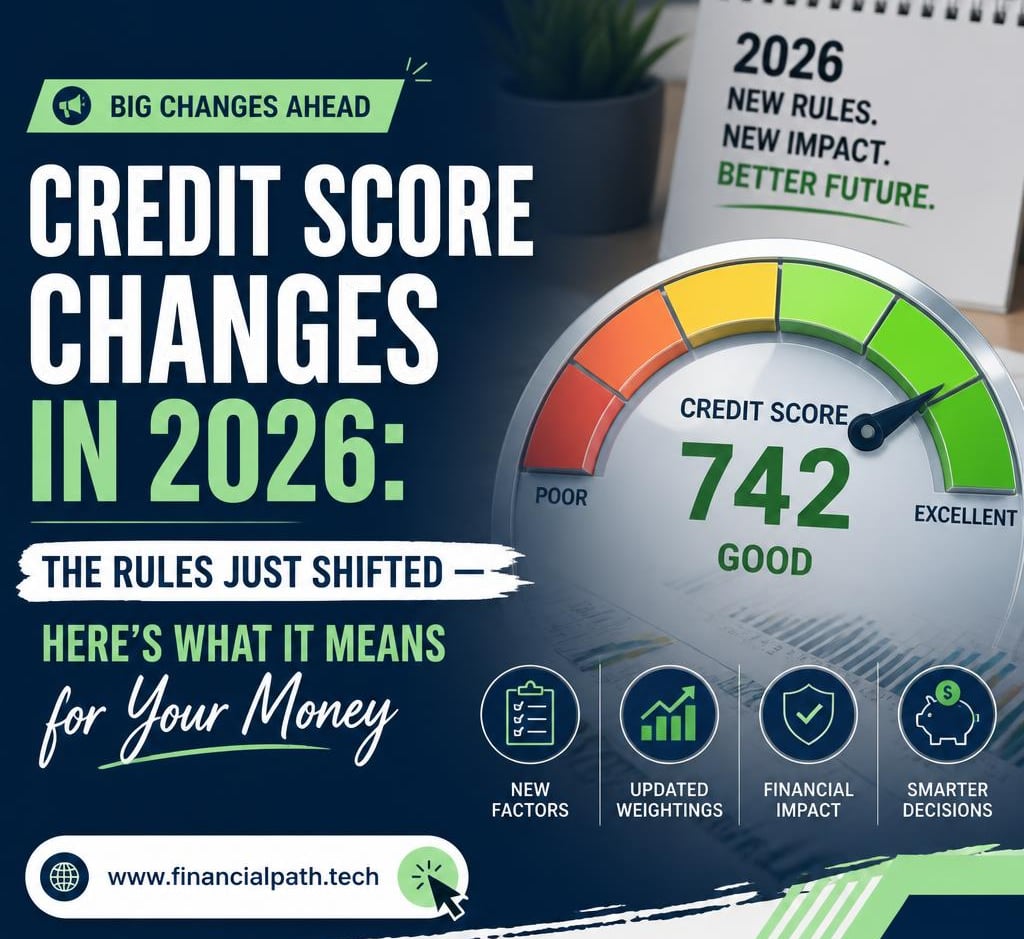
There's a number that quietly controls more of your financial life than almost any other single figure — more than your salary, more than your savings balance, and in many cases more than your actual net worth. That number is your credit score. And in 2026, the way that number gets calculated, used, and weighed by lenders has changed more significantly than at any point in the past two decades.
The credit score changes of 2026 aren't minor tweaks. Fannie Mae, which backs more than half of all US home loans, eliminated its minimum credit score requirement entirely in November 2025. Lenders can now use VantageScore 4.0 alongside FICO scores — and this newer model counts rent payments, utility bills, and telecom payments toward your creditworthiness for the first time. FICO 10, another new model, looks at two years of credit behaviour rather than a single snapshot. Meanwhile, today's average 30-year fixed mortgage rate is 6.61% as of July 7, 2026, and the average credit score for homebuyers reached a six-year high of around 736 — putting enormous pressure on anyone below that threshold.
Whether you're trying to buy a home, qualify for a car loan, get better credit card terms, or simply understand what financial institutions actually think of you — this is the article you need to read right now.
Table of Contents
What's Actually Changing With Credit Scores in 2026
The New Scoring Models — VantageScore 4.0 and FICO 10 Explained
What Credit Score You Actually Need in 2026
How Credit Score Affects the Real Cost of Borrowing
Building or Rebuilding Your Credit Score Strategically
Credit Scores in Nigeria and Emerging Markets — A Different Reality
Step-by-Step: How to Raise Your Credit Score in 90 Days
Common Credit Mistakes That Silently Drag Your Score Down
Key Takeaways
1. What's Actually Changing With Credit Scores in 2026
To understand why 2026 is genuinely a turning point for credit scoring, you need to understand what the old system was and why it was increasingly seen as inadequate.
The traditional credit scoring model — FICO Classic, developed in the late 1980s — was built on five factors: payment history, amounts owed, length of credit history, credit mix, and new credit inquiries. It looked at credit accounts reported by lenders and created a score between 300 and 850. For decades, this worked reasonably well for people who had established credit histories through credit cards, car loans, and mortgages.
The problem: roughly 45 million Americans have thin or no credit files — meaning the traditional model has almost nothing to score them on. Many of these people are perfectly capable of paying their bills on time. They pay rent every month without fail. They pay electricity, internet, and phone bills consistently. None of that showed up in the old credit score. The result was a system that systematically excluded younger borrowers, recent immigrants, and lower-income households from the financial products they qualified for — not because they were risky borrowers, but because their financial behaviour wasn't being measured.
The Federal Housing Finance Agency (FHFA) mandated an expansion of the credit scoring models used by Freddie Mac and Fannie Mae. Mortgage lenders can now use newer models like VantageScore 4.0, which consider additional information such as rent, utilities, or telecom payments. This can help more people, especially those with limited or "thin" credit histories, have a score on record. Centennial Bank
This is not a small administrative change. For millions of people who've been locked out of competitive borrowing rates despite being financially responsible, it potentially opens doors that were previously closed.
2. The New Scoring Models — VantageScore 4.0 and FICO 10 Explained
Two new scoring models are reshaping how lenders evaluate creditworthiness in 2026, and understanding them helps you know what financial behaviours actually matter now.
VantageScore 4.0
VantageScore 4.0 is the most significant departure from traditional credit scoring. Mortgage lenders can now use newer models like VantageScore 4.0, which consider additional information such as rent, utilities, or telecom payments. This gives lenders a fuller picture when evaluating applications, and it highlights how credit scoring is evolving to include a wider range of financial behaviours.
Practically, this means: if you've been paying rent consistently for three years, that payment history can now contribute positively to your creditworthiness assessment. Same for your electricity bill, your internet subscription, your phone contract. For younger borrowers, recent immigrants, and anyone who's been financially responsible in ways the old system didn't measure — this is genuinely significant.
VantageScore 4.0 also incorporates trended data — looking at whether your credit card balances are trending up or down over recent months, not just what they are at a single point in time. A borrower paying down balances consistently is scored more favourably than someone whose balances are growing, even if the snapshot figure is identical.
FICO 10
Lenders are also adopting FICO 10, which looks beyond a single snapshot to your credit patterns over the past two years.
FICO 10 places greater emphasis on personal loan behaviour — specifically, whether borrowers have been using personal loans to consolidate credit card debt (viewed positively) or whether personal loan balances are growing alongside credit card balances (viewed negatively). It's designed to capture the trajectory of a borrower's financial behaviour, not just a frozen moment.
The practical implication of both models: financial behaviour over time matters more than ever. A single bad month is less damaging in trend-based models. A consistent pattern of improving financial management is more rewarding.
💡 Tip — Which Model Is Your Lender Using?
Don't assume. Different lenders use different scoring models, and the score you see when you check your credit may be calculated using a different model than the one your lender will actually use. Before applying for any significant loan, ask your lender directly: "Which credit scoring model do you use, and what score do I need to qualify for your best rate?" This question alone can save you significant money by letting you focus improvement efforts on the right variables.
3. What Credit Score You Actually Need in 2026
This is the question most people come to this article wanting answered — and the honest answer is: it depends on what you're trying to borrow.
A recent trend report from Mortgage Monitor showed that the average credit score for homebuyers reached a six-year high of around 736, putting pressure on borrowers with lower scores. That rising average matters because it signals that the typical homebuyer competing in the same market as you has a stronger credit profile than at any point in the last six years. If your score is significantly below that 736 average, you're not just paying a higher mortgage rate — you're competing at a disadvantage in markets where seller-accepted offers increasingly come from stronger financial profiles.
The current average mortgage rate for someone with a good credit score of 700 is 6.91% as of June 2026, according to Curinos data. You generally need a credit score of at least 580 to qualify for a mortgage, and a score of 760 or higher to get the best interest rate.
4. How Credit Score Affects the Real Cost of Borrowing
Abstract credit score numbers become very concrete when you translate them into actual monthly payments and total loan costs.
The difference between a 760 and a 620 credit score on a $300,000 mortgage is $397 per month — every single month for 30 years. That's $4,764 per year. Over the life of the loan, that's $143,000 in additional interest paid for having a lower credit score.
This is why credit score improvement is arguably the highest-return financial activity available to anyone who expects to borrow money in the next few years. A few months of deliberate credit score management before applying for a mortgage or car loan can save tens of thousands of dollars in total borrowing cost.
⚠️ Warning — The Hard Inquiry Trap
Every time you apply for new credit — a credit card, a loan, a financing plan — the lender typically performs a "hard inquiry" that temporarily reduces your credit score by 5–10 points. If you're planning to apply for a mortgage or car loan within the next 6–12 months, stop applying for new credit cards or loans now. Multiple hard inquiries in the months before a major loan application can drag your score down at the worst possible time. The one exception: multiple mortgage or auto loan inquiries within a 14–45 day window are typically counted as a single inquiry by most scoring models, since rate shopping is considered financially prudent.
5. Building or Rebuilding Your Credit Score Strategically
The good news about credit scores is that they respond to deliberate behaviour. Unlike income or net worth, which take years to meaningfully change, credit scores can improve significantly within three to six months of focused effort.
The factors that drive your score — in approximate order of importance — are:
Payment history (35%): The single largest factor. Every on-time payment improves this. Every missed payment damages it — and the damage from a 30-day late payment can persist for up to seven years. Set up autopay for at least the minimum on every credit account, even if you plan to pay more manually.
Credit utilization (30%): The ratio of your current credit card balances to your total credit limits. The standard advice is to keep this below 30%, but the borrowers with the best scores typically stay below 10%. If your utilization is high, paying down balances or requesting a credit limit increase (without spending more) can improve this relatively quickly.
Length of credit history (15%): The average age of all your credit accounts. This is why financial advisors consistently recommend keeping old credit cards open, even if you rarely use them. Closing an old account shortens your average account age and can reduce your score.
Credit mix (10%): Having both revolving credit (credit cards) and instalment credit (loans) is viewed more favourably than having only one type. You don't need to take on unnecessary debt to improve this factor, but it's worth knowing that a small personal loan or car loan adds positive diversity to your credit profile.
New credit (10%): Recent credit applications. As noted above, minimise hard inquiries in the period before a major loan application.
Building credit from scratch requires starting with a secured credit card or becoming an authorised user on a responsible person's credit card. Use these credit lines responsibly, always making timely payments and keeping utilisation low. Over time, this approach can help establish a positive credit history.
According to Experian's credit building guide, the most reliable path to credit score improvement combines consistent on-time payments, reduced utilisation, and time — there are no legitimate shortcuts, but there are clear, predictable actions that produce results.
6. Credit Scores in Nigeria and Emerging Markets — A Different Reality
The credit score conversation in Nigeria and most African markets looks fundamentally different from the Western framework described above — but it's evolving rapidly, and understanding where it's going matters for every financially active Nigerian.
Nigeria's formal credit bureau system has existed since 2008, with licensed Credit Bureaus including CRC Credit Bureau, CreditRegistry, and XDS Credit Bureau. These bureaus maintain credit records for Nigerians who have interacted with formal financial institutions — banks, microfinance institutions, and licensed lenders. However, the vast majority of Nigeria's population remains outside the formal credit scoring system, either because they've never borrowed from a formal institution or because their borrowing history is minimal.
The Nigerian Credit Reporting Act of 2017 and subsequent CBN regulations have expanded the framework for credit data sharing, but practical access to credit scores and the ability to meaningfully build a credit profile remains limited for most Nigerians compared to the US system.
What's changing: digital lenders operating in Nigeria — including Carbon, Branch, FairMoney, and Renmoney — are building proprietary credit models that incorporate alternative data: phone usage patterns, social media activity, transaction data from mobile wallets and banking apps, airtime purchase history, and utility payment records. These models are the Nigerian equivalent of VantageScore 4.0's alternative data inclusion — and they're already affecting who can access digital loans and at what rates.
Practical steps for Nigerian readers:
If you've borrowed from any formal Nigerian institution — a bank, a microfinance bank, a BNPL provider — your credit data is likely being reported to at least one credit bureau. You can request a free credit report from any licensed Nigerian credit bureau to check your standing.
Building a positive credit profile in Nigeria practically means: maintaining a bank account with regular transactions, repaying any digital loans promptly and completely, keeping BNPL payments current, and building a relationship with a formal financial institution that reports to credit bureaus.
The CFPB's credit building resources are US-focused but contain principles that translate across financial systems — particularly the emphasis on payment history and utilisation as the dominant credit score drivers regardless of the specific model being used.
7. Step-by-Step: How to Raise Your Credit Score in 90 Days
Ninety days won't fix a severely damaged credit score, but it can meaningfully improve a moderate one — and for someone applying for a mortgage or car loan in three to four months, the difference can be worth thousands of dollars.
Step 1: Pull your credit reports from all three bureaus.
In the US, visit AnnualCreditReport.com for free reports from Equifax, Experian, and TransUnion. In Nigeria, contact CRC Credit Bureau, CreditRegistry, or XDS directly. You're looking for errors — accounts that aren't yours, incorrect late payment records, balances reported incorrectly — that you can formally dispute.
Step 2: Dispute any errors immediately.
Credit bureau errors are more common than most people expect. Each bureau has a formal dispute process; inaccurate negative information that's successfully disputed is removed, which can produce immediate score improvements. Document everything: submit disputes in writing and keep copies of all correspondence.
Step 3: Pay down credit card balances aggressively.
If your credit utilisation is above 30%, paying balances down is the fastest legitimate credit score lever available. Use the Debt Paydown Calculator on FinancialPath to model which balances to prioritise first for maximum score impact in minimum time. Paying off a maxed card completely typically produces the largest utilisation improvement per dollar paid.
Step 4: Set up autopay for every account.
Every credit account you carry should have at minimum an autopay set for the minimum payment. This eliminates the risk of accidentally missing a payment during a busy or stressful period. One 30-day late payment can drop a good credit score by 60–80 points — a damage that persists for seven years. Autopay is the cheapest possible insurance against this.
Step 5: Don't close old accounts.
The temptation to "clean up" your credit by closing cards you don't use can actually damage your score by reducing your average account age and your total available credit (which increases utilisation). Keep old accounts open, even if you put a small recurring charge on them monthly just to keep them active.
Step 6: Become an authorised user on a responsible person's account (if applicable).
If you have a family member or trusted friend with a long-standing credit card account in excellent standing, being added as an authorised user on that account adds their positive payment history and available credit to your credit profile. You don't need to actually use the card — just being listed as an authorised user can provide a meaningful boost.
Step 7: Add alternative payment data where available.
In the US, services like Experian Boost allow you to add utility, phone, and streaming service payment history to your Experian credit file — and this data is now increasingly relevant with VantageScore 4.0 in use. Enrol in any available alternative data reporting programmes to capture credit for financial responsibility that the old system ignored.
Step 8: Check your score monthly and track progress.
Most banks and credit cards now offer free credit score access through their apps. Monitor monthly to see which actions are producing results and which factors still need attention. Use the Income Planner tool on FinancialPath to see how your improving credit position fits into your broader financial picture — particularly if you're working toward a mortgage or major loan application.
8. Common Credit Mistakes That Silently Drag Your Score Down
These are the patterns that consistently show up in people with unexpectedly low credit scores — often without the person realising they're doing anything wrong:
Paying the minimum and assuming that's enough for credit health. Minimum payments keep you out of delinquency, but they leave balances high — which keeps utilisation high, which keeps scores suppressed. Paying more than the minimum on credit card balances is both financially smarter and credit-score smarter simultaneously.
Applying for store credit cards at checkout. That 15% off your first purchase with a new store card sounds appealing. But the hard inquiry it triggers plus the new account lowering your average account age can cost you more in credit score than the discount saves you in actual money — particularly if you're in the months before a major loan application.
Ignoring a small collection account. A $47 unpaid gym membership that went to collections can damage a credit score more dramatically than many people expect. Small collection accounts feel trivial — their credit score impact is not. Check your credit report for any collection accounts and address them, even if they feel too small to matter.
Closing credit cards after paying them off. This feels satisfying but often damages credit scores by reducing available credit and shortening average account age. The emotionally satisfying move and the financially optimal move are different here.
Not monitoring for identity theft. Credit fraud — someone opening accounts in your name — can devastate a credit score before you even know it's happening. Check your reports regularly to catch mistakes or fraud early. Use AnnualCreditReport.com for free yearly reports from all three bureaus and set alerts for new accounts or major changes.
Maxing out a credit card even temporarily. Even if you pay the full balance before the due date, if the statement closes while the balance is high, that high utilisation gets reported to the bureaus. Time large purchases so that they're paid before the statement closing date — not just before the payment due date.
Key Takeaways
Credit scoring in 2026 has undergone its most significant structural change in decades — Fannie Mae eliminated minimum credit score requirements, and lenders can now use VantageScore 4.0 and FICO 10, which incorporate rent, utility, and telecom payment history for the first time
The average credit score for homebuyers hit a six-year high of around 736 in 2026 — below that benchmark means higher rates and stiffer competition for mortgage approvals
The difference between a 620 and 760 credit score on a $300,000 mortgage is approximately $143,000 in total interest paid over 30 years — credit score improvement is one of the highest-return financial activities available to anyone planning to borrow
Payment history (35%) and credit utilisation (30%) are the two dominant factors — on-time payments and low balances drive the majority of credit score improvement
For Nigerian and African readers, digital lenders are building proprietary alternative-data credit models that incorporate phone usage, wallet transactions, and utility payments — the formal credit bureau system is evolving rapidly
The 90-day credit improvement plan — dispute errors, pay down utilisation, set up autopay, keep old accounts open, add alternative data — can produce meaningful improvements before a major loan application
Ask your lender which score they use and what factors matter most before applying for any significant loan — different lenders use different models, and knowing which one matters lets you optimise for the right variables
Use the Debt Paydown Calculator to model which credit card balances to pay down first for maximum utilisation impact, and the Income Planner to map your full financial picture as you build toward a major credit application
📚 Related Articles to Read Next on FinancialPath
Home Equity Loans and HELOCs in 2026 — Once your credit score is strong enough to access competitive mortgage rates, understanding how to leverage your home equity is the logical next financial step
Getting Debt Under Control Without Losing Your Mind — Paying down credit card balances improves both your credit score and your financial position simultaneously — this article gives you the complete debt reduction framework
High-Yield Savings Accounts vs CD Rates in 2026 — Building savings alongside credit improvement creates the combined financial profile that qualifies you for the best loan terms — this article covers where to put your money while you're building toward a major purchase
Your credit score isn't a judgment on your character or your worth as a person. It's a mathematical output that reflects specific financial behaviours — which means it responds directly and predictably to deliberate action. The changes happening in 2026 make that system more inclusive, more comprehensive, and in many ways more fair than it's ever been.
If your score needs work, you now have more tools, more data being counted in your favour, and more pathways to improvement than at any previous point. The rent you've been paying faithfully for years can now count. The utility bills you've never missed can contribute. The financial responsibility you've demonstrated in ways the old system ignored can finally be measured.
Use FinancialPath's Debt Paydown Calculator to model your fastest path to lower credit utilisation, check out the Income Planner to see how your overall financial picture fits together, and visit the Side Income page to explore how building additional income can accelerate both debt reduction and credit score improvement simultaneously. Your best credit score is built one good financial decision at a time — and today is a perfectly good day to start making them.
Written by the FinancialPath Team — Personal Finance Writers dedicated to making smart money decisions accessible to everyone, everywhere.
Published: Tuesday, July 7, 2026 | Sources: Bankrate (July 7, 2026), NerdWallet Mortgage Rates (July 7, 2026), Experian/Curinos June 2026, Mortgage Monitor Report, FHFA, VantageScore, Centennial Bank/Credit Score Playbook
RESOURCES
GET IN TOUCH
info@financialpath.tech
Kaduna, Nigeria
Serving emerging markets worldwide
© 2026 FinancialPath-No-nonsense math for emerging market builders.
LOCALLY RELEVANT, GLOBALLY USEFUL