
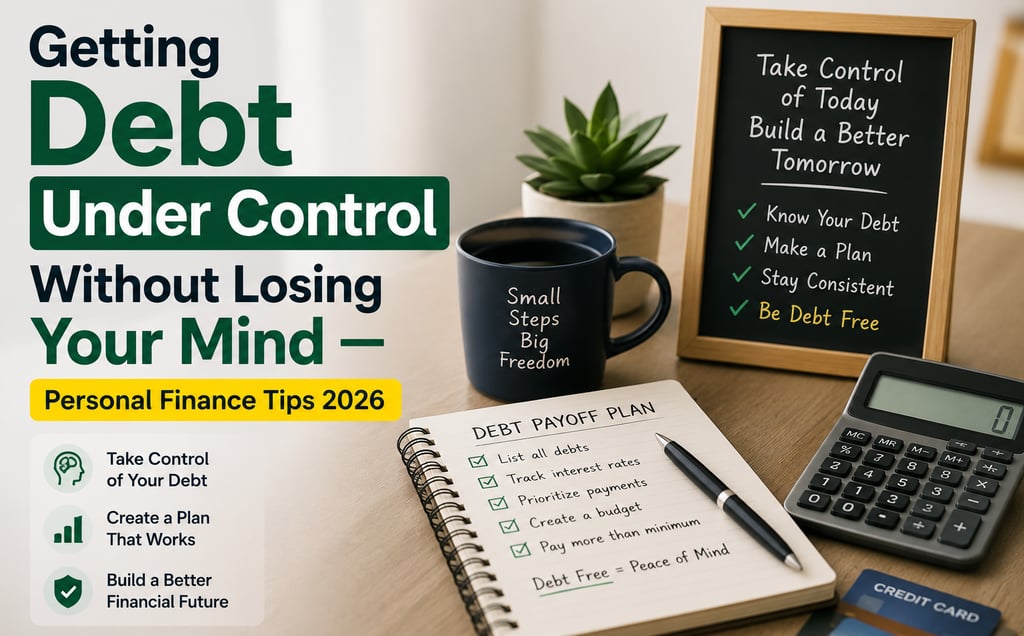
Getting Debt Under Control Without Losing Your Mind — Personal Finance Tips 2026
Practical, human personal finance tips for managing and eliminating debt in 2026 — without shame, confusion, or unrealistic advice. Real strategies that work.
FINANCIAL ADVICE
- Written by Admin
7/2/20267 min read
Debt is one of those subjects that carries an enormous amount of emotional weight alongside the financial reality. People talk about it in hushed tones, or avoid the topic entirely, or cycle between shame and avoidance in a loop that makes the actual numbers feel somehow even larger than they are.
Here is the first thing to say plainly: debt is a financial condition, not a character flaw. It exists on a spectrum from "strategic and manageable" to "genuinely overwhelming," and almost everyone lands somewhere on that spectrum at some point in their lives. The only thing that makes it worse is avoiding it.
This article is about looking at the reality of debt clearly — without the spiral — and using proven strategies to reduce it systematically, regardless of where you are starting from.
The Debt Avoidance Loop and Why It's So Common
Before getting into the mechanics of debt repayment, it is worth understanding why so many people who know they have a debt problem still avoid doing anything about it.
The avoidance loop typically looks like this: the thought of looking at the full debt picture feels overwhelming, so it gets deferred to "later." Later becomes weeks, then months, then years. During that time, interest compounds and balances grow, which makes the eventual confrontation feel even more daunting. The avoidance itself makes the problem worse, which creates more avoidance.
The way out of the loop is not motivation or inspiration — it is reducing the activation energy required for the first step. The first step is not a plan or a strategy. It is just a list.
Step One: The Debt Inventory
Get out a piece of paper, open a notes app, or create a simple spreadsheet. Write down every single debt you currently carry with these four data points next to each:
The lender's name
The current outstanding balance
The interest rate (APR)
The current minimum monthly payment
That is the entire first step. No strategy yet. No decisions. Just information.
For many people, this single act — seeing all the numbers in one place for the first time — is simultaneously uncomfortable and relieving. The vague, looming sense of debt is often more psychologically burdensome than the actual numbers, because the mind tends to assume the worst when information is absent. Seeing concrete numbers at least gives you something real to work with.
The Consumer Financial Protection Bureau offers free tools and worksheets for this debt inventory step, which can be helpful if you prefer a structured template.
Step Two: Understand What Your Debt Is Actually Costing You
Before deciding how to pay down debt, it helps to understand the real cost of the debt you carry — particularly any high-interest debt like credit cards or unsecured personal loans.
Here is an example that illustrates the point clearly: a ₦200,000 credit card balance at 24% annual interest with a minimum payment of ₦5,000 per month will take approximately 5 years to pay off — and you will pay roughly ₦100,000 in interest alone. You will have paid ₦300,000 in total to clear a ₦200,000 debt.
If instead you paid ₦15,000 per month — three times the minimum — you would clear the same debt in about 15 months and pay less than ₦25,000 in interest. Same original debt. Radically different outcome based entirely on payment amount.
Understanding this mathematics is not meant to create panic — it is meant to illustrate why minimum payments are such an expensive long-term strategy, and why even modest increases in monthly payment can dramatically change your timeline.
The Two Proven Repayment Strategies
Once you have your debt inventory and understand the interest cost of each debt, you need a repayment strategy. There are two that have genuine track records:
The Avalanche Method
In the Avalanche method, you rank all your debts by interest rate from highest to lowest. You pay the minimum on every debt each month, and then you direct every extra dollar or naira you can find toward the highest-interest debt.
When the highest-interest debt is cleared, you take the total amount you were paying on it (minimum plus extra) and redirect all of it to the next highest-interest debt. This continues until every debt is gone.
The advantage: This is mathematically optimal. You minimise the total interest paid across all debts. For people who are motivated by numbers and efficiency, this is the superior method.
The disadvantage: Depending on your debt structure, it can take a long time to completely eliminate even one debt — especially if your highest-interest debt also happens to be your largest balance. That lack of visible progress can erode motivation over months.
The Snowball Method
In the Snowball method, you rank debts by balance from smallest to largest, ignoring interest rates. You pay minimums on everything and direct extra payments toward the smallest balance.
When the smallest debt is completely eliminated, you roll its full payment (minimum plus extra) onto the next smallest debt. This continues until all debts are gone.
The advantage: You get a complete debt elimination faster — sometimes within weeks or months — which provides a genuine psychological win that fuels continued motivation. Research by professors at Harvard Business School and Kellogg School of Management found that people following snowball-style approaches were more likely to maintain their debt paydown momentum compared to those taking purely mathematical approaches.
The disadvantage: You will typically pay more in total interest than with the Avalanche method, because you are not prioritising the most expensive debts first.
Neither method is universally correct. The best method is the one you will actually stick with long enough to finish.
Finding Extra Money for Debt Repayment
The two strategies above are frameworks for how to allocate extra payments. The question of where to find those extra payments is equally important.
Audit your current subscriptions. The average person carries more active subscriptions than they realise — streaming services, app memberships, gym memberships they rarely use. A 30-minute review of bank statements typically reveals at least one or two cancellable subscriptions.
Reduce one variable spending category temporarily. Eating out, entertainment, clothing — pick one and reduce it by 50% for three months. Apply that difference directly to your target debt. This is temporary, not permanent, which makes it psychologically easier to commit to.
Sell unused items. Electronics, clothing, furniture, books — most homes contain hundreds of dollars or thousands of naira worth of items that are not being used. Converting these to cash and applying it directly to debt is both financially effective and psychologically satisfying.
Apply all unexpected income directly. Any time money arrives that was not in your regular budget — a work bonus, a tax refund, a cash gift, freelance income — direct 100% of it to your target debt before it has a chance to disappear into general spending.
Consider a temporary income boost. A side gig, additional freelance work, or a one-time income opportunity dedicated specifically to debt can dramatically accelerate your timeline. Even one month of additional income applied entirely to debt can shorten your payoff period significantly.
Negotiating With Lenders
One personal finance tip that is vastly underused: calling your lender and asking for better terms.
This is not a guaranteed strategy, and it works better in some situations than others. But it is free to try, and the potential upside is significant. There are three things worth asking about:
Lower interest rate: If you have been a reliable payer and have been with a lender for a reasonable period, calling and asking for a rate reduction is a legitimate request. Many people are surprised to find their lenders willing to negotiate rather than risk losing a reliable customer.
Hardship plan: If you are genuinely struggling to meet minimum payments, many lenders have formal hardship programmes that temporarily reduce payments or pause interest accrual. These are not widely advertised, but they exist. You have to ask.
Settlement offer: In cases of severe financial distress, some lenders will accept a lump sum payment lower than the full balance as settlement. This has significant credit score implications and tax consequences in some jurisdictions, and should only be considered in genuine hardship situations, ideally with advice from a financial counsellor.
The Money Advice Service (UK) and NFCC (US) both offer free debt counselling if you need guidance on negotiating with lenders.
The Psychological Side of Debt
Getting debt under control is as much a psychological challenge as a financial one. A few realities worth naming directly:
Progress is not always linear. Some months you will make strong progress. Others, life intervenes and you barely cover the minimums. This is normal. Consistency over time matters far more than perfection in any given month.
Celebration matters. Every debt you fully eliminate is worth acknowledging. This is not frivolous — it is neurologically reinforcing the behaviour you want to continue. You do not need to celebrate with spending; even just acknowledging the milestone consciously makes a difference.
Your debt does not define your financial future. Where you are today is not where you have to be in two, three, or five years. People clear significant debts regularly, using exactly the strategies described in this article, starting from positions that felt impossibly far from debt-free. The system works when it is applied consistently.
What to Do the Month You Become Debt-Free
This moment deserves its own section because what you do in the first month after your last debt payment is paid off has an outsized impact on your long-term financial trajectory.
The biggest risk is lifestyle inflation — gradually replacing the debt payments with increased discretionary spending until the income that was going to debt has completely disappeared into the budget without building any new wealth.
The most powerful move: on the month your last debt payment clears, redirect the full payment amount — what you were paying to the debt — directly to savings or investment. You were already living without that money. You have already proved you can. Keeping that momentum going and pointing it at wealth building rather than debt is how people who escape debt actually build financial security.
Key Takeaways
Start with a debt inventory: write down every debt with its balance, interest rate, and minimum payment
Understand the true cost of your debt — minimum payments are extremely expensive long-term
Use Avalanche (highest interest first) if you're motivated by efficiency; Snowball (smallest balance first) if you need visible wins
Find extra repayment money by auditing subscriptions, reducing one spending category, and directing all windfalls to debt
Call your lender — rate reductions and hardship plans exist but require you to ask
When debt is cleared, immediately redirect the payment to savings or investment
The strategies in this article connect directly to everything we cover in The Savings Habit That Beats Willpower Every Time and our Debt Paydown Calculator tool — both are worth exploring as your next step.
Considering investment while managing debt? Small Investing Moves That Compound Into Something Real covers exactly how to think about that balance.
RESOURCES
GET IN TOUCH
info@financialpath.tech
Kaduna, Nigeria
Serving emerging markets worldwide
© 2026 FinancialPath-No-nonsense math for emerging market builders.
LOCALLY RELEVANT, GLOBALLY USEFUL