
High-Yield Savings Accounts vs CD Rates in 2026: Where to Put Your Money Before the Window Closes
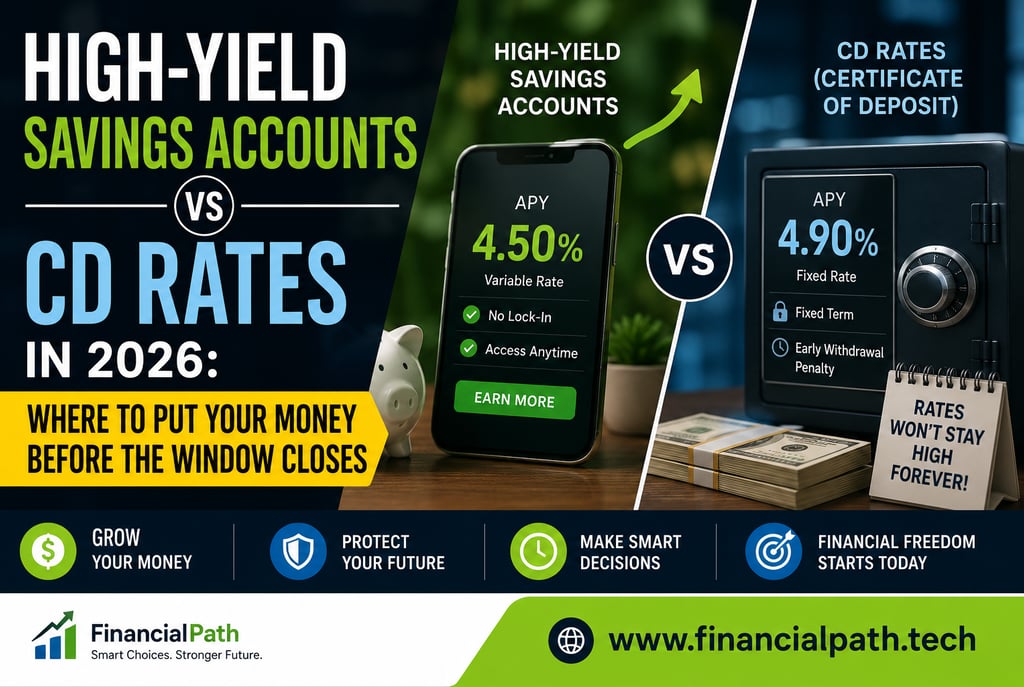
CD rates hit 4.40% APY and high-yield savings accounts offer up to 5% in July 2026. Here's exactly where to put your money before rates drop further.
FINANCIAL ADVICEINFLATION HEDGING
Financial Path Team
7/6/202611 min read
Here's a question that's worth sitting with for a moment: if someone told you that your savings could be earning 4% or even 5% per year — completely risk-free, government-insured, and fully accessible — but you're currently earning less than 1% at your regular bank, how long would you wait before doing something about it?
For millions of people right now, the answer is apparently: indefinitely.
High-yield savings accounts and CD rates in 2026 are still sitting near decade-long highs, even after three Federal Reserve rate cuts in 2025. The top certificates of deposit are offering up to 4.40% APY as of this week. The best high-yield savings accounts are paying between 4% and 5%. Meanwhile, the average traditional savings account at a brick-and-mortar bank is still paying somewhere between 0.01% and 0.5% — which, against today's 3.8% inflation, means you're losing real purchasing power every single month your money stays there.
The urgency is real. The Fed's next meeting is scheduled for July 28–29, 2026, and analysts widely expect further rate cuts before the end of the year. Every cut means banks will reduce their CD and savings rates in response. The window to lock in these returns is open right now — but it won't be open indefinitely.
This is your complete guide to understanding both options, comparing them honestly, and deciding where your money belongs before that window narrows further.
Table of Contents
What's Actually Happening With Savings and CD Rates Right Now
High-Yield Savings Accounts — How They Work and Who They're For
Certificates of Deposit (CDs) — The Case for Locking In Now
High-Yield Savings vs CDs — The Full Comparison
How to Choose the Right Option for Your Situation
Step-by-Step: How to Open Your First High-Yield Account
What Nigerian and Emerging Market Readers Should Know
Common Mistakes That Cost Savers Money
Key Takeaways
1. What's Actually Happening With Savings and CD Rates Right Now
To understand why this moment matters, you need a quick picture of how we got here.
Between March 2022 and July 2023, the US Federal Reserve raised its benchmark interest rate eleven consecutive times — the most aggressive rate-hiking cycle in four decades. The goal was to bring inflation under control. The side effect was that savings rates, CD rates, and money market rates all climbed to levels that most people under 50 had never seen before.
Then came 2025. The Fed made three rate cuts in late 2025, prompting many banks to reduce rates on CDs and savings accounts accordingly. Rates began drifting downward. But here's what most people missed: they didn't fall off a cliff. They eased gradually. And by mid-2026, something interesting happened.
We saw a surprising number of banks and credit unions — almost two dozen — increase CD rates in May 2026, double the number that decreased rates. Rate increases continued in June. Competition among online banks and credit unions kept rates surprisingly elevated even as the overall trend pointed downward.
The top-performing certificates of deposit on the market offer rates up to 4.40% APY as of July 3, 2026, with the most generous yield coming from the 3-year, 4-year, and 5-year CDs issued by Morgan Stanley.
The gap between what your regular bank pays and what the best online accounts offer is not a minor difference. On a $10,000 balance over one year, the difference between 0.5% and 4.5% is $400 in earned interest versus $50. That's real money — and it requires zero extra risk to capture.
2. High-Yield Savings Accounts — How They Work and Who They're For
A high-yield savings account works exactly like a regular savings account in every way that matters for daily life: your money is liquid, meaning you can access it whenever you need it. It's FDIC-insured up to $250,000 per depositor in the US. You can add to it any time. There's no penalty for withdrawing.
The only meaningful difference is that it pays a dramatically higher interest rate — because high-yield savings accounts are almost exclusively offered by online banks. Without the overhead of physical branches, ATM networks, and large customer service infrastructure, online banks can return more of their earnings to depositors in the form of higher interest rates.
This sounds simple because it is simple. There's no hidden complexity, no investment risk, no lock-up period. The confusion comes from the fact that most people have never bothered to move their savings away from the bank where they have their checking account — and most traditional banks have relied on that inertia for decades to justify paying almost nothing on deposits.
Savers will also find that some of the top high-yield savings accounts offer rates competitive with or even higher than comparable CDs. You can find savings accounts offering APYs between 4.00% and 5.00% as of this writing, with the most appealing rates typically coming from online institutions.
High-yield savings accounts are best suited for:
Your emergency fund — three to six months of living expenses that needs to stay accessible
Money you'll need within the next one to two years for a specific goal (car, travel, house deposit)
Your buffer fund — the monthly cushion for unexpected expenses
Any cash you're holding while deciding where to invest it longer term
💡 Tip — The Emergency Fund Sweet Spot
Your emergency fund should never be invested in stocks or anything that can lose value when you need it most. But it also shouldn't be sitting in a 0.5% account losing ground to inflation. A high-yield savings account earning 4–5% is the ideal home for emergency funds — accessible immediately, earning meaningfully, completely safe.
3. Certificates of Deposit (CDs) — The Case for Locking In Now
A certificate of deposit is a savings instrument where you agree to leave a specific amount of money with a bank for a fixed period — anywhere from one month to ten years — in exchange for a guaranteed interest rate that doesn't change for the duration of the term.
That last part is the key distinction. Unlike a high-yield savings account whose rate can change any time the bank chooses, a CD locks in your rate the day you open it. If you open a 2-year CD at 4.20% today and the Fed cuts rates three more times over the next eighteen months, you still earn 4.20% on your money for the full two years. The rate doesn't follow the market down.
This rate certainty is exactly why CDs are generating so much attention right now. Yields are likely to keep falling in 2026, though the good news for CD savers is you can still lock in rates that are outpacing inflation. Analysts at Bankrate project three additional quarter-point Fed rate cuts before the end of 2026 — which means CD rates will continue drifting lower. Every month you wait to open a CD is a month where the available rate is potentially lower than it is today.
The total interest you'll earn over the life of your CD depends on how much you initially deposit, the term you select, what APY you receive, and how frequently your interest compounds. Taking a little time to shop around for a high CD rate for the term you need can potentially mean earning hundreds of dollars more in interest compared to accepting whatever the standard rate is at your existing bank.
CDs are best suited for:
Money you won't need for a defined period — the exact length of the CD term
Savings with a specific future goal and target date (e.g. a deposit for a house purchase in 18 months)
People who want guaranteed returns without market exposure
Anyone who wants to lock in today's rates before they fall further
4. High-Yield Savings vs CDs — The Full Comparison
The honest summary: right now, the best high-yield savings accounts actually pay slightly higher rates than most CDs for shorter terms. But CDs offer something savings accounts don't — rate certainty. If you're confident you won't need the money for a year or more, locking in a CD at 4.20–4.40% today protects you from the rate cuts coming over the next twelve to eighteen months.
5. How to Choose the Right Option for Your Situation
The decision between a high-yield savings account and a CD doesn't have to be either/or. Most financially thoughtful people use both — and the right allocation depends on your specific situation.
Choose a High-Yield Savings Account if:
The money is your emergency fund or general-purpose accessible savings
You're not sure exactly when you'll need the funds
You want maximum flexibility
You're building toward a goal but the timeline is uncertain
Choose a CD if:
You have a clear date by which you won't need the money
You want to guarantee your rate against future Fed cuts
You're saving toward a specific goal with a defined timeline
You have excess savings beyond your emergency fund that aren't earmarked for investing
The smart approach most people overlook: a CD ladder. Instead of putting all your money in one CD, you split it across multiple CDs with different maturity dates — for example, one-quarter each in 6-month, 12-month, 18-month, and 24-month CDs. As each CD matures, you either use the funds or roll them into a new CD. This gives you regular access to portions of your money while still capturing fixed rates on the rest.
⚠️ Warning — Early Withdrawal Penalties Are Real
The single most important thing to understand about CDs before opening one: early withdrawal penalties can be significant. Depending on the bank and term length, breaking a CD early can cost you anywhere from 3 months to 15 months of interest. If there's any chance you'll need the money before the CD matures, either choose a shorter term, keep that portion in a high-yield savings account, or look for a no-penalty CD — which sacrifices some rate for full flexibility.
6. Step-by-Step: How to Open Your First High-Yield Account
Opening a high-yield savings account or CD is genuinely straightforward. Here's the full process:
Step 1: Compare current rates across institutions.
Don't just open an account with the first rate you see. Check NerdWallet's best CD rates and Bankrate's CD rate tracker for up-to-date comparisons across dozens of institutions. Rates change frequently — what was best last week may not be best today.
Step 2: Verify FDIC or equivalent insurance.
Any account you open should be at an FDIC-insured bank (US) or equivalent government-backed protection scheme in your country. This guarantees your deposits up to the insured limit regardless of what happens to the institution. Don't skip this step.
Step 3: Check the minimum deposit requirement.
Some high-yield accounts have no minimum. Some CDs require $500, $1,000, or $1,500 to open. Make sure you meet the minimum before going through the application process.
Step 4: Gather your documents.
You'll need: a valid government-issued ID, your Social Security Number or Tax Identification Number (for US accounts), your current address, and your existing bank account details for the initial funding transfer.
Step 5: Complete the online application.
Most online banks process applications in under fifteen minutes. Identity verification is typically instant or takes one business day.
Step 6: Fund your account.
Link your existing bank account and initiate a transfer. ACH transfers typically take two to three business days. Some banks allow instant funding from certain institutions.
Step 7: Set up automatic contributions (for savings accounts).
If you're using a high-yield savings account, set up an automatic monthly transfer from your primary account on payday. The consistency compounds over time in ways that occasional manual deposits don't.
7. What Nigerian and Emerging Market Readers Should Know
The specific products described above — FDIC-insured US bank accounts and US CDs — require a US bank account and typically a US Social Security Number to access directly. For readers in Nigeria, Ghana, Kenya, or elsewhere in Africa, direct access to these exact products isn't immediately available. But the strategy is absolutely transferable.
For Nigerian readers specifically:
Fixed deposits at Nigerian banks function similarly to CDs — you lock in a fixed amount for a defined period and earn a predetermined interest rate. Nigerian banks currently offer fixed deposit rates ranging from 10% to 18% per annum for naira deposits, which sounds impressive until you factor in Nigeria's 22% annual inflation rate. In real terms, many naira-denominated fixed deposits are still producing negative real returns.
This is precisely why dollar-denominated savings products matter so much for Nigerian savers. Platforms like PiggyVest (which offers dollar savings options), Bamboo, Risevest, and Grey allow Nigerian users to save or invest in dollar-denominated instruments. A 4–5% return on dollar savings, combined with naira's continued devaluation, often represents a far better real return than a 15% naira fixed deposit.
For readers who have access to a US bank account — through work, international study, or residency — the high-yield savings account and CD strategies described in this article apply directly and are worth acting on immediately.
Our Inflation Hedge page covers the broader strategy of protecting savings in high-inflation emerging market environments — it's directly relevant to this conversation and worth reading alongside this article.
8. Common Mistakes That Cost Savers Money
After everything we've covered, here are the patterns that consistently cost people money when it comes to savings and CDs:
Staying loyal to your main bank out of convenience. This is the single most expensive savings mistake most people make. Traditional brick-and-mortar banks know you're unlikely to move your money — so they pay almost nothing on deposits. The difference between 0.5% and 4.5% on a $20,000 savings balance is $800 per year. That's not abstract. That's eight hundred dollars you didn't earn because moving your savings felt like too much effort.
Choosing the longest CD term without considering your timeline. Locking money in a 5-year CD because it offers the highest rate makes sense only if you genuinely won't need that money for five years. If there's a reasonable chance you'll need early access, the early withdrawal penalty can wipe out months of interest gains — turning a seemingly attractive rate into an expensive mistake.
Ignoring the compounding frequency. Two CDs can advertise the same APY but compound at different frequencies — monthly vs annually, for example. Monthly compounding slightly outperforms annual compounding at the same stated rate. Check the compounding frequency before committing.
Waiting for rates to go higher. Rate timing is as unreliable for savings products as market timing is for investments. The next Fed meeting is in three weeks. If they cut rates — which most analysts expect — the best CD rates available today will likely be lower tomorrow. Waiting for a better rate that may not come costs you the rate that's available right now.
Not using a CD ladder. Many people put all their savings in either a single CD or a single savings account when the smarter move is a ladder that combines the higher fixed rates of CDs with regular liquidity.
Our Compound Interest Calculator on FinancialPath lets you model the difference between different savings rates and compounding frequencies on your specific balance — it takes about two minutes to run and the numbers are genuinely eye-opening.
Key Takeaways
The top CD rates available right now reach 4.40% APY, while the best high-yield savings accounts are paying up to 5% — dramatically higher than most traditional banks
The Fed's next meeting is July 28–29, 2026 — further rate cuts are widely expected, which will push savings and CD rates lower; acting now locks in better rates
High-yield savings accounts offer full flexibility with competitive rates — ideal for emergency funds and accessible savings goals
CDs lock in your rate regardless of future Fed cuts — ideal for money with a defined timeline you won't need before maturity
A CD ladder splits savings across multiple maturity dates, combining rate certainty with periodic liquidity
Early withdrawal penalties on CDs can be significant — only lock in money you genuinely won't need before the term ends
For Nigerian and emerging market readers, dollar-denominated savings platforms and local fixed deposit products are the closest equivalents — and dollar savings often produce better real returns than naira products despite lower nominal rates
Never stay with a low-rate traditional bank out of inertia — the difference between 0.5% and 4.5% on a $20,000 balance is $800 per year
📚 Related Articles to Read Next on FinancialPath
How to Protect Your Money From Inflation in 2026 — This morning's article covers the full inflation protection strategy that makes high-yield savings and CDs even more valuable as part of your financial plan
The Savings Habit That Beats Willpower Every Time — Before you can benefit from high rates, you need money consistently flowing into savings. This article covers the automation system that makes that happen
Small Investing Moves That Compound Into Something Real — Once your emergency fund is earning 4–5% and your short-term savings are covered, the next step is putting longer-term money to work in investments with even greater growth potential
There's a certain satisfaction in knowing your money is working as hard as you do. Most people have never experienced a genuinely high-rate savings environment — the years between 2009 and 2022 offered almost nothing. What we have right now, in July 2026, is genuinely unusual. And it won't last forever.
The gap between the best available rate and what most people are currently earning on their savings is not a small rounding error — it's hundreds or thousands of dollars per year, completely risk-free, requiring only the willingness to open an account somewhere new.
Use the Compound Interest Calculator on FinancialPath to see exactly what your savings could earn at 4% or 5% versus what they're earning now. Then use the Income Planner to map out how your savings fit into your broader financial picture. Both tools are free, and both are built for exactly this kind of decision.
Your money deserves better than 0.5%. And right now, getting better has never been more straightforward.
RESOURCES
GET IN TOUCH
info@financialpath.tech
Kaduna, Nigeria
Serving emerging markets worldwide
© 2026 FinancialPath-No-nonsense math for emerging market builders.
LOCALLY RELEVANT, GLOBALLY USEFUL