
Inflation Just Came in Softer Than Expected — Here's Exactly What It Means for Your Money Right Now
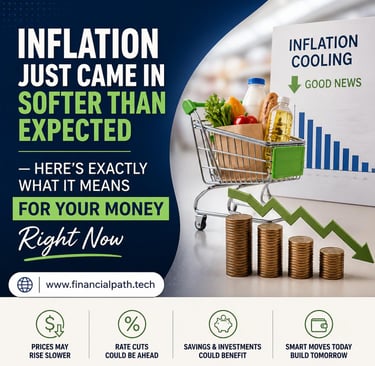
June 2026 inflation came in softer than expected at 3.5% this morning. Here's exactly what it means for your mortgage, savings, debt and investments right now.
FINANCIAL ADVICE
- Financial Path Team
7/15/202615 min read

There's a number that dropped this morning that genuinely matters to your household budget, your mortgage rate, your savings account, and the cost of every dollar you owe — and most people won't hear it framed in personal finance terms until it's already moved markets and changed the calculus on their financial decisions.
The June 2026 Consumer Price Index came in at 3.5% year-over-year — softer than the 3.8% reading from the previous month and meaningfully below what most analysts had expected. That deceleration is significant. US stock futures edged higher immediately after the data released, bond yields dipped, and traders began repricing their expectations for Federal Reserve interest rate cuts this year. The dollar softened. The market's collective reaction was clear: the inflation easing of 2026 has arrived, at least for this month, and it changes the financial landscape in ways that ripple directly into your personal finances.
This matters whether you're a homeowner watching mortgage rates, a saver watching CD rates, a borrower managing credit card debt, or an investor deciding how to position a portfolio. The inflation number is not abstract economic data. It is the single most important monthly data point for the cost of everything you borrow, the value of everything you save, and the trajectory of prices on everything you buy. This article tells you exactly what this morning's reading means — and what you should do about it today.
Table of Contents
What This Morning's Inflation Reading Actually Says
Why Softer Inflation Is Genuinely Good News — For Most People
What It Means for Mortgage Rates Right Now
What It Means for Your Savings and CD Rates
What It Means for Your Credit Card and Loan Debt
What It Means for Your Investment Portfolio
What Nigerian and Emerging Market Readers Should Know
Step-by-Step: How to Act on This Data Before the Window Closes
Key Takeaways
1. What This Morning's Inflation Reading Actually Says
Let's start with the actual data rather than the headlines — because understanding specifically what the CPI measures and what today's reading means helps you separate signal from noise in the financial commentary that will fill your feed for the rest of the day.
The Consumer Price Index measures the change in prices paid by urban consumers for a representative basket of goods and services. It covers housing, food, energy, healthcare, transportation, clothing, and a range of other categories. The year-over-year figure compares what that basket costs today to what it cost twelve months ago.
Consumer prices rose 3.5% annually in June, less than expected as energy prices eased — this is the headline figure that moved markets this morning. The deceleration from April's 3.8% reading reflects primarily an easing in energy prices, which had been the dominant inflation driver earlier in 2026. Inflation accelerated again in April. The Bureau of Labor Statistics reported that the consumer price index rose 3.8% over the 12 months ending in April 2026, the largest annual increase since May 2023. Energy prices drove much of the gain, with gasoline up 28.4% over the year.
The June reading suggests that energy price pressure has moderated from its peak. That's important because energy costs affect virtually every other price in the economy — transportation costs for goods, heating and cooling for homes and businesses, manufacturing costs for consumer products. When energy costs stabilise or fall, the disinflationary ripple moves through the economy over subsequent months.
What this morning's data does NOT mean: that inflation is defeated, that prices are falling, or that the cost of living is suddenly affordable again. Food costs 19.1% more in 2026 than it did four years ago. Cumulative price increases from 2020 to 2026 haven't reversed — they've just stopped accelerating as fast. The burden on household budgets remains real and significant.
What it DOES mean: the trajectory is heading in the right direction for the first time in several months, and that trajectory has immediate implications for the cost of borrowing money.
2. Why Softer Inflation Is Genuinely Good News — For Most People
The relationship between inflation data and individual financial wellbeing is more direct than most people realise — but it works through specific channels, not all at once and not for everyone equally.
For borrowers, softer inflation opens the door to lower interest rates. The Federal Reserve raises interest rates to fight inflation — making money more expensive to borrow, which slows spending, which reduces price pressure. When inflation moderates, the Fed has room to cut rates. U.S. stock futures edged higher on Wednesday after a softer-than-expected inflation reading eased fears — and part of that market optimism reflects expectations that the Fed's rate-cutting timeline has moved forward.
For savers, softer inflation means your real return improves. If inflation is 3.8% and your savings account pays 4.10%, your real return is 0.3%. If inflation falls to 3.5%, your real return becomes 0.6% — a doubling of your actual purchasing power gain without any change to the account's nominal rate. This is a meaningful improvement in the genuine value of holding savings.
For consumers, softer inflation means the rate of price increases is decelerating. Prices aren't falling, but they're rising more slowly. Your grocery bill in August should rise less than it rose between April and July. That's not dramatic relief — but over months, deceleration accumulates into meaningful budget improvement.
For investors, softer inflation is broadly positive for equities. When inflation is high, companies face higher input costs that compress margins. When inflation eases, margin pressure reduces. At the same time, the prospect of Fed rate cuts improves the present value of future corporate earnings — a fundamental driver of equity valuations.
💡 Tip — Don't Wait for the Trend to be "Confirmed"
A common personal finance mistake is waiting for multiple months of softer inflation data before acting. By the time three or four months of improving data have been confirmed, the opportunities it creates — locking in CD rates before they fall, refinancing debt at better rates, repositioning investments — have often already closed. The time to act on a single month of positive data is immediately, while the window is open. You can always reverse a decision if the trend reverses.
3. What It Means for Mortgage Rates Right Now
The average interest rate for a 30-year, fixed-rate conforming mortgage loan in the U.S. is 6.626%, barely changed from the day before, according to data from Mortgage Resource Center. Meanwhile, the average rate for a 15-year, fixed-rate conforming mortgage loan is 5.792%.
Mortgage rates don't move instantly with a single month's inflation reading — but the trajectory matters enormously for anyone making housing decisions over the next six to twelve months. Here is the mechanics of how today's data affects mortgage rates:
Mortgage rates track closely with the yield on the 10-year US Treasury bond, which itself reflects market expectations about where the Federal Reserve's benchmark rate will be over the coming decade. When inflation data comes in softer than expected, markets reprice their Fed rate cut expectations higher — meaning they expect more cuts, sooner. That repricing immediately pulls 10-year Treasury yields lower, and mortgage rates follow.
Today's softer CPI reading is likely to exert modest downward pressure on mortgage rates over the next few days — not a dramatic drop, but movement in the right direction for anyone currently locked out of buying by elevated rates.
Mortgage rates might go down if the Fed proceeds with a cut to the federal funds rate in 2026. But other factors influencing mortgage rates include inflation, the national debt, and the current demand for home loans.
What this means for prospective home buyers: If you've been waiting for rates to fall before buying, today's data improves the trajectory. But waiting indefinitely for rates to return to pandemic-era lows (3–4%) is likely to mean waiting for years. The more productive strategy is evaluating whether today's rates at 6.4–6.6% are manageable for your specific budget and time horizon — while keeping an eye on whether additional inflation deceleration opens the window further.
What this means for existing homeowners considering refinancing: Refinancing makes economic sense when your current rate is meaningfully higher than available rates and you plan to stay in the home long enough to recoup the closing costs of the refinance (typically 2–3 years). Today's rates aren't yet at the threshold that makes refinancing compelling for most people — but the trend is worth monitoring monthly.
4. What It Means for Your Savings and CD Rates
Today, Wednesday, July 15, 2026, the highest savings account rate available from our partners is 4.10% APY. This rate is offered by Bask Bank and CIT Bank.
On Wednesday, July 15, 2026, some of the highest CD rates are at 4% APY.
This is one of the most time-sensitive personal finance implications of today's inflation data — and it points in a counterintuitive direction. Softer inflation increases the probability of Fed rate cuts. Fed rate cuts directly reduce the interest rates that banks pay on savings accounts and CDs. This means the 4.10% APY available today on the best high-yield savings accounts, and the 4% CD rates, may not be available in three to six months if the Fed proceeds with cuts.
The window for locking in today's rates through certificates of deposit is open right now — and today's softer inflation reading potentially makes it narrower rather than wider.
The practical implication: if you have cash savings sitting in a low-interest account, today is a better day to move it to a high-yield account or a CD than tomorrow will be. Every day you delay is a day the best rates may be slightly lower.
If you're trying to decide between a high-yield savings account (flexible, variable rate) and a CD (locked rate, penalty for early withdrawal), the softer inflation reading tilts the argument toward CDs — because locking in today's rate protects you from rate decreases that may come as the Fed cuts. Our Compound Interest Calculator can show you exactly how different rate scenarios affect your savings balance over different time horizons — useful for making this decision with concrete numbers rather than guesses.
⚠️ Warning — Don't Confuse Inflation "Easing" With Rate Dropping to Zero
Inflation at 3.5% is still significantly above the Federal Reserve's 2% target. The Fed is not going to cut rates aggressively or immediately in response to one month of softer data. The most likely scenario involves one to two quarter-point cuts before year-end — modest movement, not a dramatic collapse in rates. Don't make irreversible financial decisions based on expectations of rates falling to near-zero. Plan for gradual, modest rate reduction over the next 12–18 months.
5. What It Means for Your Credit Card and Loan Debt
This is where softer inflation data has its most immediately valuable personal finance implication for many households — and it's also where the most important caveat lives.
Credit card interest rates track the Federal Reserve's benchmark rate closely. Credit card APRs remain near record highs. When the Fed eventually cuts rates in response to improving inflation data, credit card rates will follow — but with a lag, and typically less completely than they rose.
The practical implication for anyone carrying credit card debt: softer inflation data is modestly good news, but it doesn't change the urgency of paying down high-interest credit card debt. At 21–24% APR, credit card debt remains the most expensive obligation in most people's financial lives. A quarter-point rate cut (0.25%) on a $5,000 credit card balance saves approximately $12.50 per year. The scale of the relief from Fed cuts on existing card balances is real but small — nothing that justifies slowing your debt paydown effort while waiting for lower rates to arrive.
For variable-rate loans — HELOCs, adjustable-rate mortgages, and some personal loans — today's inflation data and its implication for eventual Fed cuts is more meaningfully positive. The average HELOC adjustable rate is 7.23% today, Wednesday, July 15, 2026. If the Fed cuts twice before year-end, a HELOC at 7.23% might fall toward 6.73% — a saving of about $41 per month on a $100,000 balance. Not transformational, but meaningful over a year.
Our Debt Paydown Calculator models the exact impact of different interest rate scenarios on your specific debt balance and payoff timeline — useful for understanding whether it makes sense to accelerate payoff now or wait for rate relief that may arrive in coming months.
6. What It Means for Your Investment Portfolio
The market's immediate reaction to today's softer inflation data was positive — US stock futures edged higher, reflecting the chain of logic: softer inflation → more likely Fed cuts → lower discount rates → higher present value of future corporate earnings → higher equity valuations.
This logic is directionally correct but shouldn't drive dramatic portfolio changes based on a single month's data. Here's the more nuanced picture:
Equities: Softer inflation is broadly supportive for stock markets over time. Companies facing less input cost pressure can maintain or grow margins. Consumer spending can hold up better when price increases moderate. The sectors that typically benefit most from disinflation include technology (higher valuations justified by lower discount rates), consumer discretionary (spending improves as price pressure eases), and real estate investment trusts (interest rate sensitive; benefit from rate cut expectations).
Bonds: Bond prices move inversely to yields. When softer inflation leads to rate cut expectations, bond yields fall — and existing bond holdings appreciate in price. If you hold bonds or bond funds, today's data is directly positive for their near-term value.
Cash and money market: As discussed, softer inflation leading to eventual rate cuts means the returns on cash holdings will decline. Holding excess cash beyond your emergency fund and near-term needs has a diminishing real return as rates fall.
Gold and commodities: Inflation protection assets like gold and commodities tend to underperform when inflation decelerates — though the geopolitical environment (the US-Iran situation with the tanker attack this week and ongoing Strait of Hormuz tensions) provides an independent support floor for energy commodities.
The most important investment implication of today's data is not to make dramatic moves — it's to ensure your existing allocation is appropriate for a gradually improving inflation environment where the next major policy move is likely a rate cut rather than a hike. The Income Planner tool on FinancialPath helps you map your full financial picture including investment income, so you can see how changing rates affect your overall position.
7. What Nigerian and Emerging Market Readers Should Know
The June CPI reading from the US matters for Nigerian and African readers through several specific transmission channels that aren't always obvious but are genuinely important.
The dollar trajectory. Softer US inflation leads to Fed rate cut expectations, which typically weakens the US dollar — because lower US rates make dollar-denominated assets less attractive relative to alternatives. A weaker dollar is good news for emerging market currencies including the naira, which has faced sustained pressure from dollar strength. If the dollar weakens modestly over coming months as Fed cut expectations solidify, naira purchasing power for imported goods may improve at the margin.
The oil price dimension. Energy price easing — the primary driver of this month's softer US inflation — is directly connected to global oil market dynamics and the geopolitical situation in the Strait of Hormuz. Lower energy prices globally can benefit Nigeria's consumers (lower fuel costs) even as they hurt Nigeria's government revenues (lower oil export receipts). This is the perennial Nigerian energy price dilemma — the country simultaneously benefits and suffers from oil price changes depending on whether you're a consumer or a fiscal analyst.
Capital flow implications. When US rates are expected to fall, capital historically flows out of the US dollar and into higher-yielding emerging market assets. This dynamic can support Nigerian equities, bonds, and currency — though it's highly dependent on Nigeria's own economic fundamentals and policy environment, not just the US rate cycle.
The local inflation reality. Nigeria's own inflation environment is dramatically different from the US picture. While the US celebrates a moderation to 3.5%, Nigeria's inflation rate continues to run significantly higher, making the purchasing power preservation strategies we've discussed throughout this week's articles — dollar savings accounts, inflation-hedging assets, foreign currency income — more urgent than ever. Visit our Inflation Hedge page for the specific strategies designed for high-inflation emerging market environments.
8. Step-by-Step: How to Act on This Data Before the Window Closes
The financial opportunities created by today's softer inflation reading are real — but several of them have time horizons measured in weeks, not months. Here's exactly what to do, in priority order:
Step 1: Move cash savings to a high-yield account today if you haven't already.
The average interest rate on a traditional savings account is only 0.38%, according to the FDIC. The gap between 0.38% and 4.10% on your emergency fund and short-term savings is costing you real money every day. If you haven't already moved your savings to a high-yield account, today is a better day than next week — because the probability of rate cuts has just risen with this morning's data.
Step 2: Evaluate whether to lock in a CD rate before cuts arrive.
If you have cash savings you won't need for 12–36 months, today's CD rates at 4% are worth locking in. Use the Compound Interest Calculator to model the difference between a locked 4% CD rate versus a high-yield savings account that tracks Fed rate cuts downward. The CD wins if the Fed cuts twice or more before your CD matures.
Step 3: Review your variable-rate debt.
HELOC holders, adjustable-rate mortgage holders, and anyone with variable-rate personal loans should note the current rate and model what a 0.50% rate reduction (two quarter-point cuts) would save annually. If the savings are significant, it argues for holding rather than rushing to pay down this specific debt — while continuing to aggressively pay down fixed high-rate credit card debt.
Step 4: Check your investment allocation for inflation sensitivity.
If your portfolio was positioned for persistent high inflation — heavy commodities, minimal bonds, short duration — today's data suggests gradually rebalancing toward assets that perform well in a declining-rate environment. Don't make dramatic moves on one month's data, but do check whether your allocation still reflects your view of the inflation trajectory.
Step 5: Revisit any deferred major financial decisions.
If you've been delaying a mortgage application, a major purchase, or a financial restructuring because of high interest rates, today's data provides a modest but real basis for revisiting that timeline. Rates aren't falling dramatically today — but the direction has shifted, and a decision deferred indefinitely may cost more than a decision made thoughtfully at current rates.
Step 6: Update your budget for food and energy categories.
Grocery prices are forecast to rise 3.2% in 2026, above the 20-year average of 2.6% — but today's data suggests the rate of increase is moderating. Review the food and energy categories in your budget and adjust your monthly allocation downward if you've been budgeting for the higher inflation trajectory from earlier in 2026. Freed-up budget capacity from slightly lower price pressure should go directly to debt paydown or savings — not lifestyle expansion.
Step 7: For Nigerian readers — monitor naira-dollar dynamics this week.
Today's US dollar softening in response to the inflation data creates a short window where dollar-denominated assets may be marginally cheaper to access in naira terms. If you've been planning to build your dollar savings position through Grey, Wise, or a domiciliary account, this week may be a slightly better entry point than last week.
Key Takeaways
June 2026 CPI came in at 3.5% year-over-year this morning — softer than the 3.8% April reading and below analyst expectations — driven primarily by easing energy prices, with US stock futures immediately rising in response
Softer inflation increases the probability of Federal Reserve rate cuts in 2026 — the most likely scenario is one to two quarter-point cuts before year-end, with the July 28–29 meeting now more likely to signal at least one cut is approaching
The best high-yield savings accounts pay 4.10% APY today and the best CDs pay 4% — these rates will fall as the Fed cuts; locking in a CD now protects you from that decline on any cash you won't need for 12–36 months
The average 30-year fixed mortgage rate is 6.46% today — softer inflation will exert modest downward pressure on rates over coming weeks, improving the trajectory for home buyers without producing a dramatic immediate drop
Credit card APRs will eventually fall as the Fed cuts, but the scale of relief from one to two cuts on existing balances is modest — pay down high-interest credit card debt aggressively regardless of the rate outlook
One month of softer inflation data doesn't mean the battle is won — cumulative food prices are still 19.1% higher than four years ago, and inflation remains above the Fed's 2% target; plan for gradual improvement, not immediate relief
For Nigerian and emerging market readers, softer US inflation and the resulting dollar weakening creates marginal improvements in naira purchasing power for imports and potentially supports emerging market capital flows
Use today's data as a trigger to act on deferred financial decisions — move idle cash to high-yield accounts, evaluate CD locking, review variable-rate debt — before the market fully prices in the expected rate cuts
📚 Related Articles to Read Next on FinancialPath
High-Yield Savings Accounts vs CD Rates in 2026 — Published earlier this week, this article covers exactly the savings and CD comparison that today's inflation data makes more urgent — the rates, the platforms, and how to decide between the two options
How to Protect Your Money From Inflation in 2026 — Even as inflation eases, the cumulative 19% increase in food prices over four years means purchasing power protection remains a critical priority — this article covers the complete framework
Tariffs and Your Household Budget in 2026 — Wednesday's second morning article covers the tariff-driven price pressures that are partially independent of the Fed's inflation reading — understanding both layers helps you build a complete picture of the 2026 cost environment
This morning's inflation reading is good news — genuinely good news, stated plainly. The trajectory has improved. The direction has shifted. The probability of financial relief through lower interest rates has increased. For millions of households that have been squeezed by elevated prices and high borrowing costs for the better part of three years, a moderation to 3.5% represents real progress toward the kind of financial environment where budgets breathe more easily.
But good news doesn't manage itself into good financial decisions. The opportunities created by softer inflation — locking in CD rates before they fall, positioning investments appropriately, reviewing variable-rate debt — require deliberate action in a window that has a real timeline. The tools to take that action are available right now.
Use FinancialPath's Compound Interest Calculator to model what today's savings rates produce over your specific horizon. The Debt Paydown Calculator to understand how potential rate cuts affect your payoff timeline. And the Income Planner to see your full financial picture as the economic environment gradually — modestly, but genuinely — improves.
The numbers are moving in the right direction. Your financial decisions should move with them.
Written by the FinancialPath Team — Personal Finance Writers dedicated to making smart money decisions accessible to everyone, everywhere.
Published: Wednesday, July 15, 2026 — Morning Edition | Sources: Fortune Mortgage Rates July 15 2026, Yahoo Finance Personal Finance July 15 2026, Kiplinger Personal Finance July 15 2026, CNBC Personal Finance Headlines July 2026, Reuters Business News July 15 2026, Experian Latest Personal Finance News July 2026, USDA Food Price Outlook 2026, AARP Grocery Prices Summer 2026
RESOURCES
GET IN TOUCH
info@financialpath.tech
Kaduna, Nigeria
Serving emerging markets worldwide
© 2026 FinancialPath-No-nonsense math for emerging market builders.
LOCALLY RELEVANT, GLOBALLY USEFUL