
Medical Debt and Health Insurance Costs in 2026: How to Protect Your Finances When Getting Sick Could Bankrupt You
Health insurance premiums rose 6–7% in 2026 and 100 million Americans carry medical debt. Here's how to protect your finances from the healthcare cost crisis.
FINANCIAL ADVICE
- Financial Path Team
7/7/202614 min read
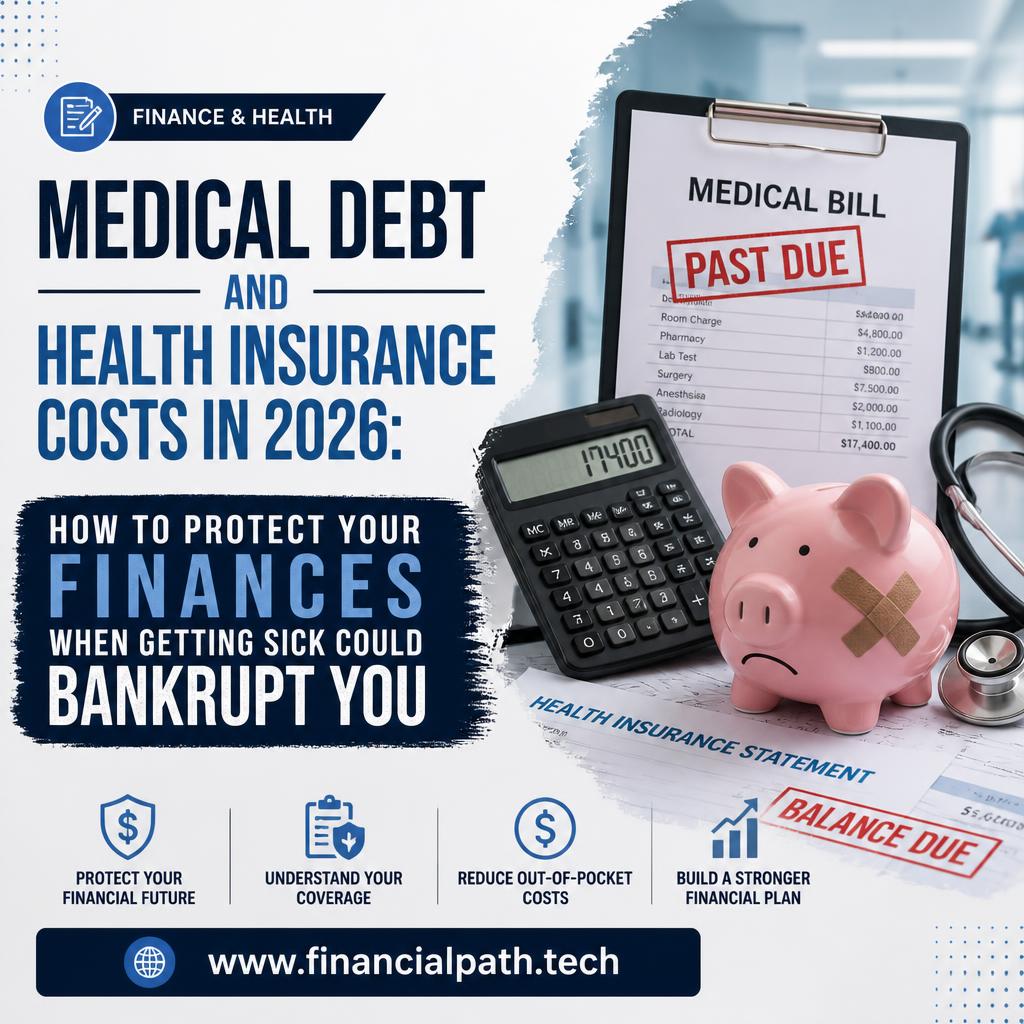
Here is a statistic that should stop you cold: approximately 100 million Americans currently carry some form of medical debt. Not people without insurance. Not people in poverty. People across every income level, every insurance category, every demographic — all carrying debt that arrived not from reckless spending but from getting sick.
The medical debt and health insurance costs crisis of 2026 is one of the most financially devastating yet underreported personal finance emergencies of this decade. Health insurance premiums rose 6–7% for employer-sponsored plans this year — more than double the current inflation rate. ACA Marketplace premiums jumped even more sharply following the expiration of enhanced federal subsidies. The average marketplace deductible for a silver plan in 2026 is $5,304 — meaning most Americans with insurance must pay over five thousand dollars out of pocket before their coverage contributes a single dollar toward a medical bill.
An estimated 60–65% of personal bankruptcies in the US are tied to unpaid medical bills. Two-thirds of Americans surveyed by KFF say they're worried about paying for healthcare — more than they worry about housing, food, or utilities. And about half of all US adults say they could not pay an unexpected medical bill of just $500 without going into debt.
This isn't a problem for other people. This is a financial emergency that can arrive in your life without warning, regardless of how carefully you've managed everything else. This article tells you exactly what's happening, what it could cost you, and how to protect yourself before the bill arrives.
Table of Contents
How Bad Are Medical Costs Actually in 2026?
Why Health Insurance Isn't Protecting People the Way They Think
The Medicaid and ACA Crisis — Millions Losing Coverage
What Medical Debt Actually Does to Your Financial Life
How to Choose Health Coverage Smartly in 2026
Strategies to Reduce Your Medical Bills — Before and After They Arrive
What Nigerian and Emerging Market Readers Need to Know
Step-by-Step: How to Build Your Medical Financial Protection Plan
Key Takeaways
1. How Bad Are Medical Costs Actually in 2026?
The numbers coming out of health policy research in 2026 are genuinely alarming — not because they represent a sudden crisis, but because they represent the culmination of a decades-long trend reaching a breaking point simultaneously with major policy changes that are making coverage less accessible for millions of people.
Healthcare spending in the US increased by 7.5% between 2022 and 2023, and then rose another 7.2% between 2023 and 2024, reaching over $15,000 per person annually. US healthcare spending per capita is roughly double what peer nations pay — and health outcomes in the US are measurably worse than those in most other developed countries.
What makes these numbers particularly troubling is who they're affecting. Financial burdens from medical costs occur across income levels and are most common among people who don't have health insurance — but they're also alarmingly prevalent among insured Americans. More than 19% of uninsured adults carry medical debt, but so do 9% of adults with commercial insurance and 8% of adult Medicare beneficiaries. Insurance isn't protecting people the way most assume it will.
2. Why Health Insurance Isn't Protecting People the Way They Think
When most people imagine "being covered," they picture insurance absorbing the bulk of any medical bill. That picture is increasingly disconnected from reality in 2026 — and the gap is specifically designed into plan structures that shift costs from insurers to patients.
The mechanism is the high-deductible health plan (HDHP). To keep monthly premiums at an affordable level, many employers and marketplace insurers have pushed enrollees toward plans with deductibles of $3,000, $5,000, or even higher. In 2026, the average silver plan deductible is $5,304 and the average bronze plan deductible is $7,186.
Here's what those numbers mean in practice: if you're hospitalized for a car accident, a fall, an appendectomy, or any emergency that generates a $30,000 hospital bill, your insurance starts paying only after you've personally covered the first $5,000–$7,000. For a family already living paycheck to paycheck — or even one with modest savings — that threshold alone can be financially catastrophic.
Researchers found that patients with private insurance were more at risk for financial consequences than those covered by Medicare or Medicaid in many emergency scenarios. And 18 months after being hospitalized for a traumatic injury, the share of patients with medical debt in collections rose 5.2 percentage points — a 24% relative increase — compared to before the emergency.
The situation is compounded by out-of-network billing. Many Americans who carefully choose in-network hospitals and doctors still receive bills from out-of-network providers — anaesthesiologists, radiologists, assistants — who happened to be present during their treatment without their knowledge or consent. The No Surprises Act of 2022 was meant to address this, but enforcement has been uneven and the practice continues in modified forms.
⚠️ Warning — The "I Have Insurance" False Security
Having a health insurance card does not mean you're financially protected against medical costs. Know your specific plan's deductible, out-of-pocket maximum, and coinsurance before any planned medical procedure. Call your insurance provider and ask: "If I have this procedure at this facility, what will I personally owe?" Get the answer in writing whenever possible. The gap between what people think they'll owe and what they actually owe is consistently one of the most financially damaging surprises in personal finance.
3. The Medicaid and ACA Crisis — Millions Losing Coverage
The policy landscape in 2026 is actively making the healthcare affordability crisis worse for millions of Americans simultaneously. Two changes deserve specific attention because their financial consequences are still unfolding.
The ACA Enhanced Subsidy Expiration
The enhanced Affordable Care Act premium tax credits — introduced during COVID-19 in 2021 and extended through 2025 — expired at the end of 2025. These subsidies had made marketplace health insurance genuinely affordable for millions of people who purchased coverage independently rather than through employers.
With the subsidies gone, the Urban Foundation projects that 7.3 million people lost their enhanced subsidies, and approximately 4.8 million people could become uninsured entirely. Monthly premium payments for those who remain enrolled could increase by an average of 114% — essentially more than doubling overnight for people who cannot access employer-sponsored coverage.
More than 1 million fewer people signed up for a Marketplace plan in 2026 compared to the prior year, though initial numbers may not show the full impact on coverage rates. Those who dropped coverage aren't disappearing from the healthcare system — they're disappearing from the insurance rolls, which means when they do need care, they'll receive it without any financial protection.
The Medicaid Cuts
As part of recent federal legislation, approximately $1 trillion in cuts to Medicaid were enacted, with the Congressional Budget Office projecting that millions will be pushed off the programme, alongside new work requirements for eligibility that critics warn will push additional people off the rolls due to administrative burden rather than actual ineligibility.
Medical debt has been increasing over a long time, and if ACA subsidies are not renewed it could increase faster next year as many people will drop health insurance coverage, according to Johns Hopkins health policy professor Gerard Anderson.
The financial consequence of losing Medicaid coverage and being unable to afford a marketplace alternative isn't that people stop getting sick. It's that they delay care until conditions worsen, receive emergency treatment without insurance, and emerge with medical bills they have no realistic path to paying.
4. What Medical Debt Actually Does to Your Financial Life
Medical debt is different from most other forms of consumer debt in ways that matter enormously for personal finance management — and understanding those differences changes how you should think about protecting yourself.
It Arrives Without Warning
You can plan for a mortgage. You can plan for a car payment. You can avoid taking on a personal loan. Medical debt arrives when your body decides to malfunction — when the accident happens, when the diagnosis comes, when the emergency occurs. It is fundamentally unplannable, which is what makes financial preparation so critical. The only effective response to unplannable debt is building protection before you need it.
It Cascades Into Other Areas of Financial Life
Medical debt doesn't stay contained. A KFF analysis found that people with unaffordable medical bills are more likely to delay or skip needed care to avoid more debt, cut back on basic household expenses, take money out of retirement or college savings, or increase credit card debt. People with medical debt are five times more likely to forgo mental health care than people without it.
The cascade effect is real and well-documented: one medical crisis can trigger delayed follow-up care (making the original condition worse), retirement account withdrawals (breaking compounding), increased credit card debt (adding high-interest obligations), and reduced spending on food and household necessities.
It Impacts Your Credit Score
Medical debt affects credit scores — and this has become more complex in 2026. The three major credit bureaus had previously agreed to remove medical debt under $500 from credit reports, and the CFPB had proposed rules to remove medical debt from credit reporting entirely. However, the Trump administration recently secured permission from a federal court to roll back regulations that would have removed medical debt from consumer credit reports. This means medical debt's negative credit impact remains in play for most borrowers.
It Affects Your Health
This is the feedback loop that makes medical debt particularly insidious: the debt from healthcare costs makes people less likely to seek healthcare going forward. About half of adults in households with annual incomes under $40,000 say they have not taken their prescribed medication as directed due to cost. When people skip medications or delay follow-up appointments because of financial pressure from previous medical bills, their health outcomes worsen — which can generate more medical costs, more debt, and more avoidance.
💡 Tip — Negotiate Medical Bills Before Paying
Approximately 80% of medical bills contain errors, according to various healthcare billing studies. Before paying any significant medical bill, request an itemized statement and compare every charge against your insurance's explanation of benefits (EOB). Dispute any discrepancies. Then, regardless of whether errors exist, ask the billing department: "Do you offer a financial hardship discount or payment plan?" Most hospitals — especially non-profits — have charity care programmes and financial assistance policies that are rarely volunteered but almost always available when asked. The standard list price on a hospital bill is frequently negotiable downward by 20–50% for self-paying patients.
5. How to Choose Health Coverage Smartly in 2026
Given the landscape described above, here's how to think about health coverage decisions in 2026 — whether you're choosing employer-sponsored plans during open enrollment, shopping the marketplace, or navigating coverage gaps.
Understand the True Cost Formula
The premium is only one part of what health insurance actually costs you. The formula that matters is:
Annual Premium + Expected Out-of-Pocket Costs = True Annual Cost
A plan with a lower premium but a $7,000 deductible may cost you significantly more in a bad health year than a plan with a higher premium but a $2,000 deductible and richer coverage. Most people choose based on monthly premium alone — which is often the financially suboptimal choice, particularly for anyone with chronic conditions or family health needs.
The out-of-pocket maximum is the number that matters most for financial protection planning. Once you hit your out-of-pocket maximum in any plan year, insurance covers 100% of remaining costs. Knowing your maximum exposure lets you plan your financial buffer precisely.
Health Savings Accounts (HSAs) — The Most Underused Protection Tool
If you're enrolled in a High Deductible Health Plan (which qualifies for HSA access), funding a Health Savings Account is one of the most powerful personal finance moves available. HSA contributions are tax-deductible going in, grow tax-free, and come out tax-free when used for qualified medical expenses. The 2026 HSA contribution limits are $4,400 for individuals and $8,750 for families.
An HSA functioning as a dedicated medical emergency fund — separate from your general emergency fund — means that when the unexpected bill arrives, you have earmarked, tax-advantaged funds available to cover it without disrupting your other financial goals. Our Insurance page covers the full strategy for using HSAs alongside other insurance tools to build comprehensive financial protection.
6. Strategies to Reduce Your Medical Bills — Before and After They Arrive
Financial protection from medical costs isn't only about insurance coverage. There are specific strategies that reduce your exposure before medical events and reduce your bills after they arrive.
Before Care
Verify network status every time. Before any planned procedure, call your insurance provider and confirm that every provider involved — the surgeon, the anaesthesiologist, the facility, the assistant surgeon — is in-network for your plan. One out-of-network provider in an otherwise in-network procedure can generate thousands in unexpected bills.
Request cost estimates in advance. Under price transparency rules, hospitals are required to publish their prices. Ask for a cost estimate for any planned procedure before agreeing to it. Compare costs between facilities — prices for identical procedures can vary by 300–400% between facilities in the same city.
Use in-network urgent care instead of emergency rooms. An emergency room visit for a non-life-threatening condition can cost $1,500–$3,000 or more. An urgent care visit for the same condition typically costs $100–$300. Know your nearest in-network urgent care options before you need them.
After Bills Arrive
Request itemised billing immediately. Never pay a lump sum bill before seeing the individual charges. Billing errors are extremely common, and catching them before payment is far easier than recovering money after.
Apply for financial assistance programmes. Non-profit hospitals are legally required to have charity care programmes. For-profit hospitals typically also offer financial assistance. Income eligibility thresholds are often surprisingly generous — many hospitals provide assistance to households earning up to 400% of the federal poverty level.
Negotiate the balance. After insurance has processed your claim and applied your coverage, the remaining patient balance is often negotiable. Offering to pay a reduced amount as full settlement — particularly if you can pay upfront in a lump sum — is frequently accepted by hospital billing departments that prefer certainty over a lengthy collection process.
Set up a payment plan if needed. Most medical providers offer payment plans, and many offer interest-free plans for reasonable payment periods. Never let a medical bill go to collections when a payment plan is available — the credit score damage from collections far exceeds any short-term convenience.
According to NerdWallet's medical debt guide, patients who proactively engage with hospital billing departments — requesting itemised statements, applying for assistance, and negotiating balances — consistently achieve better financial outcomes than those who either ignore bills or pay without question.
7. What Nigerian and Emerging Market Readers Need to Know
The specific policy details above — ACA, Medicaid, HSAs — are US-centric. But the underlying financial reality of healthcare costs creating devastating personal debt is a genuinely global phenomenon, and the principles of protection translate across every healthcare system.
In Nigeria, access to formal health insurance has expanded through the National Health Insurance Authority (NHIA) and private health management organisations (HMOs), but coverage remains limited and patchy for the majority of the population. Out-of-pocket healthcare spending as a share of total health expenditure in Nigeria remains among the highest in the world — meaning most Nigerians pay for healthcare directly from personal funds when they need it.
The financial consequences are severe and familiar: families liquidating savings, selling assets, taking high-interest loans, or simply not seeking care because the cost is prohibitive. The National Health Insurance Authority (NHIA) has expanded its mandate in recent years to include informal sector workers, but actual enrollment and utilisation remains low.
Practical protection strategies for Nigerian readers:
Building a dedicated health emergency fund — separate from your general emergency fund — is the most impactful single step available. Even ₦200,000–₦500,000 set aside specifically for medical costs changes the calculus of a health emergency entirely. It means you can seek care when needed rather than delaying until a condition worsens.
Investigating NHIA enrollment — whether through an employer scheme or voluntary enrollment — is worth doing even if the coverage is imperfect. Partial coverage is financially better than no coverage when a significant medical event occurs.
Private HMOs in Nigeria — including Hygeia, Leadway Health, and AXA Mansard — offer plans at varying price points. For families with the income to afford a private plan, comparing the annual premium against the financial risk of a single significant medical event typically demonstrates clear value.
Our Insurance page on FinancialPath covers the full landscape of insurance products — including health insurance — and how to build a comprehensive protection strategy regardless of where you live.
8. Step-by-Step: How to Build Your Medical Financial Protection Plan
The goal isn't to avoid ever getting sick. The goal is to build a financial structure that absorbs a medical event without destroying everything else you've been building.
Step 1: Know your current health insurance numbers exactly.
Pull out your insurance card and the Summary of Benefits and Coverage document from your current plan. Write down four numbers: your annual deductible, your out-of-pocket maximum, your coinsurance rate, and your monthly premium. These four numbers define your financial exposure. If you don't know them, you can't plan around them.
Step 2: Build a dedicated medical emergency fund.
Your general emergency fund (three to six months of living expenses) is not your medical emergency fund. Build a separate account specifically for medical costs equal to your annual out-of-pocket maximum. If your out-of-pocket maximum is $5,000, that's your medical fund target. This is the exact amount you'd need in a worst-case health year — keep it liquid and accessible.
Step 3: Fund your HSA to the annual limit if eligible.
If you're enrolled in an HSA-eligible High Deductible Health Plan, funding your HSA to the annual limit ($4,400 individual, $8,750 family in 2026) gives you tax-advantaged money earmarked for medical costs. Invest HSA funds you won't need immediately in index funds within the account — they grow tax-free for future medical use.
Step 4: Add income protection insurance.
A medical event doesn't just generate bills — it can also reduce or eliminate your income during recovery. Income protection insurance (disability insurance) replaces a portion of your income if illness or injury prevents you from working. This is particularly critical for self-employed workers and side hustlers whose income stops if they stop working. Use the Income Planner tool on FinancialPath to calculate how many months of income loss your current savings could absorb — the answer is often uncomfortably small.
Step 5: Identify your nearest in-network urgent care and quality hospitals before you need them.
In a health emergency, the last thing you want is to make coverage decisions under stress and time pressure. Know in advance: which urgent care facilities are in-network, which hospitals are in-network, and how to reach your insurance's 24-hour nurse line for guidance on whether a situation requires an emergency room visit or can wait for urgent care.
Step 6: Review your coverage during every open enrollment period.
Health needs change, plan offerings change, and premium structures change. Review your coverage every year during open enrollment — don't auto-renew without checking. A plan that was optimal last year may not be optimal this year if your health needs or financial situation have shifted.
Step 7: Establish a relationship with a primary care physician.
Preventive care — annual check-ups, early screenings, routine vaccinations — catches conditions early when they're cheaper and easier to treat. Most insurance plans cover preventive care at 100% with no cost-sharing. Using that coverage consistently is one of the most financially rational health decisions available to you.
Key Takeaways
100 million Americans carry some form of medical debt in 2026, and 60–65% of personal bankruptcies are tied to unpaid medical bills — this is a mainstream financial emergency, not an edge case
Health insurance premiums rose 6–7% for employer-sponsored plans in 2026 — more than double inflation — while ACA marketplace premiums jumped even more sharply following the expiration of enhanced federal subsidies
The average silver plan deductible in 2026 is $5,304 — most insured Americans must pay this amount out of pocket before their coverage contributes a dollar, meaning "having insurance" provides far less protection than most people assume
Medicaid cuts and ACA subsidy expiration are pushing millions of additional Americans toward inadequate coverage or no coverage — the medical debt crisis is still building, not peaking
Building a dedicated medical emergency fund equal to your annual out-of-pocket maximum — separate from your general emergency fund — is the single most impactful personal finance protection against healthcare costs
HSA contributions ($4,400 individual / $8,750 family in 2026) are triple tax-advantaged and represent the most powerful medical cost protection tool available to qualifying Americans
Always request itemised medical bills, apply for financial assistance programmes, and negotiate balances before paying — most hospital billing departments have significant flexibility that they don't volunteer
For Nigerian and emerging market readers, building a dedicated health emergency fund and investigating NHIA enrollment or private HMO coverage provides the equivalent protection in a system with far less insurance infrastructure
📚 Related Articles to Read Next on FinancialPath
How to Protect Your Money From Inflation in 2026 — Healthcare costs are rising faster than general inflation — this article covers the broad strategy for protecting your purchasing power across all rising costs simultaneously
How to Build an Emergency Fund From Scratch — The dedicated medical emergency fund described in this article is built using exactly the same principles — this guide shows you how to build it from zero
10 Proven Ways to Earn Extra Income Online From Anywhere in the World — Building additional income streams creates the financial buffer that makes healthcare cost shocks survivable — this article covers the most accessible and realistic options
The healthcare cost crisis of 2026 is one of those problems where the people who suffer most are overwhelmingly not those who made bad decisions — they're people who got sick, had accidents, or developed conditions they couldn't predict or prevent. The financial devastation that follows an unprotected health emergency is real, well-documented, and spreading to higher income levels every year.
The good news is that the protection strategies are clear, accessible, and genuinely effective when built before they're needed. A dedicated medical emergency fund, appropriate insurance coverage, an HSA if you qualify, and the knowledge of how to negotiate bills and access assistance programmes changes your financial vulnerability to healthcare costs fundamentally.
Use FinancialPath's Income Planner to see how a medical emergency fund fits alongside your other financial goals, explore the Insurance page for the complete framework of financial protection including health, life, and income protection coverage, and visit the Debt Paydown Calculator if medical debt is already part of your financial picture and you need a clear path to eliminating it.
Your health is your most important asset. Protecting the financial foundation that supports your health — and that survives a health crisis intact — is one of the most important things you can do for yourself and everyone who depends on you.
Written by the FinancialPath Team — Personal Finance Writers dedicated to making smart money decisions accessible to everyone, everywhere.
Published: Tuesday, July 7, 2026 | Sources: KFF Health Tracking Poll April 2026, Johns Hopkins Bloomberg School of Public Health, Peterson-KFF Health System Tracker, Bankrate, CBS News/Mercer Survey, CNBC/Health Affairs, Newsweek, Forbes
RESOURCES
GET IN TOUCH
info@financialpath.tech
Kaduna, Nigeria
Serving emerging markets worldwide
© 2026 FinancialPath-No-nonsense math for emerging market builders.
LOCALLY RELEVANT, GLOBALLY USEFUL