
Small Investing Moves That Compound Into Something Real — Personal Finance Tips 2026
You don't need a lot of money to start investing. Learn how small, consistent investment moves compound into significant wealth over time. Personal finance tips for 2026.
FINANCIAL ADVICE
- Written by Admin
7/2/20267 min read
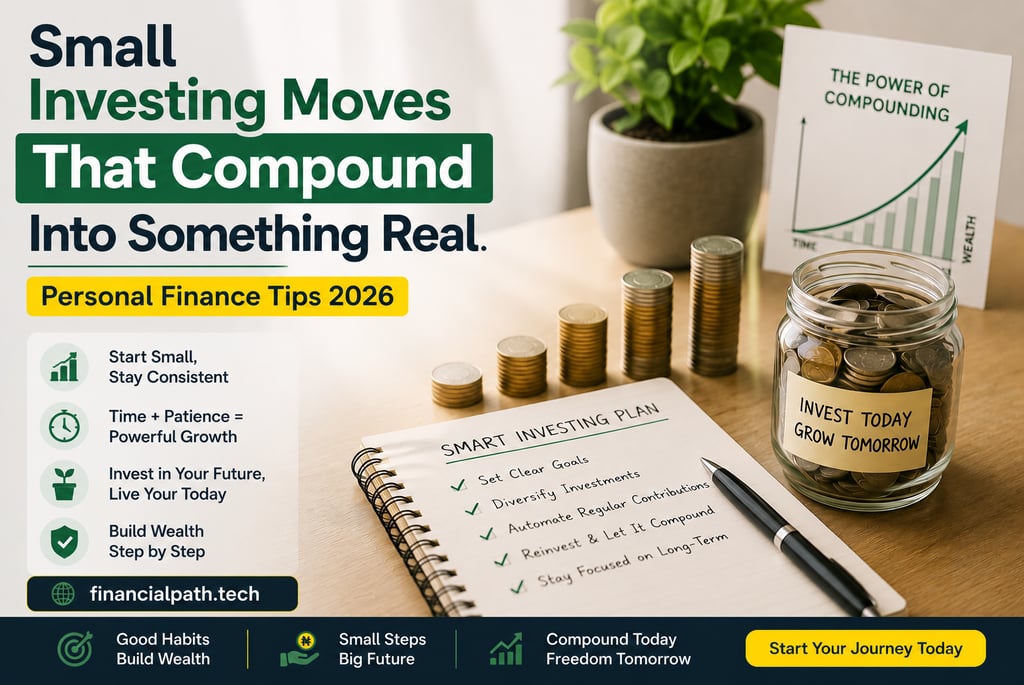
The single most common thing that keeps people from investing is the belief that they need more money before they can start. It shows up in countless variations: "I'll invest once I have £500 saved up." "I'll start when I'm earning more." "I don't have enough to make it worth it yet."
Every version of this belief costs the person holding it a significant amount of money — not in any dramatic, visible way, but quietly, compounding in reverse while the years pass.
The truth about investing is almost the opposite of what most people assume: the amount you invest matters far less than when you start and how consistently you continue. This article is about understanding why that is true, and what small, practical investing moves look like for real people at various starting points.
Why Time Matters More Than Amount
To understand why time is the dominant variable in investing, you need to understand compound growth — what Albert Einstein is often quoted as calling the eighth wonder of the world.
Compound growth means that your investment returns generate their own returns over time. In Year 1, you earn returns on your original investment. In Year 2, you earn returns on your original investment plus the returns from Year 1. By Year 10, you are earning returns on a much larger base that includes a decade of accumulated growth. The longer the time horizon, the more dramatic this effect becomes.
Here is a concrete example using realistic numbers:
Person A invests $100 per month starting at age 22, at a 7% average annual return (roughly the historical inflation-adjusted average of global stock markets). They continue until age 62 — 40 years of consistent investing.
Person B waits until age 32 — just 10 years later — and invests $200 per month, double the amount, at the same 7% return. They also continue until age 62 — 30 years of investing.
At age 62:
Person A: approximately $262,000
Person B: approximately $243,000
Person A invested less money per month for longer and ends up with more. Person B doubled the monthly contribution but started a decade later and ends up behind. The 10 years of compounding in Person A's early 20s — when the amounts were modest and the returns seemed small — turned out to be the most valuable decade of their entire investment life.
Vanguard's compound interest calculator allows you to run your own numbers if you want to see this effect personalised to your situation.
The First Investment Move: Build Your Floor First
Before putting money into any investment vehicle, there is one financial prerequisite that genuinely matters: a small emergency buffer.
The specific reason this comes first is not general caution — it is a practical investing concern. Markets fluctuate. There will be months and years where your investment portfolio decreases in value. If you have no emergency fund and an unexpected expense arrives during a market downturn, you may be forced to sell investments at a loss to cover the cost.
Selling during a downturn turns a temporary paper loss into a permanent real one, and it ends the compounding process for that money. An emergency fund prevents this scenario by ensuring you never need to access your investments before you intend to.
The size of this buffer does not need to be large before you begin investing. Even one month of essential expenses — enough to cover a car repair or a medical bill without touching investments — is a meaningful start. You can build the emergency fund toward its full three-to-six month target while also beginning to invest.
What to Actually Invest In: A Beginner's Framework
The investment world has a remarkable ability to present itself as more complicated than it needs to be. For most ordinary investors — people who are not professional fund managers and do not want to spend hours researching individual companies — the case for simplicity is overwhelming.
Index Funds and ETFs
An index fund is a type of investment fund that tracks a market index — such as the S&P 500 in the US, the FTSE 100 in the UK, or similar benchmarks globally. Rather than trying to pick winning individual stocks, an index fund simply owns all the stocks in the index in proportion to their size.
This approach has a track record that is difficult to argue with. Over 15-year periods, the majority of actively managed funds — run by professional analysts and portfolio managers with access to sophisticated research — fail to outperform their relevant index benchmarks after fees are accounted for. The evidence for this comes from S&P's SPIVA reports, which track fund performance against benchmarks over time.
For a beginner investor, low-cost index funds or ETFs covering a broad market index are often the most sensible starting point: diversified automatically, low maintenance, and historically effective.
What to Look for in an Investment Platform
Low fees (expense ratios below 0.5% are reasonable; below 0.2% is excellent)
Regulated by a recognised financial authority in your country
User interface you actually understand and can navigate
Ability to set up automatic monthly contributions
Accessibility with modest minimum investment amounts
In Nigeria, platforms like Bamboo, Risevest, and Chaka allow Nigerian investors to access global stocks and ETFs. In the UK, platforms like Vanguard Investor, Freetrade, and InvestEngine are commonly used. In the US, Fidelity and Charles Schwab have zero-minimum index funds available.
How to Set Up Your First Monthly Investment
The mechanics of starting are simpler than most people expect:
1. Choose a platform. Based on your country and the criteria above, select one regulated platform. You do not need to find the perfect platform — you need to find a good one and start.
2. Open and verify your account. This typically requires identity verification (passport, national ID, or similar) and takes one to five business days depending on the platform.
3. Connect a funding source. Link your bank account or set up a bank transfer method.
4. Choose your initial investment. For a first-time investor, a broad global index fund or a total market ETF is a reasonable choice. If the platform offers a "starter portfolio" that you can examine, looking at what it contains helps you understand what you own.
5. Set up automatic monthly contributions. This is the most important step. Decide on a monthly amount — even $20 or ₦5,000 — and set it to invest automatically. Automatic contributions remove the monthly decision and ensure investing happens regardless of how you feel about the market that month.
6. Set a review date — not a monitoring habit. Schedule a quarterly check-in to review your investment once per season. Between those check-ins, do not check your portfolio. Daily or weekly checking generates anxiety without generating useful information, and it increases the temptation to react emotionally to normal market fluctuations.
The Investing Behaviours That Destroy Returns
Understanding what to do with investments is important. Understanding what not to do is equally important, because the most common investing mistakes are behavioural rather than technical.
Selling during market downturns. When markets fall — and they will, periodically, throughout any long investing timeline — the temptation to sell and "stop the losses" is powerful. This is almost always the wrong move. Selling during a downturn converts a temporary decline into a permanent loss and exits the position before the eventual recovery. Markets have historically recovered from every previous downturn; investors who stayed invested captured that recovery, while those who sold did not.
Chasing past performance. The investment that performed best last year frequently underperforms the following year. Buying into a fund or asset because it recently produced spectacular returns is often a strategy for buying at a peak.
Over-complicating the portfolio. More investment products do not automatically mean better diversification or better returns. A simple two or three fund portfolio covering global equities and bonds is often more effective than a complex portfolio of dozens of specialised funds.
Stopping contributions during bad markets. The temptation to pause monthly contributions when markets are down is understandable but counterproductive. When markets are down, your regular monthly contribution buys more units at lower prices — which means you benefit more from the eventual recovery. This mechanism, called pound-cost averaging or dollar-cost averaging, is one of the genuine advantages of regular monthly investing.
Investing When You Also Have Debt
One of the most frequent practical questions in personal finance is whether to invest while still carrying debt, or pay off all debt first before investing.
The honest answer is that it depends on the interest rate of the debt:
High-interest debt (above 8–10%): Paying this off first is typically the better mathematical choice. Earning a 7% investment return while paying 24% credit card interest is a net loss. The guaranteed "return" of eliminating high-interest debt is often better than the expected return of investing.
Low-interest debt (below 6–7%): Here, a parallel approach can make sense. Making minimum-plus-a-little-extra payments while also investing allows you to begin building investment accounts while gradually reducing debt.
Zero or very low interest debt: Continue regular minimum payments and direct surplus funds to investing.
The critical thing is not getting so focused on this question that it becomes a reason not to start investing at all. A modest amount invested while paying down moderate debt is far better than waiting indefinitely for perfect conditions.
A Note on Investment Returns and Realistic Expectations
One final personal finance tip that investing content often skips: investment returns are not guaranteed, they are not linear, and the years you experience will not look like the historical average in any given period.
The historical inflation-adjusted average return of global stock markets is approximately 5–7% annually. But this average includes years of 30% gains and years of 40% losses. The average smooths out an underlying reality that is genuinely volatile year-to-year.
Setting realistic expectations means understanding that your investment portfolio will sometimes lose value — sometimes significantly — and that this is a normal and expected part of long-term investing, not a signal that something is wrong. The investors who build wealth over decades are the ones who maintain their contributions and their calm through the inevitable down periods.
Key Takeaways
Time in the market matters more than the amount you start with — begin as early as possible
Build a small emergency buffer before investing to avoid forced selling during downturns
Low-cost index funds and ETFs are the most sensible starting point for most new investors
Set up automatic monthly contributions — consistency is the mechanism that makes this work
Do not sell during downturns, chase past performance, or check your portfolio obsessively
For high-interest debt, pay it down first; for low-interest debt, a parallel approach can work
The compound interest principles in this article are brought to life in our Compound Interest Calculator — run your own numbers and see what your monthly investment could grow to over time.
If you are managing debt alongside your investing decisions, Getting Debt Under Control Without Losing Your Mind covers how to think about the balance between the two.
RESOURCES
GET IN TOUCH
info@financialpath.tech
Kaduna, Nigeria
Serving emerging markets worldwide
© 2026 FinancialPath-No-nonsense math for emerging market builders.
LOCALLY RELEVANT, GLOBALLY USEFUL