
Student Loan Default 2026: 3.6 Million Borrowers Are Falling Off the Cliff — Are You Next?
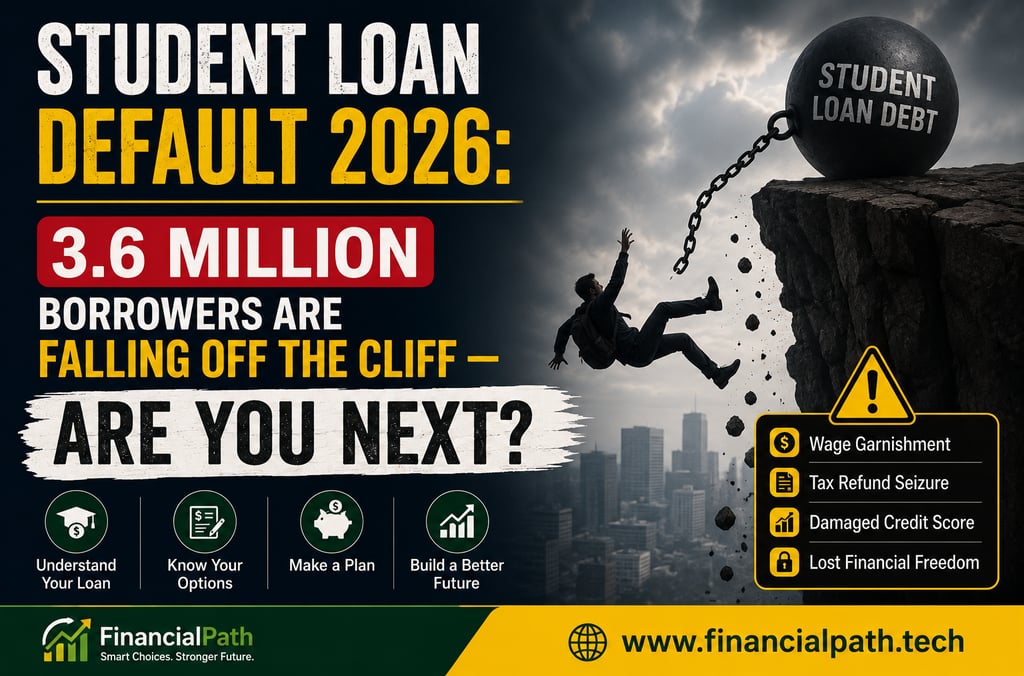
3.6 million borrowers defaulted on student loans in 2026. Here's what default really means, how to avoid it, and how to recover fast if it's already happened.
LOAN MANAGEMENTFINANCIAL ADVICE
- Financial Path Team
7/5/202610 min read
Nobody plans to default on a student loan. It doesn't happen because someone woke up one morning and decided to stop paying. It happens gradually — a missed payment here, a confusing notice ignored there, a repayment plan that quietly disappeared — until one day the consequences land all at once and everything from your credit score to your paycheck is suddenly at risk.
In Q1 2026 alone, approximately 2.6 million federal student loan borrowers fell into default, according to the Federal Reserve Bank of New York's latest Household Debt and Credit Report. Add that to the roughly 1 million who defaulted in late 2025, and you have a student loan default crisis that is affecting real people's financial lives at a scale the US hasn't seen in decades. For borrowers in Nigeria and other emerging markets navigating international student loans or local education debt, the mechanics are different — but the financial damage of default is just as devastating. Education DataLiberty Street Economics
This article is about understanding exactly what student loan default means, what's driving the 2026 crisis, and — most importantly — what you can do right now to either avoid it or recover from it.
Table of Contents
What Student Loan Default Actually Means (And When It Happens)
Why 2026 Became the Year of Mass Defaults
The Real Consequences of Default — It's Worse Than You Think
How to Avoid Default Before It Happens
If You're Already in Default — Your Recovery Options
What This Means for Borrowers Outside the US
Protecting Your Broader Financial Life During the Crisis
Key Takeaways
1. What Student Loan Default Actually Means (And When It Happens)
Student loan default is not the same as being behind on payments. There is an important distinction, and understanding it can save you from making decisions based on the wrong timeline.
Delinquency begins the day after you miss a payment. You are technically delinquent from Day 1 of non-payment. This is serious — credit scores for newly defaulted borrowers dropped an average of 91 points — but it is recoverable, and it does not yet trigger the full arsenal of consequences. Facebook
Default on federal student loans happens after 270 consecutive days of missed payments — roughly nine months. At that point, the loan is declared in default and the full weight of federal collection powers becomes available to your lender and the government.
For private student loans, the timeline is shorter and varies by lender — some declare default after just 90 to 120 days. If you have private student loans, check your loan agreement for your specific default trigger.
💡 Tip — Know Your Loan Type
Federal and private student loans have completely different rules, timelines, and recovery options. Knowing which type you carry — or if you carry both — is the essential starting point for navigating any repayment difficulty. Log in to studentaid.gov to see your federal loan details, and check your original loan paperwork for any private loans.
2. Why 2026 Became the Year of Mass Defaults
To understand why millions of people are defaulting right now, you need a short history lesson — because this crisis did not come out of nowhere.
When COVID-19 hit in March 2020, the US federal government paused all federal student loan payments and set interest rates to 0% as an emergency measure. This pause lasted over three years — far longer than most people expected when it started. Tens of millions of borrowers simply stopped thinking about their student loans. For many, the loans mentally became a distant problem.
When payments resumed in late 2023, the transition was rocky. Loan servicers were overwhelmed. Borrowers had changed contact information. Repayment plan options were confusing. The government introduced an "on-ramp" period that temporarily shielded borrowers from the worst credit consequences of missed payments — but that protection ended.
Then came the SAVE plan collapse. A court ruling ended the SAVE student loan repayment plan, and borrowers who signed up for SAVE have been navigating how to transition to another income-based plan while simultaneously being expected to make payments. For millions of people who had enrolled in SAVE specifically because it promised the most affordable payments, this left them scrambling. U.S. News & World Report
The result: over 17% of student loan borrowers have fallen at least 90 days past due on their payments at least once since repayments resumed, and just over 10% of student loan balances are now past due. Yahoo Finance
The New York Fed researchers noted that "a second wave of defaults might emerge" as millions of borrowers who enrolled in the now-defunct SAVE plan are forced to begin repayment. In other words, this is not the peak of the crisis. It may be the beginning. Education Data
TimelineWhat HappenedMarch 2020Federal student loan payments paused, interest set to 0%2020–2023Pause extended repeatedly — borrowers stopped engaging with loansLate 2023Payments resume — servicer chaos, confusion widespread2024On-ramp protections briefly shield worst credit impacts2025 Q4First wave — approximately 1 million defaults recorded2026 Q1Second wave — 2.6 million additional defaults recorded2026 (projected)Third wave possible as SAVE plan borrowers enter repayment
3. The Real Consequences of Default — It's Worse Than You Think
People often underestimate how far-reaching student loan default consequences are. It is not just a credit score hit. The effects spread across almost every area of financial life.
Your Credit Score Takes a Severe Hit
Credit scores for newly defaulted borrowers dropped an average of 91 points. A 91-point drop is not a minor blemish — it can move someone from "good credit" to "poor credit" territory overnight. That affects your ability to rent an apartment, qualify for a car loan, access a mortgage, and in some cases pass employment background checks. Facebook
Wage Garnishment Is Coming Back
Wage garnishment for defaulted student loans will restart in 2026. This means the federal government can legally instruct your employer to withhold a portion of your paycheck before it ever reaches you — without needing to take you to court first. The government can garnish up to 15% of your disposable income. That is not a small amount for most people. Yahoo Finance
Tax Refunds and Federal Benefits Can Be Seized
The federal government has extraordinary collection powers on student loans — it can seize borrowers' tax refunds, paychecks, and Social Security retirement and disability benefits. For many lower-income borrowers who rely on tax refunds as a significant annual lump sum, losing that refund to loan collection is genuinely devastating. Education Data
Your Entire Loan Balance Becomes Immediately Due
When a loan defaults, the standard repayment terms end. The full remaining balance — principal, accrued interest, and collection fees — typically becomes due immediately. This is called acceleration, and it effectively eliminates any negotiated payment plan you may have been working toward.
⚠️ Warning — Collections Are Paused But Not Cancelled
The U.S. Department of Education has delayed collections to "enable the Department to implement major student loan repayment reforms," but calls the delay temporary — meaning wage garnishment should still be a concern for any defaulted borrowers. Do not treat the current pause as permanent protection. Use this window to act. Yahoo Finance
4. How to Avoid Default Before It Happens
If you are behind on payments but have not yet reached the 270-day default threshold, you are in a critical window. The options available to you right now are significantly better than what's available after default. Here is what to do:
Step 1: Find out exactly where you stand.
Log in to studentaid.gov for federal loans or contact your private servicer directly. You need to know: your current balance, whether you are delinquent, how many days past due you are, and who your current servicer is. Many borrowers are surprised to discover their servicer changed during the pandemic pause.
Step 2: Apply for income-driven repayment (IDR).
If your monthly payment is unaffordable, income-driven repayment plans cap your payment at a percentage of your discretionary income. With the SAVE plan now defunct, the remaining options include IBR (Income-Based Repayment), PAYE (Pay As You Earn), and ICR (Income-Contingent Repayment). NerdWallet's income-driven repayment guide has a solid breakdown of each option.
Step 3: Apply for deferment or forbearance if you need breathing room.
If you are temporarily unable to make any payment at all, deferment and forbearance pause your required payments. Interest behaviour during these periods varies by loan type and plan, but either option keeps you out of default while you stabilise your situation.
Step 4: Call your servicer and explain your situation.
This feels uncomfortable, but it is one of the most effective steps available. Servicers have hardship options that are not always advertised. Simply calling and saying "I'm struggling to make payments and I'm trying to avoid default — what options do I have?" opens conversations that a missed payment notification never will.
Step 5: Set up autopay.
Even if you switch to a lower income-driven payment plan, enrol in autopay immediately. Most servicers offer a 0.25% interest rate reduction for autopay, and it eliminates the risk of forgetting a payment during a busy or stressful period.
Step 6: Monitor your loan status monthly.
Student loan servicing has been notoriously error-prone during the post-pandemic period. Check your account monthly to ensure payments are being applied correctly and your balance is moving in the right direction.
5. If You're Already in Default — Your Recovery Options
Defaulting is not the end of the road. It feels like it might be — especially when collection notices start arriving — but there are formal recovery paths that can restore your standing and, in some cases, remove the default from your credit report entirely.
Option 1: Loan Rehabilitation
If you choose loan rehabilitation and complete the programme, the record of default will be removed from your credit report. This is significant — unlike most negative credit events that stay on your report for seven years, successful rehabilitation actually erases the default record. Yahoo Finance
Rehabilitation requires making nine voluntary, reasonable, and affordable monthly payments within ten consecutive months. The payment amount is negotiated with your servicer based on your income. Once you complete the nine payments, your loan is transferred out of default and back to regular repayment status.
Option 2: Loan Consolidation
Consolidating your defaulted loans into a Direct Consolidation Loan can bring them out of default status. The process is faster than rehabilitation — typically completed within a few months — but with consolidation, the record of default remains on your credit history, unlike rehabilitation which removes it. Yahoo Finance
Consolidation also comes with an important 2026 warning: be cautious consolidating your loan after July 1, 2026, as new laws mean your repayment options may be significantly limited when you consolidate after that date. Liberty Street Economics
Option 3: Repayment in Full
If you have access to funds — through a family gift, a business windfall, or other means — paying the defaulted loan in full immediately resolves the default. This is the least common option because most people in default are in that position precisely because they don't have available funds, but it's worth naming for completeness.
💡 Tip — Act Before Collections Resume
The current pause on federal student loan collections is a window, not a solution. Every week you spend in default without taking action is a week closer to wage garnishment restarting. Rehabilitation and consolidation both take time to process — start the conversation with your servicer now, while collections are still paused, to give yourself the best possible outcome.
6. What This Means for Borrowers Outside the US
If you are reading this from Nigeria, Ghana, Kenya, or elsewhere in Africa or the developing world, the specific mechanics of US federal student loan default may not apply to you directly — but the broader lessons absolutely do.
Many Nigerian and African students who studied internationally — in the US, UK, or Canada — carry international student loan debt that follows them home. Private international student loans have their own default timelines and consequences, and the distance between you and your lender does not protect you from those consequences. International credit damage, collection agency involvement, and restrictions on future study abroad or visa applications are all real possibilities.
For students navigating local education loans — through banks, state schemes, or programmes like Nigeria's NELFUND — the core principle is identical: communicate early, know your repayment options, and never let a missed payment become a months-long silence.
The average federal student loan debt balance is $39,633 in Q1 2026, representing a significant financial burden that affects life decisions including homeownership, entrepreneurship, and career choices. 71% of college students report delaying one or more major life events due to student loan debt — and that dynamic is not uniquely American. Education debt shapes financial trajectories globally, and managing it actively rather than passively is one of the most important personal finance decisions a graduate can make. CNBCCNBC
7. Protecting Your Broader Financial Life During the Crisis
Whether you are in default, approaching it, or simply watching the news and feeling anxious about your own student loans, there are practical steps to protect your broader financial health during this period.
Keep your emergency fund intact. If student loan payments are resuming or increasing, now is not the time to let your emergency fund slide. Loan repayment difficulties and unexpected expenses tend to arrive together. Our Debt Paydown Calculator at FinancialPath can help you model repayment scenarios so you can see exactly how different payment levels affect your timeline.
Be strategic about which debts to prioritise. Federal student loans in default have extraordinary government collection powers — wage garnishment, tax seizure — that most private debts don't have. This makes them uniquely high-priority. If you are juggling multiple debts, getting student loans out of default often deserves prioritisation over other debt types with less aggressive collection mechanisms.
Build income capacity aggressively. The most direct solution to unaffordable student loan payments is earning more. Our Side Income page covers the most effective ways to build dollar-earning income streams remotely — skills that pay in USD or EUR are particularly powerful for borrowers who need to increase their repayment capacity quickly.
Understand the impact on your net worth. Student loan default doesn't just affect your credit score and payment obligations — it affects your entire financial position. Use the Income Planner tool on FinancialPath to get a clear picture of all your income sources, obligations, and the gap between them. Clarity is the foundation of every recovery plan.
Track your credit score and dispute errors. During a period of mass defaults and servicer transfers, credit reporting errors are common. Check your credit report — in the US, AnnualCreditReport.com provides free reports from all three bureaus — and dispute any inaccurate default entries immediately. Errors happen, and the burden of correcting them falls on you.
Key Takeaways
3.6 million federal student loan borrowers defaulted between Q4 2025 and Q1 2026, with a third wave possible as SAVE plan borrowers enter repayment — this crisis is not over Yahoo FinanceEducation Data
Federal student loan default happens after 270 days of missed payments; private loan default can happen much sooner — know your timeline
Wage garnishment for defaulted student loans is restarting in 2026 — the current collections pause is temporary, not permanent protection Yahoo Finance
If you are delinquent but not yet in default, income-driven repayment, deferment, and forbearance are all available options — call your servicer now
Loan rehabilitation removes the default from your credit report entirely — it's the best recovery option for most borrowers who can manage nine consecutive payments Yahoo Finance
Be cautious about consolidating after July 1, 2026 — new laws limit your repayment options post-consolidation
For borrowers outside the US, the lesson is universal: communicate early with lenders, know your repayment options, and never let missed payments become months of silence
📚 Related Articles to Read Next on FinancialPath
Getting Debt Under Control Without Losing Your Mind — The full framework for managing and eliminating debt of every kind, including the Avalanche and Snowball methods explained clearly
10 Proven Ways to Earn Extra Income Online From Anywhere in the World — Because increasing your income is the most direct path to making student loan payments manageable
How to Build an Emergency Fund From Scratch — Protecting your financial stability while navigating debt repayment requires a safety net — this guide shows you how to build one
The student loan default crisis of 2026 is real, it's large, and it's affecting real people's financial lives in ways that will take years to fully play out. But it is not hopeless — and if you are reading this, you are already doing the most important thing: paying attention and educating yourself.
At FinancialPath, we are here to help you navigate every part of your financial journey — from the difficult moments like debt and default recovery, to the exciting ones like building income and growing wealth. Explore our Debt Paydown Calculator, Income Planner, and Side Income page — they're built for exactly the situations real people face, not the ideal scenarios that only exist in textbooks.
You've got this. And we've got you.
RESOURCES
GET IN TOUCH
info@financialpath.tech
Kaduna, Nigeria
Serving emerging markets worldwide
© 2026 FinancialPath-No-nonsense math for emerging market builders.
LOCALLY RELEVANT, GLOBALLY USEFUL