
Tariffs and Your Household Budget in 2026: The Price Hikes Aren't Over — Here's How to Protect Yourself
The New York Fed warned this morning that tariff price hikes aren't done yet. Here's exactly what it means for your household budget and how to protect yourself.
FINANCIAL ADVICE
- Financial Path Team
7/10/202614 min read
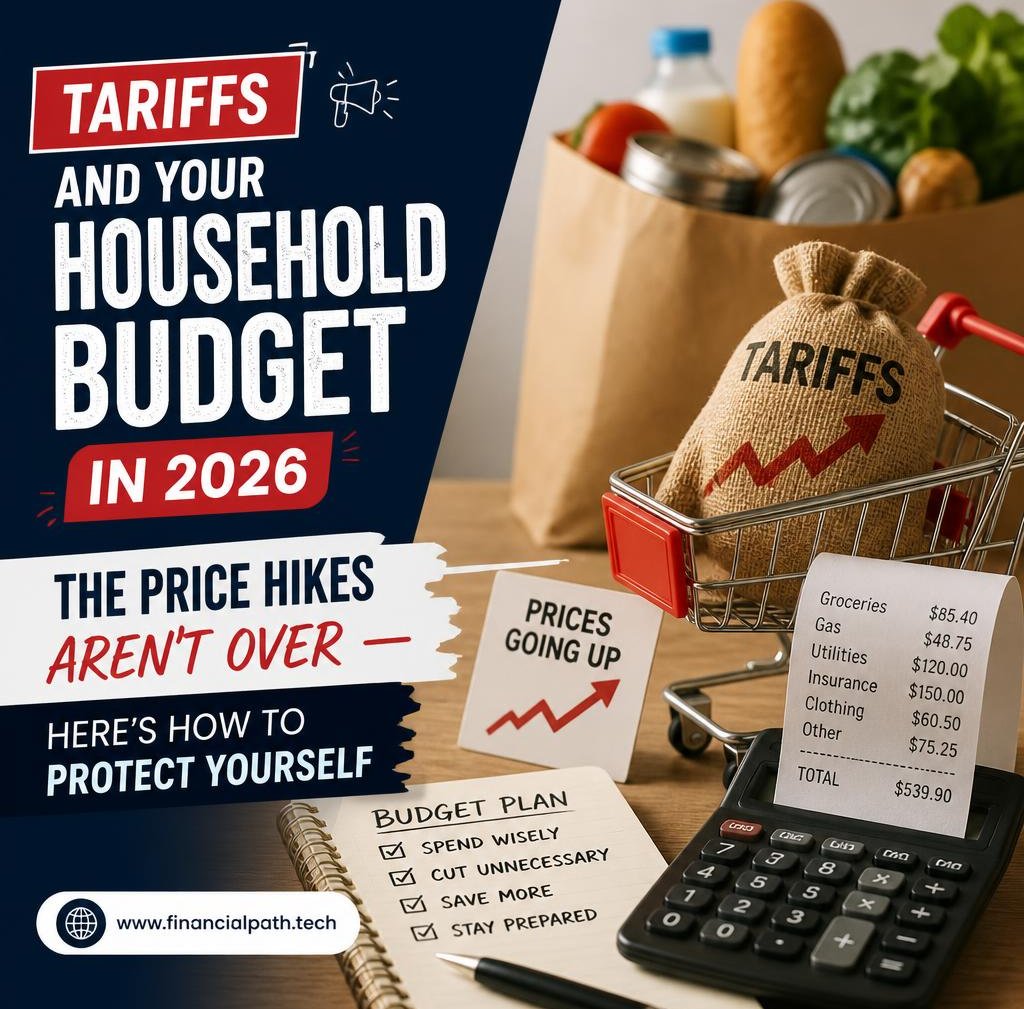
You've probably noticed something at the grocery store, the electronics shop, and the petrol station over the past year — prices are higher, and they've stayed higher. You might have assumed the worst was behind you. This morning, the Federal Reserve Bank of New York published research suggesting otherwise: tariff-driven price increases "may well last for some time to come," the report warned, as businesses that absorbed tariff costs for over a year are now passing them on to consumers in waves rather than all at once.
The impact of tariffs on household budgets in 2026 is one of the most directly personal economic stories of this year — and it's not abstract policy debate. The Tax Foundation estimates that the current tariff regime amounts to an average tax increase of $1,500 per US household in 2026. Yale University's Budget Lab puts the figure at $700–$940 per household if the Section 122 tariffs expire as scheduled this month, rising to $1,200–$1,500 if they're extended. Meanwhile, 95% of Americans surveyed in a recent Harris Poll say they believe the country is in an affordability crisis driven by rising costs of groceries, gas, and other essentials.
The Section 122 tariffs — a 10% levy on nearly all US trading partners, covering approximately $1.2 trillion in annual imports — are scheduled to expire after 150 days, putting their deadline squarely in July 2026. Whether they expire, get extended, or get replaced determines a significant portion of what you'll pay for everyday goods for the rest of the year. And that decision is being made right now.
This article tells you exactly what's happening, what it's costing you specifically, and — most importantly — what you can do about it.
Table of Contents
What the New York Fed Warning This Morning Actually Means
The Real Tariff Bill — What American Households Are Actually Paying
Which Products Are Getting Most Expensive and Why
The Section 122 July Deadline — What Happens Next
How to Tariff-Proof Your Household Budget
What This Means for Emerging Market Economies
Step-by-Step: Your Tariff Survival Budget Plan
The Bigger Picture — Tariffs, Inflation, and the Fed
Key Takeaways
1. What the New York Fed Warning This Morning Actually Means
The Federal Reserve Bank of New York publishes regular business surveys that ask companies directly about their pricing behaviour and intentions. This morning's report is significant because it doesn't just measure what prices have done — it asks what businesses plan to do with prices over the next six months.
According to the New York Fed's latest business surveys, 40% of service sector firms and 70% of manufacturers reported paying tariffs directly over the past year. More than half of both groups said they had either already passed these costs on to consumers, or did not expect any further pass-through from the duties. However, this indicates that 47% of service firms and 44% of manufacturing firms have more tariff-related price increases planned either within or beyond the next six months.
Read that again slowly. Nearly half of service firms and manufacturing companies haven't finished raising prices from tariffs that were introduced over a year ago. They've been absorbing costs, drawing down pre-tariff inventory, and waiting for contracts to reset. As those buffers run out, the price increases arrive at your checkout.
The economists noted that firms may have sought to avoid "shocking" customers with significant and immediate price increases, or held off on any price increases while waiting to see how the tariff landscape evolved. That strategy is ending. The pipeline of delayed price increases is clearing, and July 2026 is when many of those increases arrive.
The practical meaning for your household: the prices you're paying today may not reflect the full tariff cost yet. More increases are coming from businesses that haven't finished adjusting. Budget accordingly.
2. The Real Tariff Bill — What American Households Are Actually Paying
Setting aside political rhetoric, the data shows American consumers are experiencing sticker shock on standard goods such as electronics, auto parts and even their morning coffee due to the compounding impact of sweeping 2025/2026 tariffs.
The most important thing to understand about how tariffs work is the pass-through mechanism — because this is what determines when and how much of the tariff cost lands in your wallet.
According to recent research from the Kiel Institute for the World Economy, US importers and consumers bear 96% of the tariff burden, while foreign exporters absorb only 4%. Tariffs are not, in any meaningful economic sense, a tax on foreign countries. They are a tax on American importers that gets passed through to American consumers. The political framing and the economic reality are almost perfectly inverted.
Goldman Sachs pegs the consumer share at 55% now, potentially climbing to 70% in 2026 as inventories deplete and contracts renegotiate. This is the pipeline dynamic mentioned above: businesses have been absorbing roughly half the tariff cost so far. As their ability to absorb that cost runs out, their share falls and your share rises.
The cumulative effect is substantial. The Trump tariffs are the largest US tax increase as a percent of GDP since 1993 and amount to an average tax increase per US household of $1,500 in 2026. For a household earning $70,000 per year — roughly the US median — $1,500 represents about 2.1% of gross income. That's money that was previously going to savings, debt payments, retirement contributions, or simply everyday living that's now flowing to the federal government through higher prices on imported goods.
3. Which Products Are Getting Most Expensive and Why
Not all tariff impacts are equal. Some product categories face much steeper price increases than others, and knowing which ones helps you prioritise where to focus your budget adaptation.
According to the most recent data from The Budget Lab at Yale University, very few products haven't been affected by tariffs. Even items made in the US aren't completely immune — many companies are facing increased production costs because they import materials like fabric, batteries and microchips from foreign countries.
The pharmaceutical tariff deserves special attention because of its potential health and financial impact. Generics would be exempt from the 100% pharmaceutical tariff — which means switching from brand-name to generic medications where clinically appropriate can shield you from this specific tariff's impact entirely. Ask your doctor at your next appointment whether any of your current brand-name prescriptions have generic equivalents.
💡 Tip — The "Made in USA" Tariff Myth
Many people assume that buying American-made products fully protects them from tariff impacts. Even items made in the US aren't completely immune — many companies face increased production costs because they import materials like fabric, batteries and microchips from foreign countries. A US-assembled product might contain Chinese semiconductors, Canadian aluminum, and Mexican components — all subject to various tariffs that raise its production cost. Buy domestic where you can, but don't assume it makes you fully tariff-proof.
4. The Section 122 July Deadline — What Happens Next
Right now — this week — one of the most consequential tariff decisions of 2026 is playing out. The Section 122 tariff, which applied a 10% levy on nearly all US trading partners covering $1.2 trillion in annual imports, was implemented after the Supreme Court struck down IEEPA tariffs in February 2026.
The Section 122 tariff is scheduled to expire after 150 days. That expiration falls in mid-July 2026 — this month. Whether it expires, gets extended, or gets replaced with new Section 301 tariffs currently under investigation determines a significant portion of the price environment for the rest of 2026.
If Section 122 tariffs expire as scheduled, the ultimate price level impact will be between 0.5% and 0.7%, representing a loss of between about $760 and $940 for the average household. If they are instead made permanent, the price impact would be between 0.9% and 1.1% and the household loss figures would be between $1,200 and $1,500.
The difference between these two scenarios — expiration versus extension — is approximately $500 per household annually. Not dramatic at the individual level, but multiplied across 130 million US households, it's a $65 billion annual difference in consumer purchasing power.
The average tariff rate is currently 10 to 13%, depending on what category of goods you're looking at, which is the highest they've been since the 1940s. Even after certain tariffs expire in mid-July, so long as Congress does not extend them, the average rate would drop to 6 to 9% — but that's still high.
The practical budgeting implication: even in the best-case scenario where Section 122 expires on schedule, tariffs remain at historically elevated levels. The relief is relative, not absolute. Planning your household budget around continued elevated import costs for the remainder of 2026 is the prudent approach — treat any tariff reduction as a bonus rather than a baseline.
⚠️ Warning — Don't Make Major Purchases Based on Tariff Assumptions
Some financial commentators are advising consumers to rush major purchases before tariffs potentially increase again, while others suggest waiting for potential price relief if Section 122 expires. Both strategies carry risk. Buying something you don't need now to "beat" a potential price increase often costs more than any tariff saving. And waiting for price relief that may not come has its own cost. Make purchasing decisions based on genuine need and your budget capacity — not on tariff speculation.
5. How to Tariff-Proof Your Household Budget
You cannot control trade policy. You can control how you respond to its effects on your personal finances. Here's a practical framework for protecting your household budget in the current tariff environment.
Audit Your Tariff-Sensitive Spending
The first step is understanding which categories of your current spending are most exposed to tariff-driven price increases. Look at your last three months of spending and identify what percentage goes to:
Electronics and technology purchases
Clothing and footwear
Automobile costs (parts, service, potential new purchase)
Medications (brand-name vs. generic)
Imported foods and specialty grocery items
Appliances and household goods
These are your highest tariff-exposure categories. They're also the categories where deliberate purchasing decisions — timing, alternatives, and reduction — give you the most budget control.
Time Major Purchases Strategically
For large discretionary purchases in high-tariff categories, timing matters:
Electronics: If you need a new laptop or phone, consider whether your current device can be maintained for another 6–12 months. Repair costs are often far lower than replacement costs, even accounting for service charges.
Vehicles: The 25% auto tariff has pushed new vehicle prices significantly higher. Used vehicles remain an alternative — though used car prices have also risen in response to lower new vehicle supply. If you must replace a vehicle, domestic-assembled models with higher US parts content face lower tariff exposure than imported vehicles.
Appliances: Repair before replacing wherever possible. The cost of repairing a washing machine or refrigerator is typically 30–50% of replacement cost, and the tariff impact on new appliances has made that differential even larger.
Switch to Generics on Medications
The 100% tariff on patented pharmaceuticals is one of the most significant household cost increases for families with ongoing medication needs. Generic equivalents are explicitly exempt from this tariff. Ask your doctor at your next appointment about switching any brand-name prescriptions to generics. This single step can save hundreds or thousands of dollars annually depending on your medication profile.
Shift Food Shopping Toward Domestic Producers
Not all food tariff impacts are avoidable, but deliberately choosing domestic-produced alternatives where available reduces your exposure. Farmers markets, local produce, and US-sourced proteins face lower direct tariff impacts than imported equivalents. This doesn't mean completely changing how you eat — it means making intentional choices at the margins that add up over time.
Accelerate Your Emergency Fund
The tariff environment adds a specific dimension to emergency fund importance: price shocks can be sudden and concentrated. If a major appliance fails and replacements cost 20–30% more than expected, or if medication costs spike, having an accessible emergency fund means absorbing that shock without going into high-interest debt.
Use the emergency fund framework from our Inflation Hedge page — a dedicated savings account holding three to six months of essential expenses — as your financial shock absorber for tariff-driven price spikes.
6. What This Means for Emerging Market Economies
The US tariff story is driving ripple effects through the global economy that matter directly to FinancialPath's Nigerian and African readers, even though those readers don't pay US tariffs directly.
Trade flow disruption. When the US imposes high tariffs on Chinese goods, Chinese manufacturers seek alternative export markets — including African ones. This can increase the supply of competitively priced Chinese goods in African markets, which sounds beneficial but also competes with domestic manufacturers and can disrupt local supply chains.
Dollar strengthening. Trade tensions and tariff uncertainty have historically supported dollar strength as investors seek safety. A stronger dollar makes imports more expensive for emerging markets whose currencies have weakened — directly contributing to the imported inflation that Nigerian readers are already experiencing. Beijing has allowed the yuan to appreciate this year, and its roughly 2.8% year-to-date gain puts it near the top of emerging market currencies — a reflection of the complex currency dynamics trade tensions create globally.
Oil price volatility. The Iran war and resulting blockages in the Strait of Hormuz, a waterway between the Persian Gulf and the Gulf of Oman that's critical to oil transportation, is causing significant global supply chain disruptions. For Nigeria — an oil-producing country whose government revenues depend heavily on petroleum exports and whose consumers are severely affected by domestic fuel prices — oil price volatility from geopolitical trade tensions is both a revenue opportunity and a cost pressure simultaneously.
The agricultural wildcard. There is a threat that may be less obvious than a Middle East war: the potential for a powerful El Niño. The weather pattern is shaping up to disrupt agricultural output, and historically that has meant higher grain, beans, livestock, poultry, and palm oil prices. Markets spent the first half of the year fixated on energy-driven inflation. July may be when food starts pulling its own weight in the inflation conversation. For Nigerian readers, food represents a larger share of the household budget than for American readers — making this agricultural inflation dimension particularly important to watch.
The practical response for Nigerian and emerging market readers follows the same logic as for US readers: strengthen your emergency fund, reduce exposure to discretionary tariff-sensitive categories, and — given the currency dimension — prioritise building dollar-denominated savings that protect against both local inflation and currency depreciation. Our Inflation Hedge page covers this strategy in depth.
7. Step-by-Step: Your Tariff Survival Budget Plan
Here is the exact process for protecting your household budget from tariff-driven price increases through the rest of 2026:
Step 1: Calculate your current monthly spending in tariff-sensitive categories.
Look at your last three bank or credit card statements. Add up everything spent on electronics, clothing, medications, vehicles/auto parts, appliances, and imported food items. This is your tariff exposure total — the amount of your monthly budget most directly at risk from further price increases.
Step 2: Identify your highest-priority category to reduce.
Pick the single largest tariff-sensitive spending category from Step 1. Focus there first. Don't try to optimise everything simultaneously — pick one category and make deliberate choices for 30 days.
Step 3: Build a "price shock buffer" in your emergency fund.
Separate from your general emergency fund, identify how much a single major appliance replacement, a 30-day medication cost spike, or an unexpected vehicle repair would cost at current tariff-elevated prices. Ensure that amount is accessible in your emergency fund before investing further.
Step 4: Switch to domestic or tariff-exempt alternatives where practical.
For medications: request generic alternatives at your next prescription renewal. For groceries: identify three to five staple items where domestic alternatives are available and make the switch. For electronics: evaluate repair versus replacement for any device showing issues.
Step 5: Delay non-urgent high-tariff purchases.
If you were planning a discretionary technology upgrade, appliance replacement, or vehicle purchase within the next six months, evaluate whether the purchase can wait 12 months without genuine hardship. Section 122 tariff expiration in July could bring modest price relief on some categories — if the tariff expires, waiting costs you nothing. If it doesn't expire, you haven't lost anything by evaluating the decision carefully.
Step 6: Redirect tariff-savings to accelerate debt paydown.
If you successfully reduce spending in tariff-sensitive categories, redirect the saved amount immediately toward high-interest debt. Credit card APRs near 21% mean every dollar not spent on inflated goods and instead applied to card debt produces a 21% guaranteed return. Use our Debt Paydown Calculator to model exactly how much faster your debt clears with redirected savings.
Step 7: Review your budget monthly through December 2026.
The tariff environment is changing on a monthly basis — Section 122 expiration, new Section 301 investigations, pharmaceutical tariff implementation in September. Review your tariff-exposed spending categories monthly and adjust as the policy landscape evolves. A budget that doesn't update doesn't protect you.
Step 8: Build dollar-denominated savings if you're in an emerging market.
For Nigerian and African readers, the compounding effect of US tariffs on global supply chains, dollar strength, and oil prices makes building dollar-denominated savings even more urgent. Platforms like Grey, Wise, and domiciliary accounts provide accessible ways to build this protection.
8. The Bigger Picture — Tariffs, Inflation, and the Fed
The tariff story connects directly to the Federal Reserve's interest rate decisions — which in turn affect mortgage rates, savings rates, credit card APRs, and the overall cost of borrowing for every consumer.
The Federal Reserve finds itself caught in the crossfire. Tariffs complicate its dual mandate, injecting upside risks into inflation just as rate cuts aim to spur growth. Policymakers have paused easing, with one fewer cut eyed for 2026, as tariff-driven pressures on durables like appliances and electronics add 0.33 percentage points to core goods prices alone.
This is the channel through which tariffs affect every borrower in the country, not just those buying imported goods. When tariffs keep inflation elevated, the Fed delays interest rate cuts. When the Fed delays cuts, mortgage rates stay higher, credit card rates stay higher, and auto loan rates stay higher. The $1,500 average household tariff cost is the direct cost — but the indirect cost through elevated borrowing rates potentially exceeds that for any household carrying significant debt.
The Federal Reserve looks at several economic indicators — along with the stock market — to form a better picture of the economy and make decisions on interest rates. Current consumer inflation (4.2% headline CPI) may be short of alarmingly high, but it's certainly in uncomfortable territory. Affordability pain is likely to remain a headline throughout 2026, even if inflation stops climbing.
The Fed meeting on July 28–29 — which we've referenced in previous articles — will be shaped significantly by the tariff inflation data coming in through July. If the Section 122 tariff expires and provides some relief, the Fed may feel more comfortable moving toward rate cuts. If tariffs remain elevated or new ones are imposed, the rate cut path narrows further.
For borrowers managing debt in this environment, our Debt Paydown Calculator helps you model the impact of different interest rate scenarios on your payoff timeline — useful for planning whether to accelerate debt payoff now while rates are high or allocate more to investing if rates decline.
Key Takeaways
The New York Fed published research this morning warning that tariff-driven price increases "may well last for some time to come" — with 47% of service firms and 44% of manufacturers still planning additional price increases in the next six months
The current tariff regime represents the highest average US tariff rate since the 1940s and costs the average American household $1,500 in 2026 — a direct reduction in purchasing power that affects every budget category
US importers and consumers bear 96% of the tariff burden while foreign exporters absorb only 4% — tariffs function as a domestic consumer tax, not a foreign country penalty
The Section 122 tariffs covering $1.2 trillion in imports are scheduled to expire this month — if extended permanently, household costs rise by an additional $500 per year compared to expiration
Pharmaceutical tariffs of 100% on patented drugs took effect April 2, 2026 — but generics are exempt, making generic medication switches one of the highest-return tariff mitigation strategies available
Nearly half of US businesses haven't finished passing through their tariff costs — more price increases are in the pipeline for the second half of 2026 regardless of what happens with Section 122
For Nigerian and emerging market readers, the global ripple effects — dollar strengthening, oil price volatility, supply chain disruption — compound local inflation pressures and make dollar-denominated savings even more urgent
Redirect tariff-savings from deliberate spending reductions to high-interest debt paydown — at 21% credit card APRs, every dollar not spent on inflated goods and applied to debt generates a guaranteed 21% return
📚 Related Articles to Read Next on FinancialPath
How to Protect Your Money From Inflation in 2026 — Tariffs are one driver of the inflation story covered in Monday morning's article — this gives you the complete inflation protection framework including the asset classes that outpace rising prices
Social Security Reform 2026: The Clock Is Ticking — This morning's first article covers the other major household financial pressure of July 8, 2026 — together they explain why Americans are feeling squeezed from multiple directions simultaneously
Getting Debt Under Control Without Losing Your Mind — With tariff costs effectively raising your monthly expenses, redirecting any budget savings toward high-interest debt payoff is one of the highest-return financial moves available right now
The tariff price hike story isn't over. This morning's New York Fed research makes that clear in the most direct terms possible — nearly half of American businesses have more price increases planned, and the pipeline of delayed cost pass-through is still clearing. The households that navigate this period best aren't the ones hoping prices will fall on their own. They're the ones who made deliberate adjustments to their spending categories, built protective financial buffers, and redirected every freed-up dollar toward reducing the high-interest debt that the same elevated rates are making more expensive.
FinancialPath's tools are built for exactly this kind of environment. Use the Debt Paydown Calculator to model your fastest path to clearing high-interest debt while rates remain elevated. Visit the Income Planner to identify whether your current income covers your now-higher essential expenses or whether additional income streams are needed. And explore the Inflation Hedge page for the full strategy of protecting your purchasing power when prices are rising faster than your income.
The tariff bill has arrived. The question is who pays it — your future financial goals, or your past financial decisions. With the right plan, it doesn't have to be either.
Written by the FinancialPath Team — Personal Finance Writers dedicated to making smart money decisions accessible to everyone, everywhere.
Published: Wednesday, July 8, 2026 — Morning Edition | Sources: New York Federal Reserve July 8 2026, Tax Foundation April 2026, Yale Budget Lab, NBC Select/Supply Chain Experts, The Fulcrum/Goldman Sachs, Kiel Institute for the World Economy, NerdWallet Economy Tracker, Harris Poll/The Guardian 2026
RESOURCES
GET IN TOUCH
info@financialpath.tech
Kaduna, Nigeria
Serving emerging markets worldwide
© 2026 FinancialPath-No-nonsense math for emerging market builders.
LOCALLY RELEVANT, GLOBALLY USEFUL