
The $39 Trillion National Debt Is Coming for Gen Z's Wallet — Here's What It Really Means for Your Money
The US $39 trillion national debt will mean fewer jobs and lower wages for Gen Z. Here's what it means for your money — and how to protect yourself now.
LOAN MANAGEMENTFINANCIAL ADVICE
- Financial Path Team
7/15/202615 min read
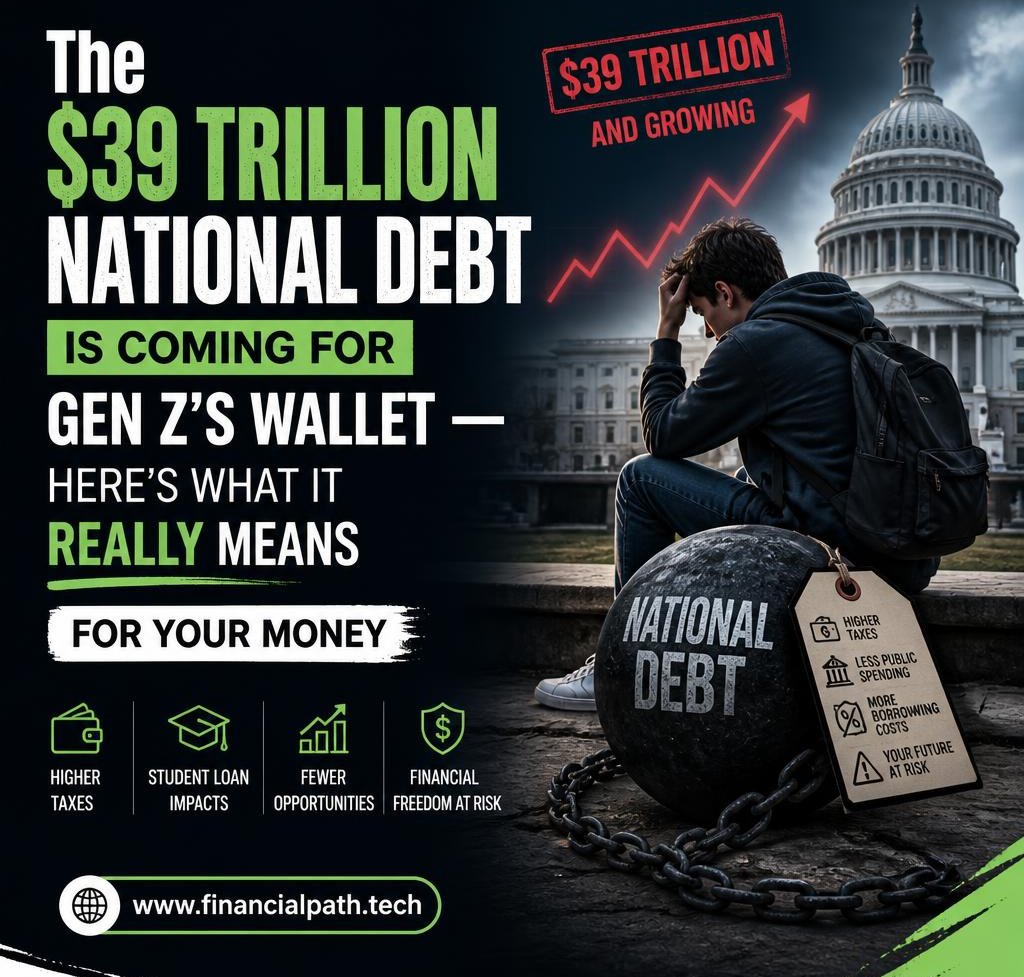
There's a number that's been growing so fast for so long that most people have stopped really hearing it. The United States national debt stands at approximately $39 trillion as of July 2026. The government paid $10 billion a week to service that debt in the first months of the current fiscal year. That's not a national budget number that affects you in some distant, abstract way — it's a fiscal reality that is already shaping the job market, the interest rate environment, the cost of borrowing, and the tax landscape that Gen Z and millennials will live and work inside for the rest of their careers.
A report published yesterday by the Peter G. Peterson Foundation delivered a stark and specific warning: Gen Z, in particular, will face a smaller job market with lower wages if the fiscal trajectory of the country continues to persist. The US national debt's impact on Gen Z and millennials' personal finances in 2026 is no longer a theoretical policy debate. It's a concrete financial threat with specific channels that translate directly into your salary, your mortgage rate, your tax bill, and the quality of public services your tax dollars fund.
This article cuts through the political noise and tells you exactly what the debt means for your personal financial life — and what you can do about it.
Table of Contents
The $39 Trillion Number — What It Actually Means in Human Terms
How the Debt Directly Affects Gen Z and Millennial Wages
The Interest Rate Trap — How Debt Keeps Borrowing Expensive
The Tax Burden Shift — Who Actually Pays for This
What the Debt Means for Public Services You Depend On
Why This Generation Is Starting From a Harder Position Than Their Parents
What Nigerian and Emerging Market Readers Should Know
Step-by-Step: How to Debt-Proof Your Personal Finances Against This Reality
Key Takeaways
1. The $39 Trillion Number — What It Actually Means in Human Terms
Let's ground the $39 trillion figure in something comprehensible, because numbers at this scale become essentially meaningless to the human brain without translation.
$39 trillion is approximately $117,000 for every man, woman, and child in the United States. It's nearly 140% of the entire US GDP — the total value of everything the country produces in a year. It's larger than the combined GDP of every country in Europe. And it's growing at a pace that makes previous debt expansion look modest.
The federal government reported a $120 billion deficit in June FY26, up $147 billion from the $27 billion surplus recorded in June FY25. Spending in June FY26 was $616 billion, $117 billion more than in June last year. Categories that saw the largest increases were net interest costs ($20 billion more than June FY25) and Veterans Services ($16 billion).
The interest cost line is particularly significant. The government paid more in interest on its existing debt last month than it did the month before — because the accumulated debt keeps growing and interest rates remain elevated. This creates a self-reinforcing cycle: more debt requires more interest payments, which requires more borrowing to fund, which creates more debt, which requires more interest payments.
JPMorganChase CEO Jamie Dimon and Fed Chairman Jerome Powell are among those nervously eyeing the nation's $38 trillion debt burden. When the two most prominent voices in American finance are expressing concern rather than dismissing it, that's a signal worth taking seriously.
2. How the Debt Directly Affects Gen Z and Millennial Wages
This is the most directly personal dimension of the debt for younger workers — and it's the one that receives the least attention in mainstream personal finance coverage.
The Peterson Foundation's report and the American Action Forum's research both point to the same mechanism: high government debt, sustained over time, produces lower economic growth. Lower economic growth means fewer jobs created per year. Fewer jobs competing for workers means workers have less bargaining power. Less bargaining power means slower wage growth.
Jordan Haring, director of fiscal policy at the American Action Forum, wrote: "The United States' high debt load exacerbates generational imbalances. These imbalances will ultimately burden younger and future generations with higher interest payments, slower economic growth, slower income growth, and a greater burden to bear for future tax or spending changes."
The wage growth dimension is already visible in the 2026 data. The share of Americans who have difficulty paying their monthly expenses has climbed from a third (36%) in 2021 to almost half (48%) in 2026 — a 33% increase in five years. That challenge has been hardest on women, Gen X, lower-income households and those with consumer debt.
The mechanism isn't complicated. When the government borrows enormous sums, it competes with private businesses for available capital. This drives up the cost of business borrowing — which means companies invest less in expansion, hire fewer people, and offer smaller raises. The debt doesn't just affect government finances. It affects the entire economic environment in which private employers make decisions about hiring and compensation.
As interest costs rise, the federal government will have less money available for education, infrastructure, or scientific research — areas that directly support long-term prosperity. Future taxpayers will face higher tax burdens or reduced government services simply to cover the costs created by previous budget deficits.
For a 28-year-old starting their career today, this is not a distant concern. It's the economic environment they'll be building their financial life inside for the next four decades.
3. The Interest Rate Trap — How Debt Keeps Borrowing Expensive
The most immediate financial impact of the national debt on ordinary people's lives isn't abstract wage effects — it's the interest rates on every loan they carry or apply for.
The Federal Reserve's ability to cut interest rates is constrained by the fiscal situation. When the government runs persistent large deficits, the bond market demands higher yields on Treasury securities to compensate for the risk of lending to an increasingly indebted government. Those higher Treasury yields put a floor under all other interest rates in the economy — mortgage rates, car loans, credit card APRs, and student loan rates all track Treasury yields to varying degrees.
This creates a scenario where even when the Fed wants to cut rates to stimulate the economy, the debt dynamics exert upward pressure on rates through the bond market. Economists are concerned that at some point, the growth of the American economy will become so disconnected from the borrowing of its government that bond buyers will demand higher premiums on their loans.
For Gen Z and millennial borrowers navigating the housing market, this matters enormously. The 30-year mortgage rate sits at 6.46% this morning. Even after today's softer inflation data has pushed rate cut expectations higher, the floor under which mortgage rates can sustainably fall is partially determined by the government's borrowing needs. A federal government borrowing $1.5+ trillion per year doesn't leave room for the kind of ultra-low rates we saw in 2020–2021 for any extended period.
💡 Tip — The Debt-Aware Interest Rate Strategy
Given that the national debt creates a structural floor under interest rates that's likely to persist for years, planning your personal finances around a "rates will return to 3%" assumption is probably unrealistic. The more prudent base case is that rates stay structurally elevated relative to the 2010s — meaning fixed-rate debt at today's rates locks in today's environment, variable-rate debt remains risky, and paying down high-interest debt aggressively is more important than ever. Use our Debt Paydown Calculator to model your fastest path to debt freedom in a higher-rate world.
4. The Tax Burden Shift — Who Actually Pays for This
The debt accumulated by current and previous governments will ultimately be paid for by current and future workers. That payment comes through one or both of two channels: higher taxes or reduced government services. Both have direct personal finance implications for Gen Z and millennial households.
The tax channel is particularly pointed because of demographic mathematics. The US population is ageing rapidly — the baby boom generation is now in or entering retirement, drawing on Social Security and Medicare rather than contributing to them through payroll taxes. With an aging population, it is likely that spending on social care will increase over the coming decades. Lower birth rates will mean fewer entrants into the ranks of the economically active to maintain the revenues gathered by the government.
This means fewer working-age people supporting more retirees, while simultaneously servicing a growing national debt. The arithmetic points toward higher taxes on the working-age population over time — falling disproportionately on the generations currently early in their careers.
The spending reduction channel is equally consequential. Already the gap is large: In 2025, the Department of Education requested $82.4 billion for its budget, while in 2024 Medicaid spending totaled more than $900 billion. As debt service costs crowd out discretionary spending, education funding, infrastructure investment, and research budgets face the largest proportional cuts — precisely the categories that support the long-term economic productivity that younger generations depend on.
The personal finance implication: build your financial plan around the realistic expectation of a higher long-term tax burden. This means maximising tax-advantaged accounts (401(k), IRA, HSA) now, while their tax benefits are fully available, rather than assuming current tax rates are the permanent baseline.
5. What the Debt Means for Public Services You Depend On
The crowding-out effect of debt service isn't just about wages and interest rates — it directly affects the quality and availability of public services that feed directly into household financial stability.
Social Security: As covered in our Social Security reform article earlier this week, the programme faces a projected 22% benefit cut by 2033 if no reform action is taken. The national debt makes the fiscal space for reform more constrained — every dollar spent shoring up Social Security competes with debt service payments that already consume an enormous share of the federal budget.
Medicare and healthcare: Medicare outlays increased by $57 billion over the same nine-month period while simultaneously net interest rose by $78 billion. Both are growing rapidly. The budget tension between healthcare spending and debt service will ultimately be resolved either through benefit cuts, premium increases, or higher taxes — all of which directly affect household budgets.
Education and infrastructure: These are historically the first categories to face cuts when budgets are squeezed. Reduced education investment means higher student loan burdens as public universities compensate with tuition increases. Reduced infrastructure investment means higher vehicle maintenance costs, longer commutes, and reduced productivity for businesses that depend on transportation networks.
Emergency response capacity: Government capacity to respond to economic emergencies — recessions, pandemics, natural disasters — is constrained by accumulated debt. When the next major economic shock arrives, the fiscal space for stimulus spending will be significantly more limited than in previous downturns.
⚠️ Warning — Don't Count on Government as Your Financial Backstop
The trajectory of the national debt means that government's capacity to support households during financial emergencies is likely to be more constrained in the future than it has been in the recent past. The pandemic-era support programmes — stimulus payments, enhanced unemployment benefits, student loan pauses — were extraordinary measures enabled by a government with relatively more fiscal room than it has today at $39 trillion in debt. The personal finance response is to build your own financial resilience rather than relying on government programmes as a primary backstop.
6. Why This Generation Is Starting From a Harder Position Than Their Parents
The compound challenge for Gen Z and younger millennials isn't just the national debt — it's the accumulation of structural disadvantages that debt is one component of.
34% of Americans — approximately 88 million adults — describe their financial situation as "struggling" or "in crisis" in 2026, up from 22% in 2021. That's a 55% increase in five years.
Economic outlooks for 2026 expect consumer spending to grow more slowly than in the past decade. That can translate into slower wage growth and more uncertainty in some industries. Irregular income is likely to be a reality for a larger share of the workforce.
None of this means the financial situation for younger generations is hopeless. It means the strategies that worked for previous generations — single income, single employer, defined benefit pension, relatively cheap housing — are less reliable. The strategies that work better in this environment are different: multiple income streams, aggressive personal savings, tax-advantaged investing, and active management of a financial position that no employer or government programme will manage for you.
In 2021, 59% of Americans agreed with the statement that "debt is a normal part of life." In 2026, that number has dropped to 51%. And the biggest downward shifts have come from millennials (71% to 49%) and men (64% to 55%). That mindset shift — away from accepting debt as inevitable — is genuinely positive and reflects exactly the kind of attitudinal change that leads to better financial outcomes.
7. What Nigerian and Emerging Market Readers Should Know
The US national debt story is not purely American — it has specific implications for Nigerian and African economies that deserve direct attention.
The global safe asset premium. US Treasury bonds are the world's primary safe asset — the investment that global capital flows into during uncertainty. When the US debt trajectory raises questions about fiscal sustainability, that affects the premium investors demand on all global debt, including emerging market bonds. Countries like Nigeria that borrow internationally face higher borrowing costs when the global risk environment is shaped by US fiscal uncertainty.
The dollar's reserve currency status. The US dollar's dominance as the world's reserve currency is partly a function of confidence in US fiscal management. Growing concerns about the debt trajectory have accelerated global discussions about dollar alternatives — including Chinese yuan internationalisation, digital currencies, and commodity-backed payment systems. For Nigerian readers who hold dollar savings as an inflation hedge, understanding the long-term trajectory of dollar dominance matters for how you think about currency diversification.
The aid and development finance dimension. As interest costs rise, the federal government will have less money available for education, infrastructure, or scientific research. The same fiscal constraint applies to foreign aid and development finance programmes. Nigeria and other African nations that receive US bilateral aid or benefit from multilateral institutions where the US is a major contributor may see these flows constrained over time as domestic fiscal pressure mounts.
The opportunity in the uncertainty. Global debt concerns — both in the US and across developed market governments — are accelerating interest in alternative stores of value and investment destinations. African equity markets, real estate in high-growth emerging market cities, and dollar-earning digital skills all benefit from a world where the traditional safe haven assets are perceived as less safe than they once were. Building your financial position around these opportunities, as covered on our Side Income page, is a genuinely strategic response to the global fiscal environment of 2026.
8. Step-by-Step: How to Debt-Proof Your Personal Finances Against This Reality
You cannot vote your way out of the national debt in the next election cycle. But you can make personal financial decisions that reduce your exposure to its consequences. Here is the specific framework:
Step 1: Maximise tax-advantaged accounts immediately.
The most direct personal finance response to an expected higher long-term tax burden is capturing tax benefits now. Max out your 401(k) contribution ($24,500 in 2026), fund your IRA ($7,500), and if you have an HSA-eligible health plan, contribute to that ($4,400 individual). These accounts provide either immediate tax deductions (traditional accounts) or tax-free growth (Roth accounts) — both of which become more valuable as tax rates rise over time. Use our Compound Interest Calculator to model what maximising these accounts over 20 years produces versus only partially funding them.
Step 2: Build multiple income streams aggressively.
In an economy where wage growth is structurally constrained by debt dynamics, relying entirely on a single employer's willingness to give you raises is a financially vulnerable position. Building at least one additional income stream — freelancing, digital products, investment income, rental income — is not just a wealth-building strategy. It's a structural response to a labour market where single-income dependence carries more risk than it did for previous generations. The Side Income page on FinancialPath covers the most accessible and highest-return options for building that second stream.
Step 3: Pay down high-interest debt relentlessly.
In a structurally elevated interest rate environment — where debt dynamics prevent rates from returning to near-zero levels — carrying high-interest debt is more costly than in the previous decade. A 21% credit card APR in a world where savings accounts pay 4% represents a 17% guaranteed loss on every dollar you're paying interest on instead of investing. The debt-paydown urgency is higher in 2026 than in 2015. Use the Debt Paydown Calculator to find your fastest path out.
Step 4: Don't count on Social Security as a primary retirement income source.
As established in our Social Security article on Tuesday, the programme faces a 22% projected cut by 2033 — a timeline that falls squarely within the retirement planning horizon of workers in their 40s and 50s today, and within the career horizon of Gen Z workers who are decades away from retirement. Build your retirement plan to be financially viable at 78% of scheduled Social Security benefits, treating the other 22% as a potential bonus rather than a planning baseline.
Step 5: Build genuine inflation protection into your savings.
High government debt creates upward pressure on inflation over the long run — either directly through central bank money creation or indirectly through constrained productivity growth. The inflation-hedging strategies covered on our Inflation Hedge page — equities, real estate, commodities exposure, foreign currency diversification — are directly relevant to a world where fiscal excess creates persistent inflation pressure.
Step 6: Invest in skills that command premium wages regardless of economic environment.
When wage growth is structurally constrained by debt dynamics, the workers who outperform are those with skills in genuinely scarce supply. AI proficiency, data analysis, cybersecurity, healthcare delivery, and skilled trades all command premium wages because demand exceeds supply in ways that broad economic headwinds don't fully eliminate. Investing in these skills — even at the cost of short-term income — is the human capital equivalent of buying an inflation hedge.
Step 7: Diversify geographically where possible.
The debt constraints on the US economy don't apply equally to all global economies. Some emerging markets — including parts of Africa, Southeast Asia, and India — have younger demographics, lower debt levels, and faster growth trajectories. For investors who can access global markets, some exposure to these higher-growth environments provides a hedge against the slower growth trajectory that high debt implies for the US economy. Platforms like Bamboo and Risevest make global equity exposure accessible from Nigeria.
Step 8: Build your emergency fund to withstand reduced government support.
As discussed, fiscal constraints mean future government emergency support will likely be more limited than pandemic-era programmes. A robust personal emergency fund — three to six months of essential expenses, in a high-yield account earning 4%+ — is your personal fiscal backstop. Don't depend on government programmes that may be scaled back precisely when you need them. The Income Planner tool on FinancialPath helps you map how your emergency fund fits into your complete financial picture.
Key Takeaways
The US national debt reached approximately $39 trillion in July 2026, with the government paying $10 billion per week in interest — a fiscal trajectory that a Peterson Foundation report published yesterday confirms will produce slower wage growth, fewer job opportunities, and higher tax burdens specifically for Gen Z and millennial workers
"The United States' high debt load exacerbates generational imbalances. These imbalances will ultimately burden younger and future generations with higher interest payments, slower economic growth, slower income growth, and a greater burden to bear for future tax or spending changes" — American Action Forum, July 2026
The debt creates a structural floor under interest rates that constrains how far mortgage rates, credit card APRs, and loan rates can sustainably fall — planning around a return to 3% mortgage rates is probably unrealistic for the medium term
34% of Americans describe their financial situation as "struggling" or "in crisis" in 2026, up from 22% in 2021 — a 55% increase in five years — reflecting the compounding impact of debt dynamics on household financial wellbeing
The tax burden will likely rise over time as debt service costs crowd out productive spending and fewer working-age people support more retirees — maximising tax-advantaged accounts now captures benefits before rates increase
Irregular income is likely to be a reality for a larger share of the workforce — building multiple income streams is a structural response to a labour market shaped by debt-constrained growth
For Nigerian and emerging market readers, US fiscal trajectory affects global borrowing costs, dollar reserve currency status, and development finance flows — all relevant to how you build and protect wealth in a globally connected economy
The personal finance response is empowerment, not despair — the strategies that succeed in this environment (multiple income streams, tax-advantaged investing, aggressive debt paydown, skills investment, geographic diversification) are all available and actionable today
📚 Related Articles to Read Next on FinancialPath
Social Security Reform 2026: The Clock Is Ticking — Tuesday's morning article covers the specific Social Security dimension of this week's fiscal story — the 2033 depletion deadline, what a 22% benefit cut means in real dollars, and how to build a retirement plan that doesn't depend on a political solution arriving in time
The Retirement Savings Crisis of 2026 — The retirement savings gap that the national debt exacerbates is covered in full here — including the new 2026 contribution limits and the step-by-step process for accelerating retirement saving in a challenging environment
Job Switching Salary Increase Strategy 2026 — In a world where debt dynamics constrain broad wage growth, the job-switcher premium becomes even more valuable — this article from Wednesday evening covers exactly how to capture it
The $39 trillion national debt is not going to disappear in this generation's working lifetime. The political will to address it systematically has been absent for decades, and the demographic mathematics of an ageing population make the challenge harder rather than easier with every passing year. Citadel CEO Ken Griffin has warned that "it is irresponsible for the US government to incur a deficit of 6.4% when unemployment is hovering around 3.75%. We must stop borrowing at the expense of future generations." He is not alone in that assessment.
But personal finance has never been primarily about fixing systemic problems — it's about building financial resilience within whatever system exists. The same principles that have always produced financial security still apply: earn more than you spend, save aggressively in tax-advantaged accounts, invest consistently in diversified assets, pay down expensive debt, and build income that doesn't depend on a single employer's decisions.
What changes in a high-debt environment is the urgency of those steps and the importance of not counting on government programmes to fill gaps that personal savings need to fill instead. FinancialPath's tools are built for exactly this kind of deliberate financial planning. Use the Income Planner to map every income source and obligation. The Compound Interest Calculator to model what aggressive saving produces over your specific horizon. And the Debt Paydown Calculator to find your fastest path to the financial freedom that no fiscal crisis can take from you.
The debt is theirs. The plan is yours.
Written by the FinancialPath Team — Personal Finance Writers dedicated to making smart money decisions accessible to everyone, everywhere.
Published: Wednesday, July 15, 2026 — Morning Edition | Sources: Fortune/Peter G. Peterson Foundation July 14 2026, American Action Forum/Yahoo Finance National Debt Analysis, Peter G. Peterson Foundation Current Debt Deficit July 2026, Ramsey Solutions State of Personal Finance Q1 2026, Bountisphere 12 Financial Trends 2026, Fidelity 2026 Money Trends
RESOURCES
GET IN TOUCH
info@financialpath.tech
Kaduna, Nigeria
Serving emerging markets worldwide
© 2026 FinancialPath-No-nonsense math for emerging market builders.
LOCALLY RELEVANT, GLOBALLY USEFUL