
The Housing Affordability Crisis of 2026: Should You Rent, Buy, or Build Wealth Another Way?
Homes now cost 5.8x median income and buying costs 50% more than renting in 2026. Here's how to make the smartest housing decision for your finances right now.
FINANCIAL ADVICE
- Financial Path Team
7/9/202615 min read
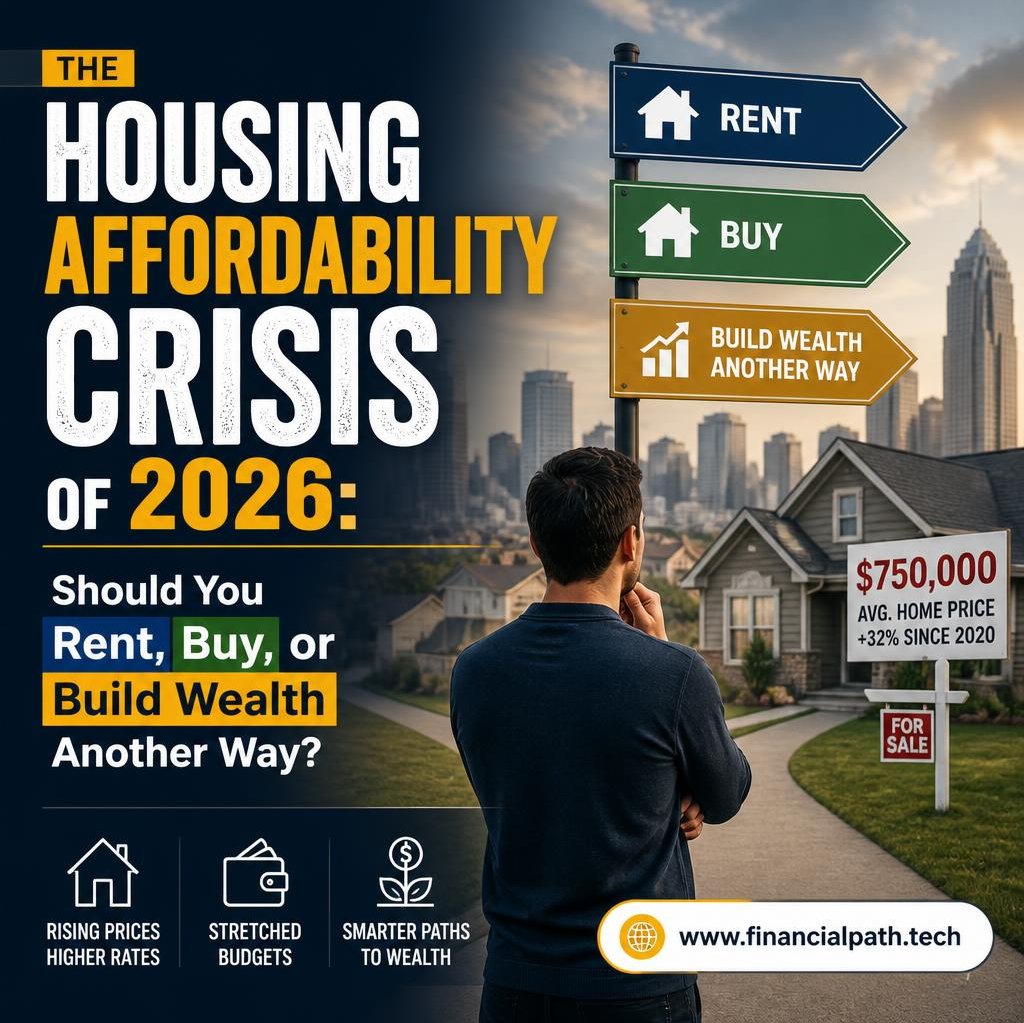
There's a housing statistic making the rounds this week that stopped a lot of people cold. In 1985, the average American home cost approximately 3.5 times the median household income. Today, in 2026, that ratio has climbed to 5.8 times income — and in cities like San Francisco, New York, and Sydney, it's closer to 7 times income or higher.
That shift — from 3.5x to 5.8x — is the entire housing affordability crisis summarised in two numbers. It's why a generation of people who did everything "right" — got educated, found good jobs, saved diligently — still can't comfortably afford to buy a home in the city where they work. It's why, in 2026, buying a home can cost up to 50% more per month than renting a comparable property, before you add repairs and maintenance. It's why even mainstream economists are describing the current real estate market as the most unrealistic housing environment in a hundred years.
But here's the nuance that most headlines miss: the housing affordability crisis of 2026 isn't uniform. Some markets are genuinely correcting. Some are still appreciating. Mortgage rates today — 6.61% for a 30-year fixed as of this morning — are meaningfully lower than their 2023 peak but still roughly double what they were during the pandemic. And renting, far from being a failure, is increasingly the smarter financial strategy in many markets — not because buyers can't save for a deposit, but because the rent-versus-buy mathematics have genuinely shifted.
This article gives you the complete picture — what's actually happening in the housing market right now, how to make the rent-or-buy decision correctly for your specific situation, and how to build real wealth through property even when buying a home outright isn't the right move yet.
Table of Contents
What's Actually Happening in the Housing Market Right Now
The Rent-vs-Buy Maths in 2026 — The Honest Calculation
Why Renting Is a Strategy, Not a Setback
When Buying Still Makes Financial Sense in 2026
How to Build a Path to Homeownership Without Destroying Your Finances
Real Estate Wealth Building Without Buying Your Own Home
What Nigerian and Emerging Market Readers Need to Know
Step-by-Step: How to Make the Right Housing Decision for Your Situation
Key Takeaways
1. What's Actually Happening in the Housing Market Right Now
To make a rational housing decision in 2026, you need an accurate picture of the market you're navigating — not the one that existed two years ago and not the one some people assume is coming.
The first thing to understand is what the market is not: it's not 2008. The housing market didn't slow down — it froze. But that freeze is different from a crash. As of February 2026, the National Association of REALTORS reported a housing supply of just 3.8 months. A balanced market between buyers and sellers requires a six-month supply. The catastrophic buildup to 2008's crash saw 13 months of supply. Today's shortage is tight — not surplus — which is why a crash remains unlikely despite the affordability squeeze.
"We're not heading toward a housing crash; we're in a market correction defined by stability, not volatility," said Hoby Hanna, CEO of Howard Hanna Real Estate Services. The issue is primarily an affordability crisis, not a supply glut.
The 0.9% annual price appreciation is a significant deceleration from the 15–20% gains of the pandemic era — but it's still appreciation, not decline. This matters because it means buyers entering today are not buying into a market on the verge of a correction that will make their purchase look foolish six months later. They're buying into a stable but expensive market with constrained supply.
What is happening is a market fragmentation. The housing market isn't tilting cleanly in one direction. It's fragmenting. Cities like Austin, Phoenix, Orlando, Denver, and Dallas — which saw enormous pandemic-era price surges from remote worker migration — are offering seller incentives and showing more inventory. Cities in the Northeast and Midwest, where construction has lagged, still have tight inventory and persistent price pressure.
2. The Rent-vs-Buy Maths in 2026 — The Honest Calculation
Most people approach the rent-vs-buy decision emotionally rather than mathematically. Buying a home feels like progress, stability, and success. Renting feels temporary. But feelings are a terrible foundation for what is typically the largest financial decision of your life.
That gap — the 50% or greater monthly cost difference between renting and buying a comparable property — is the central financial reality of the 2026 housing market. When buying costs $1,800 more per month than renting, and that $1,800 difference could be invested in a diversified index fund earning historical average returns, the rent-vs-buy calculation becomes significantly more nuanced than the conventional wisdom of "buying is always better."
The break-even analysis is the key tool here. How many years do you need to stay in a purchased home for the ownership benefits — equity building, appreciation, fixed payment certainty — to outweigh the higher monthly costs plus transaction costs (typically 5–7% of the purchase price in agent fees, closing costs, and stamp duties)?
In many 2026 markets, that break-even period is 7–10 years. If you're confident you'll stay in the same location for less than 7 years, renting is often the mathematically superior choice even setting aside the monthly cost difference.
💡 Tip — Run Your Own Break-Even Analysis
Before making any rent-or-buy decision, calculate your specific break-even period. Take the total transaction costs of buying (deposit, closing costs, agent fees) plus the monthly premium of owning over renting, and divide that by the monthly equity you'd build through mortgage principal reduction plus expected appreciation. NerdWallet's rent-vs-buy calculator automates this calculation — input your specific numbers before making any commitment. Most people are surprised by how long the break-even period actually is in their market.
3. Why Renting Is a Strategy, Not a Setback
The cultural narrative around renting — that it's "throwing money away" and buying is always better — deserves a serious reexamination in 2026. Renting is increasingly looking like a strategy rather than a setback for millions of people, and the financial case for that position has never been stronger.
Renting preserves capital flexibility. A $60,000 deposit tied up in a home purchase is $60,000 that cannot be invested in diversified assets. In a year where the S&P 500 returned 22%, that flexibility had enormous value. Even at more modest historical equity market returns of 7% annually, the opportunity cost of a large deposit is significant over a decade.
Renting avoids transaction cost risk. Buying and selling a home within five years — which happens frequently due to job changes, relationship changes, or family growth — typically costs 10–12% of the home's value in combined transaction costs between purchase and sale. For a $400,000 home, that's $40,000–$48,000 in costs that disappear regardless of what the market does.
Renting transfers maintenance risk. When the roof needs replacing or the boiler fails, a renter calls the landlord. For homeowners, maintenance typically costs 1–2% of the home's value annually — that's $4,000–$8,000 per year on a $400,000 home that most first-time buyers don't budget for and many simply don't have readily available.
Rental housing has improved. New apartment supply that came online in 2025 has improved availability and moderated rents in many markets. Ratiu expects developers to slow construction in 2026, which means this window of relatively better rental availability may not last indefinitely — but for now, renters have more negotiating power than at any point since before the pandemic.
The renter who invests the monthly cost difference between owning and renting — consistently, in diversified index funds — can build substantial wealth over a decade while maintaining complete flexibility. This isn't a consolation prize for people who can't afford to buy. It's a deliberate wealth strategy that works mathematically in many 2026 markets.
4. When Buying Still Makes Financial Sense in 2026
None of the above means buying is wrong. For the right person, in the right market, with the right financial foundation, buying a home in 2026 remains an excellent decision. Here's the profile when buying makes genuine sense:
You have a long time horizon. If you're confident you'll stay in the same location for 7–10 years or more — because of family, career, community ties — the equity you build and appreciation you capture over that period typically outweighs the higher monthly costs of ownership. The break-even maths work in your favour with a long enough timeline.
Your financial foundation is solid. Buying makes sense when you have: a 20% deposit (to avoid private mortgage insurance costs), an emergency fund of 3–6 months of expenses that remains intact after the purchase, stable income that comfortably covers the mortgage payment at a maximum of 28–30% of gross income, and no high-interest debt consuming significant monthly cash flow.
You're buying in a supply-constrained market. In markets where the Northeast and Midwest inventory continues to lag well behind 2019 levels, the combination of price stability and appreciation potential makes buying more compelling than in oversupplied Sun Belt markets where sellers are currently offering incentives.
You value the non-financial benefits. Homeownership provides genuine non-financial value — stability, the ability to customise your space, certainty of tenure, and community rootedness — that is worth real money to many people. Acknowledging these values honestly is part of making a complete decision, not just a financial one.
You plan to make extra payments. Make extra mortgage payments — even a little bit extra each month can help you build equity in your home faster. Buyers who treat their mortgage as a floor rather than a ceiling, making even modest extra principal payments, accelerate equity building meaningfully over time.
⚠️ Warning — The Deposit Drain Trap
One of the most financially dangerous homebuying mistakes is depleting your emergency fund for a down payment or stretching to a payment that consumes more than 30% of gross income. The first year of homeownership almost always involves unexpected costs — repairs, appliances, property taxes, insurance adjustments — that arrive before you've built any financial cushion. Buying without a separate, intact emergency fund puts you in a position where the first significant home repair forces you into high-interest debt. Never confuse being able to close on a home with being financially ready to own one.
5. How to Build a Path to Homeownership Without Destroying Your Finances
For people who want to buy but aren't yet financially positioned to do so without strain, the 2026 housing market actually offers something previous years didn't: time. With prices appreciating only 0.9% annually nationally and mortgage rates expected to decline modestly as the Fed potentially cuts rates later in 2026, rushing into a purchase you're not financially ready for is less necessary than it felt in 2021–2022.
Here's how to use that time productively:
Build your deposit deliberately. Open a dedicated high-yield savings account — paying 4–5% as we covered in this week's earlier article — specifically for your home deposit. Calculate your target deposit (20% of your target home price is ideal) and set up automatic monthly contributions. Use the Compound Interest Calculator on FinancialPath to model how long it takes to reach your target at different savings rates.
Aggressively pay down high-interest debt. Lenders closely monitor credit scores and payment histories. Knock out credit card balances with interest rates north of 10%, which can quietly drain cash flow even when income looks solid on paper. Reducing monthly debt obligations directly increases the mortgage you can qualify for and the monthly budget available for a payment. Use the Debt Paydown Calculator to model your fastest path to debt-free status.
Practise your mortgage payment. Try setting aside the full projected housing payment — including taxes and insurance — each month, well before applying for a loan. For some buyers, that test builds confidence that a monthly mortgage is doable. For others, it's a wake-up call that savings or income might need an upward adjustment. Either outcome is useful.
Build income. Income alignment plays a major role in homebuying capacity. As a rough planning tool, multiply a monthly payment you feel comfortable with by about 2.25 to estimate the gross income needed to support it, then adjust for existing debts. If the income required is above your current level, our Side Income page covers the most practical approaches to building additional income that closes the gap.
Improve your credit score. For renters hoping to buy in 2026, preparation matters as much as the market. Start by reducing monthly payment obligations and paying down high-interest debt. The credit score improvements directly translate to better mortgage rates — and as we showed in this morning's credit score article, the difference between a 620 and a 760 score on a $300,000 mortgage is approximately $143,000 in total interest paid.
6. Real Estate Wealth Building Without Buying Your Own Home
Here's a dimension of real estate wealth that almost no personal finance content addresses: you don't have to buy your primary residence to benefit from real estate as an asset class.
Real Estate Investment Trusts (REITs). REITs allow ordinary investors to own fractional interests in commercial real estate — apartments, shopping centres, hospitals, data centres, warehouses — through publicly traded shares. In a year where buying a home requires a $60,000+ deposit, a REIT lets you invest $500 in a diversified portfolio of income-producing real estate. They pay dividends (typically 4–7% annually) and appreciate with property values. They're available through standard brokerage accounts globally — including through Nigerian platforms like Bamboo and Chaka.
Real estate crowdfunding. Platforms like Fundrise (US) allow investors to participate in real estate deals with as little as $10 — accessing apartment developments, commercial properties, and single-family rental projects that were previously only available to institutional investors or high-net-worth individuals.
Buying an investment property before a primary residence. In some markets where prices are lower and rental yields are stronger, the maths of buying an investment property first — renting it out while continuing to rent your primary residence in a higher-cost city — produces better overall financial outcomes than buying your own home. This strategy, sometimes called "rentvesting," is increasingly common among financially sophisticated younger buyers in Australia, the UK, and Nigeria.
According to Investopedia's guide to real estate investment trusts, REITs have historically delivered competitive total returns alongside broad market equities and provide real estate exposure without the illiquidity, leverage risk, and maintenance burden of direct property ownership.
Our Inflation Hedge page on FinancialPath covers real estate — both direct ownership and REIT exposure — as one of the core strategies for protecting wealth against inflation, with specific guidance on how these tools work in Nigerian and emerging market contexts.
7. What Nigerian and Emerging Market Readers Need to Know
The global housing affordability narrative centres on Western markets — but the affordability challenge is equally real in Lagos, Nairobi, Accra, and Cairo, with some unique dimensions.
Nigerian urban real estate — particularly in Lagos and Abuja — has experienced extraordinary price appreciation over the past decade. Premium residential properties in Ikoyi, Victoria Island, and Lekki Phase 1 are priced in dollars, effectively shielding them from naira devaluation but making them accessible only to a very small portion of the population. Middle-income Nigerians find themselves in a genuinely difficult position: properties in desirable urban areas are priced beyond reach on naira incomes, but rental yields on investment properties can be attractive in emerging neighbourhoods.
The dollar-pricing reality. Many quality properties in Lagos are quoted and transacted in USD, meaning the naira devaluation of recent years has made them more expensive in naira terms even when their dollar prices haven't moved. This creates a situation where earning in foreign currency is not just an investment strategy but a housing strategy — dollar income is the currency in which Lagos's most investable real estate is priced.
Mortgage access remains limited. Nigerian mortgage penetration is among the lowest globally — formal mortgage debt represents less than 1% of GDP, compared to 70%+ in developed markets. Interest rates on naira-denominated mortgages from Nigerian banks remain in the 18–25% range, making long-term mortgage financing genuinely unaffordable for most borrowers. The National Housing Fund (NHF) and Federal Mortgage Bank of Nigeria (FMBN) offer subsidised mortgages at lower rates, but access and processing remain significant barriers.
The land and title risk. Land disputes, title verification challenges, and the complexity of Certificate of Occupancy (C of O) processes in Nigeria make property investment due diligence more demanding than in markets with cleaner registry systems. Working with a reputable real estate lawyer and conducting thorough title verification is non-negotiable before any Nigerian property purchase.
Off-plan opportunities. Some of the strongest value in Nigerian real estate comes from off-plan purchases — buying into developments during construction at below-completion prices. This strategy carries execution risk (developer default, construction delays) but can generate significant equity between purchase and completion in markets with strong demand.
8. Step-by-Step: How to Make the Right Housing Decision for Your Situation
Rather than telling you to buy or rent, this step-by-step framework helps you reach the right answer for your specific circumstances.
Step 1: Calculate your rent-vs-buy break-even for your specific target area.
Find three properties in your target area — one for rent and two comparable ones for sale. Calculate the true all-in monthly cost of ownership (mortgage + taxes + insurance + estimated maintenance at 1% of value annually). Compare to the rental cost. Divide the total transaction costs of buying (deposit + closing costs + agent fees) by the monthly saving from renting vs. buying to find your break-even period. If break-even is longer than your realistic time horizon, renting wins.
Step 2: Audit your financial foundation honestly.
Do you have a 20% deposit without depleting your emergency fund? Is your post-purchase emergency fund still three to six months of expenses? Is the mortgage payment below 28–30% of gross income? Do you have high-interest debt that should be paid first? If any of these checks fails, document what needs to change before you're genuinely ready to buy.
Step 3: Define your time horizon.
How confident are you that you'll stay in this location for 7+ years? Factor in career flexibility, relationship status, family plans, and personal priorities. If your honest answer involves significant uncertainty within seven years, renting is the lower-risk financial choice.
Step 4: Research your specific local market.
National housing statistics are averages that may not reflect your target market at all. Understand inventory levels, price trends, days on market, and rental availability in your specific neighbourhood. A real estate agent with strong local knowledge can provide this data. Watch whether homes are selling above or below asking price in your target area — this indicates supply-demand balance at the local level.
Step 5: Build or accelerate your deposit fund while renting.
Use the time while renting to build the deposit you need at the pace your budget supports. Open a dedicated high-yield savings account, set up automatic contributions, and track progress monthly. Use the Income Planner tool on FinancialPath to map your income and find any additional deposit-building capacity.
Step 6: If buying now isn't right, invest the difference.
The monthly cost premium of owning versus renting in your market — that gap — should be redirected deliberately into investments. A renter who invests $1,500 per month (the cost difference) into diversified index funds at 7% average annual returns for ten years accumulates approximately $260,000. That's more than enough for a substantial deposit on a significantly better property. Renting while investing is not stagnation — it's wealth building with different tools.
Step 7: Choose a fixed-rate mortgage when you do buy.
When the time comes to buy, choose a fixed-rate mortgage. Enjoy a steady mortgage payment, and don't worry if rates increase — a fixed mortgage rate is locked in, regardless of what happens in the real estate market. In an uncertain rate environment, rate certainty has real financial value that adjustable-rate products don't provide.
Key Takeaways
Home prices in 2026 sit at 5.8x median income nationally — adjusted for inflation, US home costs now sit above the 2006 bubble peak — but a crash remains unlikely with only 3.8 months of supply versus the 6 months needed for a balanced market
Buying costs up to 50% more per month than renting a comparable property in 2026, making renting the mathematically superior short-term choice in many markets for people with less than 7–10 year time horizons
Renting is increasingly a deliberate financial strategy — not a failure — for people who invest the monthly cost difference between renting and buying into diversified assets
Buying makes strong financial sense when you have a 20%+ deposit without depleting emergency savings, stable income with mortgage below 30% of gross pay, no high-interest debt, and a 7–10 year minimum time horizon in the location
The housing market is fragmenting — Sun Belt markets like Austin and Phoenix are softening with seller incentives, while Northeast and Midwest markets remain supply-constrained with persistent price pressure
You don't need to buy your primary residence to build real estate wealth — REITs, real estate crowdfunding, and investment property before primary residence ("rentvesting") are all viable alternatives
For Nigerian readers, dollar-priced Lagos and Abuja properties make foreign currency earnings essential for real estate participation; mortgage rates of 18–25% make formal financing largely unaffordable; NHF/FMBN subsidised options deserve investigation before approaching commercial lenders
Use the Debt Paydown Calculator to accelerate financial readiness, the Compound Interest Calculator to model how investing the rent-vs-buy difference builds wealth, and the Income Planner to build the income foundation that makes homeownership genuinely affordable
📚 Related Articles to Read Next on FinancialPath
Credit Score Changes in 2026: The Rules Just Shifted — Your credit score determines your mortgage rate — and today's fifth morning article showed that the difference between a good and excellent score is worth $143,000 over a 30-year mortgage
Home Equity Loans and HELOCs in 2026 — Already own a home? This article from Monday's evening edition covers how to access your equity strategically — the options, the risks, and the situations where it genuinely makes financial sense
High-Yield Savings Accounts vs CD Rates in 2026 — If you're building a deposit fund while renting, this article covers exactly where to put that money to earn 4–5% while keeping it accessible and safe
The housing affordability crisis of 2026 is real, it's genuinely difficult, and it's not the fault of people who are struggling to navigate it. When home prices sit at 5.8 times the median income and buying costs 50% more per month than renting, the path to homeownership requires more planning, more patience, and more financial sophistication than at any point in recent memory.
But "difficult" and "impossible" are different things. The people who will look back in ten years and feel good about their 2026 housing decisions won't necessarily be the ones who bought — they'll be the ones who made a deliberate, honest, mathematically grounded decision about what was right for their specific situation, their time horizon, and their financial foundation. For some, that was buying. For others, that was renting and investing the difference. Both paths, done deliberately, lead somewhere good.
Use FinancialPath's Debt Paydown Calculator to accelerate your financial readiness for homeownership. Use the Compound Interest Calculator to see what investing the monthly rent-vs-buy difference builds over your timeline. And use the Income Planner to map the income picture that makes whichever path you choose genuinely sustainable.
Your home should build your wealth — not consume it.
Written by the FinancialPath Team — Personal Finance Writers dedicated to making smart money decisions accessible to everyone, everywhere.
Published: Tuesday, July 7, 2026 — Evening Edition | Sources: Fortune Mortgage Rates July 7 2026, Yahoo Finance/NAR Housing Data, Forbes Advisor Housing Predictions, Momentum Realty 2026 Affordability Crisis Analysis, Multi-Housing News Affordable Housing Trends, Norada Real Estate Mortgage Forecast
RESOURCES
GET IN TOUCH
info@financialpath.tech
Kaduna, Nigeria
Serving emerging markets worldwide
© 2026 FinancialPath-No-nonsense math for emerging market builders.
LOCALLY RELEVANT, GLOBALLY USEFUL