
The Savings Habit That Beats Willpower Every Time — Personal Finance Tips 2026
Willpower-based saving almost never works long term. Here is the one savings habit that works automatically — no discipline required. Real personal finance tips for 2026.
FINANCIAL ADVICE
- Written by Admin
7/2/20266 min read
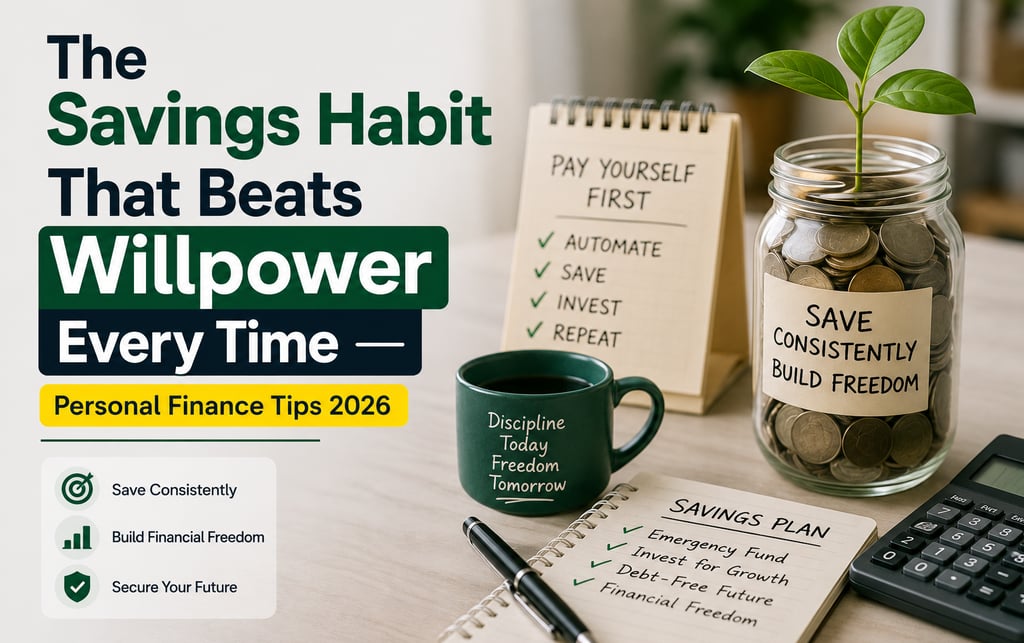

There is a version of savings advice that goes something like this: spend less, want less, resist temptation, be disciplined, and eventually money will accumulate. If you have ever tried living that advice for more than a few weeks, you already know how it ends.
The problem is not you. The problem is the advice itself.
Willpower is a finite, depletable resource. Research by psychologist Roy Baumeister, whose work on ego depletion has been widely cited in behavioural economics, suggests that the more decisions and acts of self-control we perform throughout the day, the less capacity we have for further self-control by evening. By the time most people face their biggest spending temptations — after a long, stressful day — their willpower tank is running on fumes.
Building a savings habit on willpower is building on sand. Here is what to build on instead.
Why "Save What's Left" Never Works
The most common savings approach is the most naturally flawed one: earn money, spend through the month on necessities and wants, and save whatever is left over at the end.
The fundamental problem is that there is almost never anything left. Not because people are reckless or irresponsible, but because human spending naturally expands to fill available funds. This is not a character flaw — it is a well-documented psychological tendency called lifestyle creep, and it affects people at every income level.
Studies from Bankrate's annual emergency savings report consistently show that a significant portion of adults across income brackets report saving little to nothing on a monthly basis — not primarily because they cannot afford to, but because saving is positioned as the last step in the monthly financial cycle rather than the first.
The fix is elegantly simple: flip the order.
Pay Yourself First — The Core Principle
"Pay yourself first" means treating your savings contribution like your most important bill — one that gets paid immediately and automatically when income arrives, before any other spending happens.
When savings leave your account on payday, two things happen psychologically:
First, you never see that money as "available to spend." What you do not see as available, you do not spend. The money mentally belongs to a different category from the moment it leaves.
Second, your spending brain automatically adjusts to work with whatever remains. Humans are remarkably adaptable. Give someone 80% of their income to work with and they will find a way to make it work — just as they would have found a way to spend 100% if it had been available.
This is not theory. A Vanguard research study on automatic enrollment in retirement plans found that when employees were automatically enrolled in savings programmes rather than having to opt in manually, participation rates jumped from roughly 40% to over 90%. The behaviour changed not because people became more disciplined, but because the system changed.
How Much to Automate
The most common question about pay-yourself-first is how much to start with. The honest answer: less than you think, especially at first.
The psychological barrier to starting is the biggest one. Once the habit and the account exist, increasing the amount is relatively easy. Starting with nothing is the hard part.
A practical starting framework:
If saving feels genuinely impossible right now: Start with 1–2% of income. This is not enough to build meaningful wealth yet, but it builds the habit and the account. Both matter.
If you can manage some savings but not comfortably: Aim for 5–10%. This starts making a visible difference over months.
If you are in a stable position and want to accelerate: Target 20% or more. This is where compound growth starts becoming genuinely exciting.
Whatever percentage you choose, increase it by 1% every time your income grows. A raise that arrives and immediately flows 50% into savings before you adjust your lifestyle is one of the most powerful personal finance moves available.
The Separate Account Rule
This is the detail that determines whether pay-yourself-first actually works: the savings account must be separate from your everyday spending account, ideally at a different bank.
The reason is friction. When savings sit in the same account you use for daily spending, withdrawing them feels effortless — because it is. You see the balance, you spend the balance. The barrier between "savings" and "spending" is just a mental label, and mental labels collapse under the pressure of a tempting purchase.
When savings are at a different bank:
Transfer takes 24–48 hours in most cases
The balance doesn't appear in your everyday banking view
Accessing it requires a deliberate, multi-step action
The friction gives you time to reconsider
That small amount of inconvenience is worth an enormous amount in savings preserved. Financial psychologists sometimes refer to this as "commitment device" — a mechanism you set up in advance that makes it harder to act against your own long-term interests in a moment of impulse.
Building Multiple Savings Buckets
Once the automated savings habit is established, the next evolution is separating your savings into purpose-driven buckets. Having one general savings account works — but it has a subtle problem: when you need to make a large purchase or face an emergency, all your savings feel at risk simultaneously.
A better structure uses at least three separate savings destinations:
Emergency Fund: Three to six months of essential living expenses, held in a liquid account you can access quickly. This is not for vacations or appliances — it is for genuine emergencies: job loss, medical crises, urgent repairs. NerdWallet's emergency fund guide recommends keeping this in a high-yield savings account to at least partially offset inflation.
Short-Term Goals: Money earmarked for predictable large expenses within the next one to three years — a vehicle, a laptop, holiday travel, further education. Keeping this separate prevents you from treating emergency funds as general purpose savings.
Long-Term Wealth: Contributions to investment accounts, pension plans, or other vehicles designed to grow over five or more years. This money is not for touching — it is for compounding.
The Automation Setup Step by Step
Here is how to actually implement this system, regardless of whether you bank in Nigeria, the UK, the US, or anywhere else with basic online banking:
Step 1: Decide your savings percentage. Start low if necessary — even 5%.
Step 2: Calculate the naira or dollar amount that represents that percentage of your typical monthly income.
Step 3: Open a separate savings account if you don't already have one. Many banks offer this for free. In Nigeria, options include savings accounts with Opay, Piggyvest, or your existing bank's savings product.
Step 4: Set up a standing order or automatic transfer for that amount to leave your account on payday — or the day after payday to account for processing times.
Step 5: Do not touch it. If you need to access it for a genuine emergency, do so without guilt — that is what it is for. Then rebuild.
Step 6: Every time your income increases, revisit the percentage and increase it by at least 1%.
Dealing With Irregular Income
The pay-yourself-first framework is straightforward when income is consistent. It requires a small adaptation when income varies — as it does for freelancers, entrepreneurs, commission-based workers, and anyone with multiple income streams.
The approach that works best for variable income is percentage-based rather than fixed-amount: rather than saving a specific sum each month, save a fixed percentage of whatever you earn that month. In a good month, more goes to savings automatically. In a lean month, the percentage stays the same but the absolute amount is smaller, which protects your spending ability when income is low.
A secondary technique for variable income earners is the "smoothing account" — one account where all irregular income lands first, from which you pay yourself a consistent monthly "salary" based on your average earnings. The smoothing account absorbs the variability so your budget can run on consistent numbers.
When Savings Feels Pointless
There are moments — especially early on, or during periods of inflation — when looking at a savings account balance feels discouraging. The numbers feel too small to matter. This is a completely normal feeling, and it leads many people to stop.
The thing to understand about savings, particularly in its early stages, is that you are not primarily building a balance. You are building a habit, a system, and a psychological relationship with money that compounds over time just as powerfully as the money itself does.
Someone who has saved consistently for three years and has a modest emergency fund is in a fundamentally different financial position than someone who earns more but saves nothing — not just mathematically, but in terms of options, resilience, and capacity to take advantage of opportunities when they arise.
The balance is the visible part. The habit is the foundation.
Key Takeaways
Willpower-based saving fails consistently because willpower depletes throughout the day
"Pay yourself first" by automating savings before any other spending happens
Keep savings at a separate bank to create protective friction against impulse withdrawals
Start with any percentage — even 1–2% — and increase by 1% every time income grows
Build three savings buckets: emergency fund, short-term goals, and long-term wealth
For variable income, save a consistent percentage rather than a fixed amount
This article builds directly on our piece about budgeting frameworks — if you haven't read Why Most Budgets Fail (And the One That Doesn't), that is the logical starting point before this one.
Ready to put your savings to work? Our Compound Interest Calculator will show you exactly how much your savings grow over time — the numbers are more motivating than you might expect.
RESOURCES
GET IN TOUCH
info@financialpath.tech
Kaduna, Nigeria
Serving emerging markets worldwide
© 2026 FinancialPath-No-nonsense math for emerging market builders.
LOCALLY RELEVANT, GLOBALLY USEFUL