
The Stock Market Hit 53,000 Today — But Are You Actually Benefiting? How to Close the Wealth Gap in 2026
The Dow hit 53,000 today but the top 1% owns 50% of all stock wealth. Here's exactly how ordinary people can finally get their share of the market's gains.
Misbahu Sadisu
7/9/202615 min read
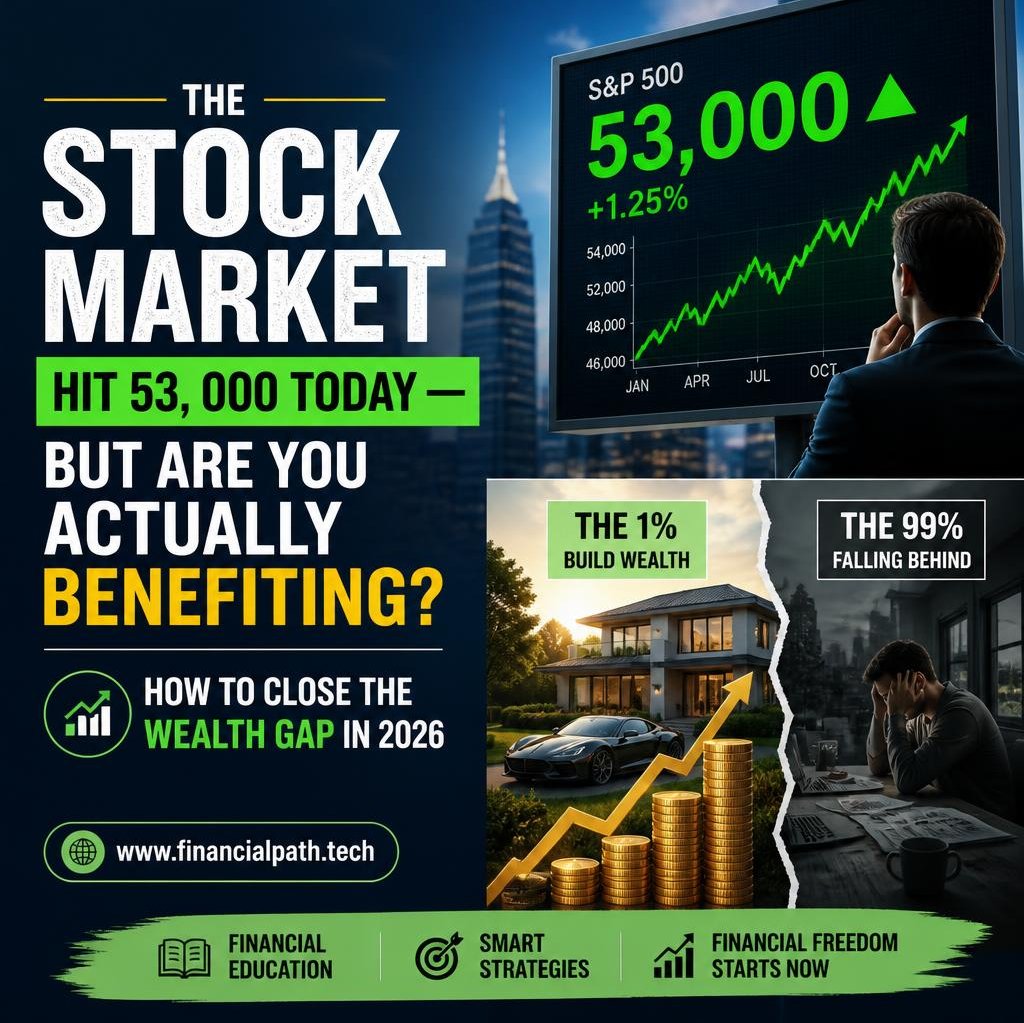
The Dow Jones Industrial Average closed at a record 53,055 points this evening. The S&P 500 has delivered a total return of 22% over the past twelve months. The Nasdaq is up over 76% since 2023. By almost every measure, the stock market in 2026 has been extraordinary — one of the strongest runs in a generation.
And yet two-thirds of Americans say they're worried about paying for basic necessities. Consumer sentiment sits near record lows. Middle-income families are cutting back on groceries, delaying medical care, and pausing retirement contributions. The stock market is making some people genuinely wealthy — and the rest of the country is watching it happen from the outside.
This is what economists call the K-shaped economy — a recovery and rally that moves upward for those at the top and sideways or downward for everyone else. Federal Reserve data makes the mechanism clear: the top 1% of earners own approximately 50% of all equity wealth from individually owned stocks. The top 20% control 87% of all stock market wealth. When the Dow climbs 5,000 points, the financial benefit flows overwhelmingly to a narrow slice of the population.
But here's the part of this story that rarely gets told: the wealth gap exists not primarily because the stock market is rigged, but because most ordinary people are not in it — or are in it in ways too small and too passive to capture its gains meaningfully. That is a fixable problem. This article tells you exactly how to fix it.
Table of Contents
The K-Shaped Market — Who's Actually Winning and Who Isn't
Why Ordinary Investors Miss Most of the Rally
Trump Accounts — The New Investment Vehicle That Just Launched
How to Build a Stock Market Position That Actually Matters
The Global Dimension — Investing From Outside the US
Asset Allocation for the Second Half of 2026
Step-by-Step: How to Start Capturing Market Gains This Week
The Psychological Barriers That Keep Most People Out
Key Takeaways
1. The K-Shaped Market — Who's Actually Winning and Who Isn't
The term "K-shaped" describes an economic trajectory where different segments of the population experience completely different financial realities simultaneously — one arm of the K moving upward, the other moving sideways or down.
The stock market gains that have helped keep the economy humming have exacerbated the yawning wealth gap. The top 20% of earners make up 57% of US consumer spending. And the top 20% of earners control 87% of the wealth generated by America's individually owned stocks, according to the Federal Reserve's Distributional Financial Accounts.
The S&P 500 has given investors a total return of 22% over the past year, 76% since 2023 and 327% over the past decade. Those are extraordinary numbers — but they only matter to people who were actually invested when those gains happened.
Trump told reporters that "everybody's profiting" because the stock market is going up, though Federal Reserve data shows that the top 1% of all earners own half the equity wealth in the country. That gap between the narrative and the reality is the central personal finance challenge of this moment — and it has a practical solution.
2. Why Ordinary Investors Miss Most of the Rally
Understanding why so many people don't benefit from stock market gains requires looking at the specific ways ordinary investors participate — or fail to.
They're not invested at all. As we covered in this morning's retirement article, the share of Americans actively investing for retirement dropped from 51% to 42% over five years. People who exit the market during periods of financial stress miss the recoveries — and the 2025–2026 recovery has been one of the most powerful in recent memory. Every month out of the market during a rally is growth you cannot recover.
They're invested too conservatively. Many people who do have retirement accounts hold primarily cash, stable value funds, or bonds inside their 401(k) — often because they never changed the default allocation from a risk-averse option chosen at enrollment. A 401(k) that's 80% in a stable value fund while the S&P 500 rises 22% earns almost nothing from that rally. The account exists, the contributions happen, but the growth doesn't follow.
They panic-sell at the worst moments. Shifting trade policies and fluctuating tariffs triggered volatility in the early months of President Trump's second term, though markets have since recovered. In 2025, the S&P 500 generated a total return of 17.9%. The people who sold during the April 2025 volatility — when tariff fears drove sharp declines — locked in losses and missed the subsequent rally that produced those returns.
They invest too little to matter. Having $500 in an S&P 500 index fund that rises 22% generates $110. That's real growth — but it doesn't change anyone's financial life. Capturing meaningful wealth from market gains requires meaningful capital invested. The compound interest calculator shows this clearly: small amounts take a very long time to compound into life-changing wealth. Increasing contribution amounts is as important as being invested at all.
They concentrate in the wrong places. Some investors are "in the market" in theory but concentrated in single stocks, sector funds, or speculative assets that don't track the broad market gains. Diversification through index funds is not just a risk management strategy — it's the mechanism that ensures your returns track the market rather than being driven by the fortunes of any single company.
⚠️ Warning — The Illusion of Participation
Having any investment account does not mean you're capturing market gains. Check what your retirement or investment account is actually invested in — specifically what percentage is in equity funds versus cash, bonds, or stable value funds. If the S&P 500 is up 22% over twelve months and your account grew only 2–3%, something is wrong with the allocation, not the market. Log in to your account today and look at the investment breakdown. This single check regularly reveals that accounts that "exist" are not actually capturing the market growth happening around them.
3. Trump Accounts — The New Investment Vehicle That Just Launched
One of the most significant personal finance developments of this week is the formal launch of Trump Accounts — a new investment programme announced yesterday, July 6, 2026, with President Trump ringing the opening bell at the NYSE and Nasdaq from the Oval Office.
Monday's event was meant to showcase the launch of Trump Accounts, created to provide children access to stock wealth. The programme creates government-seeded investment accounts for children — a concept designed to broaden stock market participation and begin building investment wealth earlier in life.
While details of the Trump Account programme are still being formalised and their long-term political durability remains uncertain, the underlying concept is sound and worth understanding: the earlier a person begins accumulating equity, the longer compound growth has to work. A child who has $1,000 in a stock market account at age five, growing at 7% annually, will have approximately $12,000 by age forty — without adding a single additional dollar. Add consistent contributions over that period and the number becomes extraordinary.
The programme reflects a broader recognition, even at the policy level, that stock market access and wealth accumulation are not separating along income lines by accident — they're separating because access and financial infrastructure have historically favoured people who already have capital. Programmes that seed accounts early and broaden participation represent one structural response to that gap.
For individual investors, the practical takeaway is not to wait for government programmes to begin building equity wealth. The tools — index funds, ETFs, low-cost brokerage accounts, employer-sponsored retirement plans — already exist and are accessible. The window to begin capturing the compounding benefit of stock market participation is always now, never later.
💡 Tip — Open an Account for Your Child This Week
Regardless of government programmes, you can open a custodial investment account for a child in your family today — through platforms like Fidelity, Vanguard, or Schwab in the US, or through Bamboo, Chaka, or Risevest for Nigerian families wanting global equity exposure. Even ₦5,000 or $50 per month invested in a diversified index fund from birth to age eighteen creates a meaningful financial foundation. The Trump Account launch is a reminder that this is worth doing — not a reason to wait for someone else to do it.
4. How to Build a Stock Market Position That Actually Matters
Participating in the stock market in a way that generates meaningful wealth over time requires thinking about four variables simultaneously: what you invest in, how much you invest, how consistently you invest, and for how long.
What to Invest In: The Case for Broad Index Funds
Investors should focus on asset allocation, diversification and rebalancing rather than reacting to each market headline. For the vast majority of ordinary investors — people who are not professional fund managers and don't have the time or expertise to analyse individual stocks — broad market index funds remain the most reliable path to capturing market gains.
An S&P 500 index fund owns a tiny piece of all 500 largest US companies simultaneously. When the index rises 22%, the fund rises 22% minus a tiny expense ratio (often below 0.1%). There's no stock selection risk, no sector concentration risk, and no fund manager risk. The return is the market return — which has averaged 7–10% annually over the long run.
For readers wanting global diversification, a total world market index fund or a combination of US and international index funds captures growth from economies beyond the US — including the emerging markets that our FinancialPath audience knows well.
How Much: The Minimum That Makes a Meaningful Difference
The honest answer to "how much should I invest?" depends on your timeline and goals. Use our Compound Interest Calculator to model specific scenarios
The difference between $50 and $500 per month is the difference between a modest supplement and genuine financial independence. If your current investment amount is below what you need it to be to reach your goals, the Income Planner tool on FinancialPath is the right starting point — mapping all your income sources and identifying where additional investment capital can come from.
How Consistently: The Automation Imperative
Investors may also want to rebalance portfolios if allocations have drifted and invest extra cash gradually instead of all at once. This gradual, consistent approach — called dollar-cost averaging — means you buy more shares when prices are low and fewer when prices are high, naturally reducing your average cost per share over time.
Consistency matters more than timing. The investors who tried to time the market during 2025's tariff-driven volatility — selling when things looked uncertain and planning to reinvest when things calmed down — largely missed the recovery that made 2025's full-year return 17.9%. The investors who stayed invested through the volatility captured it entirely.
5. The Global Dimension — Investing From Outside the US
The K-shaped stock market conversation is predominantly framed around US investors — but the implications are global, and the opportunity is increasingly accessible from anywhere.
For Nigerian investors, the practical access to US stock markets has never been better. Platforms like Bamboo, Risevest, Chaka, and Rise allow Nigerian residents to invest in US-listed stocks and ETFs in dollar terms directly from their phones. This isn't a theoretical possibility — millions of Nigerians are already doing it, and the dollar-denominated returns they're capturing represent one of the most powerful wealth-building opportunities available in the current environment.
The compound benefit for Nigerian investors is particularly significant: not only are you capturing stock market returns, but you're holding assets in dollars while living in a naira economy. If the naira depreciates further — which the historical trajectory suggests is a reasonable expectation — your dollar-denominated investment account appreciates in naira terms even on days when the market is flat. It's a double hedge: stock market growth plus currency protection simultaneously.
A market rotation has begun. As June came to a close, technology stocks fell out of favor, and investors began to find value in other market sectors, including healthcare, industrials, and financials. For global investors building positions now, this rotation creates interesting entry points. Healthcare and industrials — sectors benefiting from AI deployment and infrastructure spending — are attracting significant institutional attention in mid-2026.
Investors turned to some international stocks instead, with Japanese equities seeing their biggest inflows in seven weeks. Global diversification — holding not just US stocks but international equity exposure — is a timely strategy for investors who want to reduce their concentration in any single market.
Our Inflation Hedge page covers the specific dimension of how dollar-denominated investments function as an inflation and currency hedge for emerging market investors — essential context for any Nigerian or African reader thinking about global investing.
6. Asset Allocation for the Second Half of 2026
Here are some issues investors are watching as we head into the second half of the year. Several specific factors shape how thoughtful investors should be thinking about portfolio positioning right now:
The Fed meeting on July 28–29. The Federal Reserve's next policy meeting is three weeks away. Markets now price in only a slim majority probability of a September cut, and under hawkish Chair Kevin Warsh some traders even entertain a hike; the FOMC minutes on Wednesday should clarify the debate. Whether the Fed cuts, holds, or signals a hike will significantly affect market dynamics for the remainder of 2026 — particularly for bond-heavy portfolios and dividend stocks.
The tariff uncertainty. Iran, oil prices, tariffs and inflation remain key risks for stock market performance in 2026. Tariff-related volatility has been a recurring theme, and Washington's ongoing trade negotiations create ongoing uncertainty for sectors with significant international supply chains. Diversified investors are less affected by any single tariff development than concentrated investors.
The AI rotation. Semiconductors, which had sold off on AI-overcapacity fears at end-June, rebounded sharply on Monday, lifting all three major indices. The technology sector's volatility — driven by questions about AI monetisation and data centre demand — continues. Investors with heavy technology concentration should review whether their allocation reflects deliberate conviction or historical drift from a period when technology dominated.
Smaller company stocks. Smaller-company stocks have risen more than 73% from the April 2025 lows as of June 24, 2026, which points to improving confidence across more areas of the market. The broadening of market participation beyond large-cap technology stocks is a healthy development for index fund investors, who own the whole market including small caps.
For most ordinary investors, the right response to all of this is the same: maintain your allocation, keep contributing consistently, and resist the temptation to make dramatic changes based on any single headline. A practical approach starts with reviewing whether your portfolio still matches long-term goals, time horizon, and comfort with market swings.
7. Step-by-Step: How to Start Capturing Market Gains This Week
This is the section that matters most — because understanding the wealth gap is interesting, but closing it requires specific actions.
Step 1: Check what your money is actually doing right now.
Log into every investment or retirement account you have. Look at the current allocation breakdown — specifically what percentage is in equity funds versus cash, bonds, or stable value funds. If you're less than 50% in equities and you have a ten-plus-year investing timeline, your allocation is likely too conservative to capture the market's growth meaningfully.
Step 2: Increase your equity allocation if your timeline supports it.
Generally, investors with timelines over ten years should have the significant majority of their portfolio in diversified equity funds. The exact allocation depends on your risk tolerance, but the common mistake is being too conservative too early — which means watching the market rise while your portfolio barely moves.
Step 3: Set up or increase automatic monthly contributions.
Identify the maximum you can contribute monthly to investment accounts — your 401(k), IRA, brokerage account, or local equivalent. Set this up as an automatic transfer. If you're currently contributing $100 per month and could manage $250, the difference over twenty years at 7% annual returns is approximately $93,000 in final wealth. That's not a trivial difference.
Step 4: If you're in Nigeria or Africa, open a dollar investment account.
Platforms like Bamboo, Risevest, and Chaka make this process straightforward. The minimum required to start is genuinely accessible. Pick one, complete the KYC process, and make your first investment — even if it's small. Starting is the step that matters most.
Step 5: Choose a broad market index fund as your core holding.
An S&P 500 index fund or a total world market index fund should be the foundation of most ordinary investors' portfolios. Pick one with a low expense ratio (below 0.2% is excellent). Add to it consistently every month.
Step 6: Don't touch it when the market drops.
This is the hardest step and the most important one. Market volatility can create discomfort, but it can also create opportunities for investors who have a clear plan and a diversified portfolio. When markets fall — as they inevitably will at some point in the second half of 2026 — the right response for long-term investors is to continue contributing at the same rate, not to exit.
Step 7: Revisit your allocation once per year.
Once per year — during your annual financial review — check whether your portfolio allocation has drifted significantly from your target due to one asset class outperforming others. Rebalance if needed. Beyond that, leave it alone.
8. The Psychological Barriers That Keep Most People Out
The wealth gap in stock market participation isn't only about access or information. There are genuine psychological barriers that keep financially capable people on the sidelines — and understanding them is the first step to overcoming them.
The market feels like gambling. For people who didn't grow up in households that invested, the stock market can feel fundamentally like speculation — more casino than savings vehicle. This perception is understandable but inaccurate when applied to diversified, long-term index fund investing. The historical data on long-horizon equity returns is one of the most consistent bodies of evidence in finance. This isn't a guarantee of future performance, but it's not a coin flip either.
"I'll start when I have more money." This is the most expensive waiting game in personal finance. The investor who starts with $50 per month at age 25 outperforms the investor who starts with $200 per month at age 35 in many scenarios — because of compounding, not because of the dollar amount. The threshold required to start is lower than almost everyone assumes.
The complexity illusion. Investment products, strategies, and terminology are genuinely confusing — and the financial services industry benefits from that confusion by selling expensive managed products to people who don't know they could achieve similar returns with simple, cheap index funds. The actual mechanics of beneficial long-term investing are simpler than the industry's presentation suggests.
Fear of losing what you have. This is rational and deserves acknowledgment — losses are real and they hurt. But for investors with long timelines, the more dangerous risk is not the volatility of invested money but the certainty of purchasing power loss on cash sitting in low-interest accounts during periods of inflation and market growth. Both choices carry risk. Knowing which risk is actually larger for your situation — and for most people with long timelines, it's the risk of not investing — changes the calculus.
💡 Tip — The One Number to Focus On
Stop looking at your portfolio's daily value and start looking at your monthly contribution amount. The daily fluctuation of a $10,000 portfolio is noise. Whether you're contributing $100, $300, or $800 per month is signal. That monthly number, compounded over decades, is what determines your financial future. Make increasing that number your financial priority — and use the Compound Interest Calculator to see exactly what each level of contribution produces over your specific timeline.
Key Takeaways
The Dow hit a record 53,055 today and the S&P 500 is up 22% over twelve months — but the top 20% control 87% of all stock market wealth, meaning most of those gains are flowing to a narrow group
The K-shaped economy is not inevitable for individuals — it's the product of specific investment behaviours that ordinary people can change: being invested, being invested in equities, staying invested through volatility, and contributing consistently
Smaller-company stocks have risen more than 73% from the April 2025 lows, and S&P 500 Q1 earnings increased 28% — more than double forecasts — the market's gains are real and broad, but only investors who stayed in captured them
Trump Accounts launched yesterday — a programme designed to seed investment accounts for children and broaden market participation — representing policy-level recognition that equity access gaps are structural, not inevitable
For Nigerian and African investors, platforms like Bamboo, Risevest, and Chaka provide direct access to US markets in dollar terms — capturing both market returns and currency protection simultaneously
The Fed meeting on July 28–29 is the next major market catalyst — interest rate decisions will affect bond-heavy portfolios most significantly; diversified equity investors should stay the course regardless of outcome
The psychological barriers to investing — the gambling perception, the complexity illusion, the "I'll start later" mindset — cost more in lifetime wealth than almost any financial mistake you could make while actually invested
Use the Compound Interest Calculator to model exactly what your current and potential contribution levels produce over your investing timeline — then use the Income Planner to identify where additional investment capital can come from
📚 Related Articles to Read Next on FinancialPath
The Retirement Savings Crisis of 2026 — Today's third morning article covers exactly why millions of people are falling behind on investment contributions — and what to do about it before more time is lost
Small Investing Moves That Compound Into Something Real — The practical entry point for anyone who wants to begin capturing market gains — covering investment platforms, index fund selection, and the mechanics of consistent monthly investing
How to Protect Your Money From Inflation in 2026 — The stock market and inflation protection are connected strategies — this article covers the full picture of preserving and growing purchasing power in the current economic environment
The record close at 53,055 today is simultaneously inspiring and sobering — inspiring because it confirms the long-term power of equity investing, sobering because most of the wealth it represents is concentrated in relatively few hands. That concentration isn't inevitable. It's the accumulated result of millions of individual investment decisions made over years and decades — decisions to start or not start, to stay invested or exit, to contribute more or defer until later.
The gap between those who benefit from market rallies and those who watch them from the outside is not primarily about access anymore. The platforms exist. The minimums are low. The index funds are cheap. The information is available. What remains is the decision to begin — and the discipline to continue.
FinancialPath is built to help you make both. The Compound Interest Calculator shows you exactly what consistent investing produces over your timeline. The Income Planner helps you identify where investment capital can come from without gutting your monthly budget. And the Side Income page covers how building additional income creates the investment fuel that makes the numbers in that calculator genuinely transformational.
The market hit 53,000 today. Make sure tomorrow's rally counts for you.
Written by the FinancialPath Team — Personal Finance Writers dedicated to making smart money decisions accessible to everyone, everywhere.
Published: Tuesday, July 7, 2026 — Evening Edition | Sources: CNBC July 7 2026, CNN Business June 29 2026, Goodwin Investment Advisory Weekly Update July 7 2026, U.S. Bank Market Analysis, Global Economy Briefing July 7 2026, Federal Reserve Distributional Financial Accounts
RESOURCES
GET IN TOUCH
info@financialpath.tech
Kaduna, Nigeria
Serving emerging markets worldwide
© 2026 FinancialPath-No-nonsense math for emerging market builders.
LOCALLY RELEVANT, GLOBALLY USEFUL