
Why Most Budgets Fail (And the One That Actually Doesn't) — Personal Finance Tips 2026
Discover why most budgets fall apart within weeks and learn the one budgeting framework that works for real people with real lives. Updated 2026.
FINANCIAL ADVICE
- Written by Admin
7/2/20266 min read

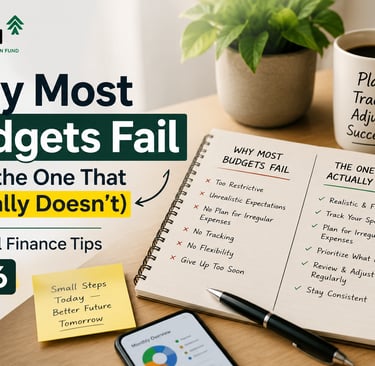
Let me be honest with you about something most finance writers won't say out loud: the majority of budgeting advice is written by people who already have their finances under control. It's like getting swimming lessons from someone who learned in a heated indoor pool and has never had to tread water in the open ocean.
Real budgeting — the kind that works for ordinary people juggling rent, food, school fees, transport, and the endless list of unexpected expenses that life throws at you — looks very different from the colour-coded spreadsheets you see on YouTube. And the gap between what gets taught and what actually works is exactly why most people quit their budget before the month is even over.
This article is about bridging that gap. By the end, you will understand exactly why budgets fail, and you will have a simple, flexible system you can start using today — no spreadsheet required.
The Real Reason Budgets Fail (It's Not What You Think)
Most people assume they quit budgeting because they lack discipline. That story feels uncomfortable but familiar, so it sticks. The truth is far less personal and far more fixable.
Budgets fail for three structural reasons that have nothing to do with willpower:
1. They are built for a perfect month that never arrives.
Traditional budgeting assumes your expenses are predictable and consistent. But real life includes the car that needs repair in March, the family emergency in June, the friend's wedding in September. When these "unexpected" costs arrive — and they always do — they blow the budget apart, leaving most people feeling like failures and abandoning the whole system.
2. They are too detailed to maintain.
A budget with twenty-seven spending categories looks impressive on paper. It is exhausting to maintain in practice. When tracking becomes a second job, people stop doing it. The friction kills the habit.
3. They create a scarcity mindset that isn't sustainable.
Many budgets are essentially lists of things you can no longer do. Cut this, stop that, give up the other. A budget that makes you feel permanently deprived is a budget you will eventually rebel against — and rebellion usually looks like spending more than you did before you started.
The Framework That Actually Works: 50/30/20
The 50/30/20 rule is not new. It was popularised by US Senator Elizabeth Warren and her daughter Amelia Warren Tyagi in their book All Your Worth, and it has stood the test of time for one simple reason: it is flexible enough to survive contact with real life.
Here is how it works:
50% — Needs
Half of your after-tax income goes to essential expenses — the things that keep your life functioning. Rent or mortgage, groceries, electricity, water, transport to work, minimum debt payments, basic clothing. These are non-negotiables.
30% — Wants
This is the category that makes budgeting sustainable. Thirty percent of your income is yours to spend on the things you genuinely enjoy — eating out, streaming services, weekend trips, new clothes beyond the basics, hobbies. The key word is deliberately. You are not spending carelessly; you are consciously allocating money to the things that make life worth living.
20% — Future You
This is savings, investments, emergency fund contributions, and extra debt payments. This is the category that builds your financial security over time.
💡 Real talk: If you live in Lagos, Abuja, London, or any major city where rent alone can eat 60% of your income, the exact percentages won't work for you without adjustment. That is completely fine. The principle — distinguish between needs, wants, and future — is what matters. The numbers flex to fit your reality.
For further reading on this framework, Investopedia's breakdown of the 50/30/20 rule is one of the clearest explanations available.
How to Actually Set Up Your Budget in 30 Minutes
Most people spend so long trying to find the perfect budgeting app or spreadsheet template that they never actually start. Here is the simplest possible approach:
Step 1: Know your actual monthly income.
This is your after-tax take-home pay — what lands in your bank account, not your gross salary. If your income varies month to month (freelancers, business owners), use your lowest typical month as the baseline.
Step 2: List your fixed expenses.
Write down every expense that is the same amount every month: rent, loan repayments, subscriptions, insurance premiums. These are easy to plan for because they don't change.
Step 3: Estimate your variable needs.
Food, transport, utilities, and similar expenses vary month to month. Look at your last three months of bank statements and take the average. If you don't have bank statement access, estimate conservatively — it is better to over-estimate your needs than under-estimate them.
Step 4: Assign your 20% automatically.
Before you think about discretionary spending, determine what 20% of your income is and set up an automatic transfer to a savings or investment account on payday. This happens before you touch anything else.
Step 5: What's left is yours to spend.
The remaining income after needs and savings is your spending money. Use it for wants without guilt, because you have already handled your responsibilities.
The One Tool That Makes Budgeting Stick
Apps, spreadsheets, and notebooks all work — but none of them matter as much as one single behavioural change: automation.
When savings are automatic, you do not need discipline for that part. When fixed bills are on direct debit, you do not need to remember them. When your budget runs largely on autopilot, the only thing left to manage is discretionary spending — which is a much smaller, more manageable task than managing everything simultaneously.
Set up your finances so that the important things happen without your involvement. Then use your limited mental energy on the decisions that actually require it.
Building in a Buffer for Real Life
Here is the single most underrated personal finance tip when it comes to budgeting: build a buffer category.
Call it whatever you like — "unexpected expenses," "life happens," "buffer fund." The name doesn't matter. What matters is that every month, you set aside a small amount — even 5% of income — specifically for the things you did not predict. Car repairs, medical costs, last-minute travel, replacing something that breaks.
When this money exists and an unexpected expense arrives, it is not a budget failure. It is the buffer doing its job. This single change prevents more budget collapses than any other technique.
The National Foundation for Credit Counseling recommends that households maintain not just an emergency fund but also a monthly "sinking fund" for irregular expenses — which is essentially this buffer concept formalised.
What to Do When You Go Over Budget
This is the most important section of this entire article, and most budgeting guides skip it entirely.
You will go over budget sometimes. Life is unpredictable. The question is not whether it will happen — it is what you do when it does.
The answer is not guilt. It is not abandonment. It is not starting fresh next month as if this month didn't happen.
The answer is adjustment: look at which category went over, understand why, and decide whether that category needs to be allocated more money next month. Sometimes going over budget reveals that your original allocation was unrealistic, not that you failed. Adjusting your budget based on real data is not cheating — it is how budgeting is supposed to work.
A budget is not a punishment. It is a plan. And like all plans, it improves when it encounters reality.
Budgeting at Different Income Levels
One thing personal finance content consistently fails to address is that the same budgeting principles work differently depending on income level.
At lower incomes: The 50% needs allocation may not be enough. Prioritise covering needs first, then focus on building even a tiny emergency buffer. The investment and savings piece can start small — even 2–3% — and scale upward as income increases.
At middle incomes: This is where the 50/30/20 framework tends to fit most naturally. The main danger zone is lifestyle inflation — wants spending quietly expanding to fill available income as salaries grow.
At higher incomes: The risk shifts to complexity — multiple accounts, investment vehicles, and tax considerations. Simplicity and automation still win; the categories just involve larger numbers.
Practical Tips to Start This Week
Open a separate savings account today if you don't already have one. Even with nothing in it.
Look at your last month of bank transactions and categorise them roughly: needs, wants, savings. No judgment — just data.
Identify one subscription you are paying for but barely using. Cancel it this week.
Set up an automatic transfer — even a small one — to go out on payday to your savings account.
Tell one person about your budgeting intention. Accountability, even casual accountability, meaningfully increases follow-through.
Key Takeaways
Budgets fail because they are over-complicated, built for perfect months, or make people feel deprived — not because you lack discipline
The 50/30/20 framework works because it is simple, flexible, and includes guilt-free spending
Automation eliminates the willpower problem entirely — set savings to move automatically on payday
Build a monthly buffer category specifically for unexpected expenses to prevent budget collapses
When you go over budget, adjust — don't quit. Budgets improve through real-world feedback
Want to build on this foundation? Read our guide on The Savings Habit That Beats Willpower Every Time — it pairs directly with everything covered here and takes your budgeting framework to the next level.
You might also enjoy our Income Planner tool to map out all your income streams in one place.
RESOURCES
GET IN TOUCH
info@financialpath.tech
Kaduna, Nigeria
Serving emerging markets worldwide
© 2026 FinancialPath-No-nonsense math for emerging market builders.
LOCALLY RELEVANT, GLOBALLY USEFUL